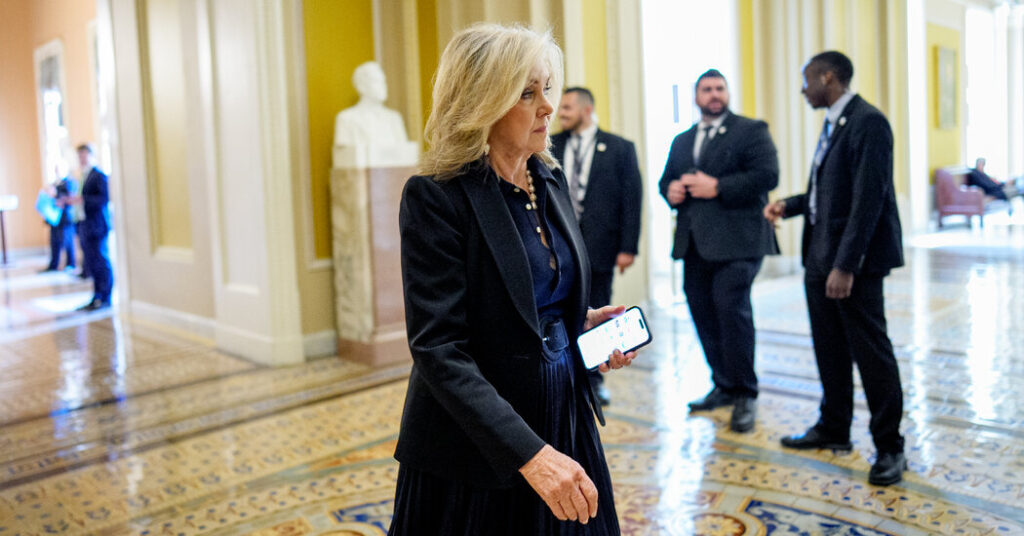
The Supreme Court’s blow to the Voting Rights Act had barely landed on Wednesday when Senator Marsha Blackburn, Republican of Tennessee, called on lawmakers to eliminate the last Democratic-held House seat in the state.
Taking to social media shortly after the Wednesday morning ruling, Ms. Blackburn, the favorite to become the state’s next governor, urged the legislature to hastily adopt a new congressional map that would put Memphis, a majority Black city, in Republican hands.
The chorus quickly grew. Her opponent in the gubernatorial primary, Representative John Rose, declared that the Democratic-led city “deserves Republican representation in Congress.” State Senator Brent Taylor, of nearby Shelby County, asked on X, “Got any ideas on who would make a great Republican congressman from West TN?”
By Thursday morning, President Trump said on Truth Social that Gov. Bill Lee, a Republican, had assured him in a call that he would “work hard” to get Republicans “one extra seat” in Tennessee, “and help save our country.”
A spokeswoman for Mr. Lee did not respond to questions about the conversation, and it remains unclear whether a new map will be approved before the midterm elections. But for some Democrats, the eager chatter was the realization of fears that have percolated since 2022, when Republicans carved a Nashville-area seat long held by Democrats into three Republican districts.
“Memphis could be like Nashville,” said Representative Steve Cohen, a Democrat who has held the Memphis seat since 2007. “Thrown off the political map.”
Mr. Cohen said he had been in touch with voting rights lawyers and would try to stop any redistricting effort.
The Supreme Court ruling, which raises the bar for finding congressional maps racially discriminatory under the Voting Rights Act, was not unexpected. But it still set off a scramble across the South, as conservatives saw a new opportunity to break up districts with large numbers of Black voters who remain loyal to Democrats.
Tennessee was not always as reliably ruby red. As recently as 2008, it had a Democratic governor, Phil Bredesen, and five Democrats in its congressional delegation.
But as the state’s electorate became increasingly disillusioned with the Democratic Party during the Obama years, the number of Democrats it sent to Congress dwindled. Then, in 2012, Republicans won a supermajority in the General Assembly, giving them the power to redraw districts without the need for Democratic input. Just two of the state’s congressional seats remained in Democratic hands when it came time to redraw the map after the 2020 census: Nashville, a safe Democratic stronghold for 150 years, and Memphis, the only Tennessee district to ever send a Black lawmaker to Congress.
With the Voting Rights Act still intact, Nashville, which is majority white and in the central part of the state, was a much easier target for redistricting. When Republicans sliced the Nashville district into three, they paired sections of the city’s urban neighborhoods with rural farmland, neutralizing its Democratic base.
Representative Jim Cooper, a Democrat who had held the district before it was divided up, retired rather than run in a far more competitive landscape. Replacing him was Representative Andy Ogles, a conservative Republican who is among those championing a new district for Memphis.
“A completely red Tennessee is VITAL to saving our Republic,” Mr. Ogles wrote on social media on Thursday. “DRAW THEM OUT.”
None of the three lawmakers who represent parts of Nashville have an office in the city or the surrounding county, where about 730,000 people live. Federal funding for Nashville projects has become less reliable.
With the city now split among three districts, voters sometimes struggle to figure out who their representative is. Being in Republican districts has also has exposed their local leaders, including Mayor Freddie O’Connell, to intense partisan scrutiny over the their stances on immigration and other issues on which they are at odds with Republican leaders.
“I don’t know that I’ve talked to anybody that went through a major urban area split as severe as Nashville,” Mr. O’Connell said in an interview ahead of the Supreme Court ruling.
Some liberal-leaning Nashville residents on occasion reach out to Mr. Cohen, the Memphis representative, who is far more aligned with their views,. But his office is limited in the help it can offer people who live outside the district.
Memphis had managed to avoid redistricting partly because of its geography: Tucked tightly into the southwest corner of Tennessee, it’s not as easy as Nashville to split up in a way that is fail-safe for Republicans.
“You don’t want to jeopardize strong Republican seats and weaken them, obviously,,” Cameron Sexton, the state’s Republican House speaker, said in an interview. He added, “There’s an opportunity there, but it’s a tight window.”
Having a Democratic representative has not entirely spared Memphis interference from state and national Republicans. Since last fall, the city has been under the purview of a federal task force sent in by the Trump administration to address crime; it has drawn backlash for targeting Black residents and immigrants.
In the legislative session that just ended, the Republican supermajority also asserted authority over the city’s troubled school system and its regional airport.
Some Democrats said they saw the new redistricting threat as a final blow to Memphis’s autonomy. State Senator London Lamar of Memphis described it as “a raw political power grab aimed directly at Memphis, Black voters and the only Democratic congressional district left in Tennessee.”
“When Memphis builds power, Republicans move to take it — from our schools and district attorney, to our airport, and now our congressional representation,” she added.
Addressing Republicans, she added, “This is a moral line. Do not cross it.”
Emily Cochrane is a national reporter for The Times covering the American South, based in Nashville.
The post Republicans Want Tennessee’s Last Democratic House District appeared first on New York Times.