A hand emerges from a rough white marble block, its elegant, polished fingers reaching toward the heavens. In its palm are tiny nude figures, male and female, locked in a passionate embrace.
“Hand of God,” a late-19th-century sculpture by Auguste Rodin, references the biblical creation of Adam and Eve, but also Michelangelo, the Renaissance artist whom Rodin admired as an artistic God. Michelangelo’s contemporaries nicknamed him “Il Divino” or “the divine one,” in part because he believed he carved figures from stone under God’s guidance.
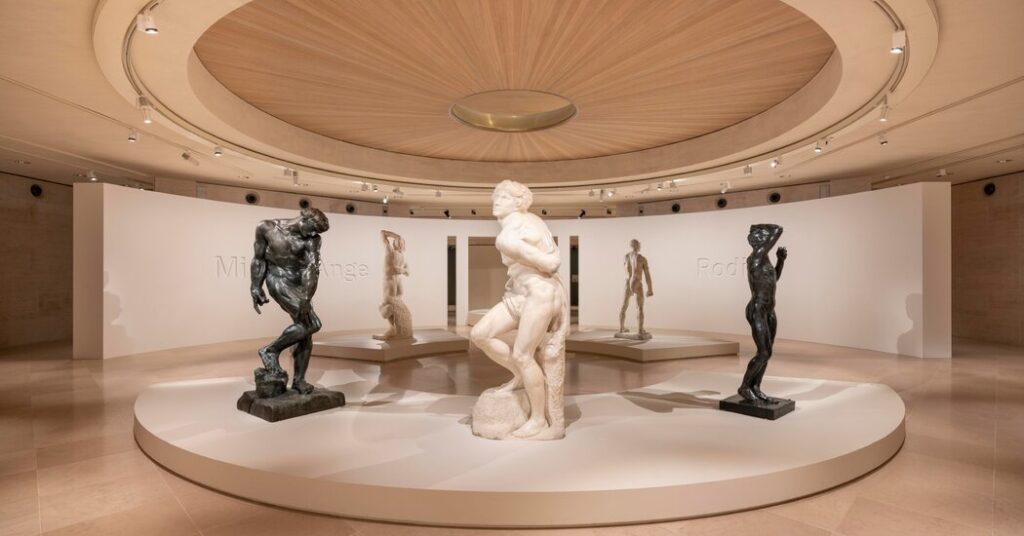
The “Hand of God” is central to a major new exhibition at the Louvre Museum, “Michelangelo and Rodin: Living Bodies,” staged in collaboration with the Rodin Museum, another Paris institution. The show, which runs until July 20, features more than 200 works to compare how the two sculptors, living four centuries apart, captured the living spirit inside a still form.
“We try to show two of the greatest sculptors of the West in confrontation,” said Marc Bormand, a co-curator of the show, who works at the Louvre.
“For Michelangelo, as for Rodin, the aim was not to show only the anatomy of the body,” Bormand said. “The purpose was to show the thinking body, with emotion, with sensation. And to show this not only in the face, but to explore this with all the parts of the body.”
Michelangelo famously described his carving method as “per via di levare,” or creating “by removal,” which meant he saw a figure within a marble block and chipped away everything else to liberate the form.
Rodin, born in Paris in 1840, traveled through Italy in 1876, a year after celebrations for the 400th anniversary of Michelangelo’s birth, and made multiple drawings of the older artist’s public statuary and frescoes, especially the reclining figures of the female “Dawn” and male “Dusk” at the Basilica San Lorenzo in Florence, Italy.
Rodin’s trip had a transformative effect. “My liberation from academicism was via Michelangelo,” he wrote.
Returning to Paris, he meticulously created an effect that mimicked the same unfinished, or “non finito,” look of Michelangelo’s sculptures. But instead of carving from stone, he created a similar texture using modeling clay and wax, assembling the parts and then casting the works out of plaster and bronze.
Rodin “saw the unfinished as finished works,” Bormand said.
Two Michelangelo works from the Louvre collection — “Rebellious Slave” and “Dying Slave” — which Rodin knew well and were crucial to developing his method, were originally commissioned for Pope Julius II’s funerary monument. Michelangelo worked on them from 1513 to 1515, then moved on when plans for the tomb changed. The slaves’ sinewy bodies, struggling against their stone restraints, became signature works of what historians would later call Michelangelo’s “non finito” style.
The rough, raw quality of the unpolished stone, revealing grooves from the mallet and chisel, fascinated 19th-century artists like Rodin, who found in it a corollary to the rapid brushstrokes and unblended colors of Impressionist paintings, said Francesco Caglioti, an art history professor at the Scuola Normale Superiore in Pisa, Italy.
Michelangelo left about two-thirds of his works incomplete, possibly because he was deluged with commissions from monarchs and church figures, Caglioti said.
The Florentine artist eventually gave the two “Slaves” to a friend, who later presented them as a gift to King Francois I of France, which is how they ended up in the Louvre collection.
Although marble, bronze, plaster and terra cotta dominate the exhibition, it also includes about 30 Michelangelo drawings that illustrate his fascination with anatomy, and studies for his marble pieces. Rodin sculptures on display include “Age of Bronze” (1875-77), “Adam” (1880-81) and a plaster cast for his monumental statue of the writer Honoré de Balzac. Rodin’s marble bust, “Man With a Broken Nose,” which depicts Michelangelo, is one of many busts on display, along with sketches and paintings.
Because it was impossible to transport major Michelangelo artworks from Italy, the show includes several reproductions, including copies of the “Dawn” and “Dusk” sculptures and a 1570 replica of his vast “Last Judgment” fresco by the French artist Robert Le Voyer.
Chloé Ariot, the exhibition’s other co-curator, who works at the Musée Rodin, said that Michelangelo had many followers and admirers, but Rodin was perhaps his most sincere acolyte. He considered it a great honor when art critics of the 1880s began to recognize him as a peer, she said.
Even so, his work looks unfinished for different reasons, she said.
“For Rodin, the ‘non finito’ was also a way to show the reality of life,” Ariot added: Rodin could have chosen to make the work more polished, but he didn’t.
“You have the feeling that it remains ‘in process,’” she said. “You have the feeling of the fluxes of life.”
Michelangelo and Rodin: Living Bodies Through July 20 at the Louvre Museum in Paris; louvre.fr.
The post Michelangelo and Rodin: Finding the Living Spirit in Stone appeared first on New York Times.