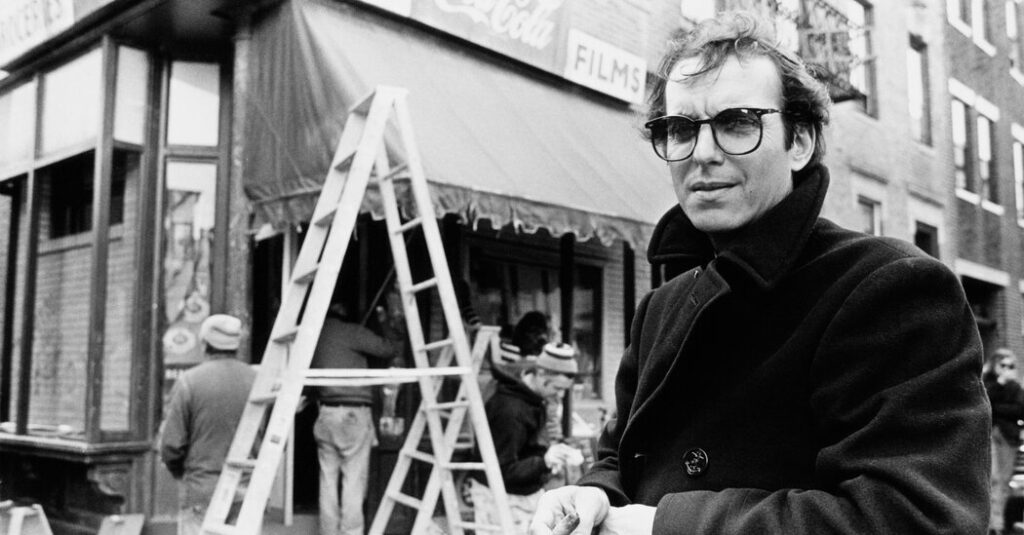
Dean Tavoularis, an Oscar-winning art director and production designer who collaborated with the director Francis Ford Coppola on 13 films, including “The Godfather” trilogy, “Apocalypse Now” and “One From the Heart,” for which he recreated the Las Vegas Strip on studio soundstages, died on Thursday in Paris, where he had been living recently. He was 93.
His death, at a hospital, was confirmed by his wife, Aurore Clément.
“Like all great collaborations, I began to depend on Dean,” Mr. Coppola told Variety in 1997, reflecting on a quarter-century of working together. “This grew into a natural and wordless collaboration, which provided so much comfort to me and added to the style of the films we worked on together.”
Mr. Tavoularis’s designs became signature elements of Mr. Coppola’s films — among them, the warm, foreboding interior of the Mafia patriarch Don Corleone’s study and the streets of 1940s New York in “The Godfather” (1972); the mysterious, perilous jungle landscape of “Apocalypse Now” (1979); and the drab, subtly detailed apartment and office of the surveillance expert played by Gene Hackman in “The Conversation” (1974).
Mr. Tavoularis received his only Oscar for “The Godfather, Part II” (1974), for which he transformed the East Village of Manhattan, on East Sixth Street between Avenues A and B, into Little Italy of the 1910s. (The award, which he shared with Angelo Graham and George R. Nelson, was for art direction; the name of the category was changed to production design in 2012.)
He was nominated for Oscars for three other Coppola films: “Apocalypse Now”; “Tucker: The Man and His Dream” (1988), the biopic of the automobile entrepreneur Preston Tucker, starring Jeff Bridges; and “The Godfather, Part III” (1990). Mr. Tavoularis’s fifth nomination was for “The Brink’s Job” (1978), a crime comedy starring Peter Falk and directed by William Friedkin.
“Tavoularis was part of a generation of artisans who were trained under the old 1950s system of Hollywood studios, but came into their own while collaborating with the new filmmakers of the 1960s and 1970s,” the Production Designers Collective, a trade association, said in a statement after his death. “He represented a bridge between traditional craftsmanship and the new rebellious spirit of the younger auteur generation.”
Mr. Tavoularis, who was also a painter, designed cinematic worlds for other A-list directors, including Arthur Penn, on “Bonnie and Clyde” (1967) and the revisionist western “Little Big Man” (1970); Michelangelo Antonioni, on the counterculture drama “Zabriskie Point” (1970); and Warren Beatty, on the political satire “Bulworth” (1998).
For “Bonnie and Clyde,” a Depression-era gangster film, he scouted and photographed the Texas towns where Bonnie Parker and Clyde Barrow robbed banks in the 1930s, in advance of location shooting. He also designed interiors with ceilings that were intentionally low.
“I wanted to give the feeling that the characters were more and more trapped,” he told Jordan Mintzer, who interviewed him for the 2022 book “Conversations With Dean Tavoularis.” “They were staying in these crummy hotels and everything was small and claustrophobic.”
Mr. Penn told Variety that Mr. Tavoularis and Theadora Van Runkle, the film’s costume designer, “created a whole era.”
For “Little Big Man,” starring Dustin Hoffman as a 121-year-old man looking back on his life, Mr. Tavoularis conceived an “entire railroad terminus” on the MGM lot “where buffalo skins were being transported,” Mr. Penn said. “There were these railroad tracks and this whole market of buffalo skins.”
Constantine Tavoularis was born on May 18, 1932, in Lowell, Mass., the child of Greek immigrants who worked in the garment industry. He grew up in Los Angeles, where his father was employed by a coffee company, and during the summer helped his father with deliveries. One of those deliveries was to 20th Century Fox, whose president, Spyros Skouras, was a Greek American.
“We would drive back to the commissary, and you saw stage pieces and ladies dressed in their period gowns,” he told The Los Angeles Times in 2012. “It was a mysterious, magical paradise.”
Dean, as he was called, studied art and architecture at the Los Angeles County Art Institute (now Otis College of Art and Design) from 1953 to 1955. During his time there, he showed his portfolio at the Walt Disney Studios, where he started to work before graduating with a fine arts degree. He went on to work as an assistant art director at Warner Bros. before Mr. Penn hired him for “Bonnie and Clyde.”
Impressed by his work for Mr. Penn, Mr. Coppola hired him for “The Godfather.”
Their admiration was mutual. “He is the ideal director to work with on a film, very generous, very open,” Mr. Tavoularis told The Los Angeles Times. “I can’t remember him ever saying, ‘That’s over the top.’ He is always pushing; you feel that open door and it frees you.”
That freedom was evident in his work on “Apocalypse Now,” Mr. Coppola’s surreal Vietnam War film. Mr. Tavoularis asked for helicopters from the Pentagon, which rejected the request, but he got them from the Philippine government; he scouted for a river for the journey central to the film and found it in the Philippines, as well.
Mr. Tavoularis designed the jungle village, including a decaying Khmer temple, that serves as the compound for Colonel Kurtz (played by Marlon Brando), the renegade Green Beret officer targeted for assassination by Captain Willard (Martin Sheen).
“To behold the awesome totality of the vista,” Sam Wasson wrote in “The Path to Paradise: A Francis Ford Coppola Story” (2023), “was to be not where one stood, surrounded by cameras and crew, in the Philippines in 1976, but somewhere on the lost river leading back into the heart of old Cambodia.”
For “One From the Heart” (1981), a musical love story, Mr. Tavoularis recreated the Las Vegas Strip on the soundstages of Mr. Coppola’s Zoetrope studio in Los Angeles.
“There was no attempt to make it realistic — it had to be stylized,” Mr. Tavoularis told The New York Times Magazine in 2003. “We had a miniature Las Vegas in the distance and put a canvas backing, painted blue, 35 feet high in front of the stage wall. From behind, we put hundreds of little lights through the canvas to make the sky. The movie was kind of a blend of a movie and theater, with music by Tom Waits.”
In addition his wife, an actress he met during the filming of “Apocalypse Now,” Mr. Tavoularis is survived by two daughters, Gina and Alison Tavoularis, from his marriage to Barbara Weiss, which ended in divorce; and a brother, Alex, a storyboard artist and production designer.
Mr. Tavoularis worked through the 1980s and ’90s, and then took a long break to paint before being hired to work on “Carnage” (2011), Roman Polanski’s film adaptation of Yasmina Reza’s Tony Award-winning play “God of Carnage.”
On a Paris soundstage, he recreated the Brooklyn apartment where the two central couples argue. He had all the furnishings for the set — including doorknobs, light fixtures and electrical outlets — shipped from the United States, he told Mr. Mintzer, and the set was rewired to accommodate the appliances’ American circuitry.
“Carnage” was Mr. Tavoularis’s final feature. After that, he focused full time on painting, sculpture and collage.
“I’m living the dream I had when I was in my teens,” he told Mr. Mintzer. “Painting my days away in a studio in Paris.”
Richard Sandomir, an obituaries reporter, has been writing for The Times for more than three decades.
The post Dean Tavoularis, Oscar-Winning Production Designer for Coppola, Dies at 93 appeared first on New York Times.