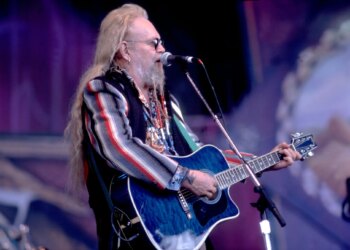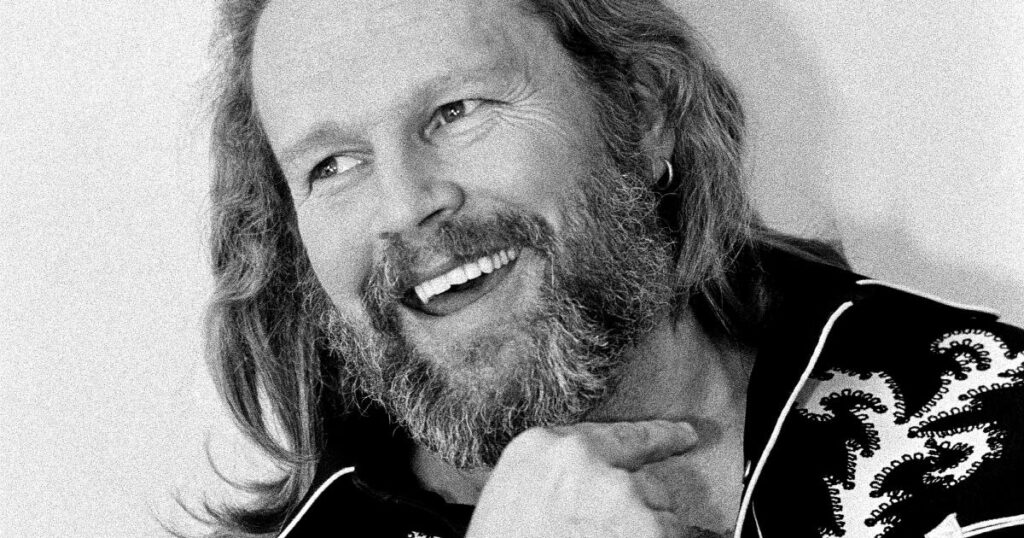
David Allan Coe, a controversial figure who helped pioneer the 20th century “outlaw country” musical subgenre, penning hits including “Take This Job and Shove It” and “Would you Lay With Me (In a Field of Stone),” has died.
Coe died Wednesday night, his representative David Wade confirmed to The Times. He was 86. No other details were available.
The origins of outlaw country music, popular in the 1970s and ‘80s, are largely credited to Waylon Jennings and Willie Nelson, but Coe was a seminal figure in the subgenre. He began writing and releasing music in the 1970s and was surrounded by some mystique. His debut effort, “Penitentiary Blues,” released in 1969, was compiled with tracks written while Coe was in prison.
The Ohio-born musician entered a reform school in Michigan at 9 years old and spent the following two decades in and out of correctional facilities. His offenses included burglary and auto theft. More recently, he pleaded guilty in 2015 to failing to pay income taxes for several years and, the following year, was ordered to pay the IRS nearly $1 million and was sentenced to three years’ probation.
Coe’s background was suitable for finding a home in the outlaw country movement. He claimed to have been inspired by blues legend Screamin’ Jay Hawkins, who he said was a fellow inmate at one point.
Upon his release from Ohio State Penitentiary in 1967, Coe headed to Nashville and attempted to break into the country music scene. He was said to have lived out of his car, sometimes camping outside the city’s Ryman Auditorium — former home of the Grand Ole Opry — in hopes of gaining notice.
It wasn’t until two years later that Coe would snag a record deal with Shelby Singleton’s SSS International and Plantation Records and release “Penitentiary Blues.” The album failed to sell well but was received with warmth by critics and fans.
He then hit the road, opening for the likes of Grand Funk Railroad and performing at clubs across the country. His second album, “Requiem for a Harlequin,” mirrored the reception of his first.
He eventually got some radio play with his 1973 single “Keep Those Big Wheels Hummin’.” Though Coe failed to shake up country music at that time, he would still release singles under Singleton’s Nashville-based record company, Plantation Records. He eventually parted with the producer.
Still, Coe was excelling as a songwriter. Notably, Tanya Tucker scored a breakout hit with his “Would You Lay with Me (In a Field of Stone),” which peaked at No. 46 on the U.S. Billboard Hot 100 — it spent 10 weeks on the charts — and reached No. 1 on the U.S. Hot Country Songs.
Coe began reinventing his on-stage persona, donning rhinestone-studded suits and wearing a cloth mask. He signed with Columbia Records and called himself “The Mysterious Rhinestone Cowboy,” releasing an album of the same name in 1974 — one year before Glen Campbell released his hit song “Rhinestone Cowboy.”
Coe’s second LP for Columbia, “Once Upon a Rhyme,” released in 1975, was a success, featuring the hit single “You Never Even Called Me by My Name.”
That same year, a documentary titled “David Allan Coe: The Mysterious Rhinestone” was released featuring the singer performing “33rd of August” from a prison cell at the Marion Correctional Institution in Ohio.
The documentary notes a claim Coe made during his lifetime that was widely disputed — that he had killed another inmate at Ohio State Penitentiary — and says prison officials said there was no evidence to support it.
Coe was known for fabricating stories about his life, with Jennings’ drummer Richie Albright once stating that he was a “a great, great songwriter” but “he could not tell the truth if it was better than a lie he’d made up.”
Regardless, Coe quickly ditched the “Rhinestone Cowboy” act and returned to the basics. In 1976, he etched his name into country music history when he was featured prominently in the documentary “Heartworn Highways.”
The film was released in 1976 and became a cult classic. It was directed by James Szalapski and would not achieve a theatrical release until 1981. The documentary chronicled the height of outlaw country, which saw Coe in good company — Townes Van Zandt, Guy Clark, Steve Earle, and the Charlie Daniels Band are also featured.
In a 1996 audio interview with Thomas W. Campbell, a member of the National Board of Review, Szalapski said of the project, “I wanted to capture a kind of movement, a kind of a revolution — to do a portrait of that rather than of three guys.
“I felt there was a change happening to country music, a sub-culture within it that was becoming powerful that would affect the main culture. So that’s what I went after and that’s why I …felt like I needed to cover a lot of different areas from the established star like Charlie Daniels to the struggling singer-songwriter to David Allan Coe, who’s … even an outlaw amongst the outlaws.”
Coe’s performance at Tennessee State Prison in 1976 is captured in the film, serving as a highlight. He performs songs such as the previously detailed “Death Row,” taking brief intervals to tell stories of his experiences while incarcerated.
“Show y’all how, someone like you, gets to where I’m at today, being someone like me, because I used to be someone like you,” he says, standing in front of inmates in a rhinestone suit. “And it started when I was 15 years old, at the Boys’ Industrial School in Ohio, and I started singing with just my guitar and five of my friends.”
The rest of the ’70s saw the outlaw country movement in full swing, with Jennings and Nelson rising to household names. Coe remained an outsider, but released would-be influential records such as “Longhaired Redneck.” The compilation album became the first-ever platinum certified country record, Rolling Stone reports. In 1977, Coe penned “Take This Job and Shove It,” which became a hit for Johnny Paycheck.
The ’80s brought all but the end for outlaw country as the urban cowboy era took its place, widely attributed to the John Travolta film of the same name,
Coe rejected the trend, sticking to his classic outlaw style.
“Castles in the Sand,” released in 1983, marked a comeback for Coe, with its lead single, “The Ride,” hitting No. 1 on the Cashbox Country Singles chart that year.
Coe appeared alongside Johnny Cash and Kris Kristofferson in a pair of TV movies in 1986, “The Last Days of Frank & Jesse James” and “Stagecoach.”
Around 1990, Coe’s contract with Columbia ended and amid personal troubles including a divorce and trouble with the IRS, his Key West, Fla., home was seized. Coe said he lived in a cave for some time — another of his claims that was disputed.
Coe spurred controversy with independent albums “Nothing Sacred” and “Underground Album,” released in 1978 and 1982, respectively.
The former includes a song targeting Anita Bryant, who was known for her opposition to gay rights. Coe’s song was titled bluntly, “F— Aneta Bryant” [sic]. On it, he rails against the entertainer while simultaneously reinforcing homophobic stereotypes and singing slurs.
“Underground Album” contains the song “N— F—,” written from the perspective of an individual whose wife leaves him for a Black man. It is riddled with slurs and, much like his song about Anita Bryant, reinforces various harmful stereotypes, this time about Black people.
As a result, Coe was called racist. He responded, “Anyone that hears this album and says I’m a racist, is full of s—.”
Throughout the rest of his life, Coe continued to make music, but turned to live performances as his primary source of income. In his personal circle, he maintained a longtime friendship with Nelson, and eventually collaborated with Kid Rock.
Times staff writer Clara Harter contributed to this report.
The post David Allan Coe, controversial ‘outlaw country’ pioneer, dies at 86 appeared first on Los Angeles Times.