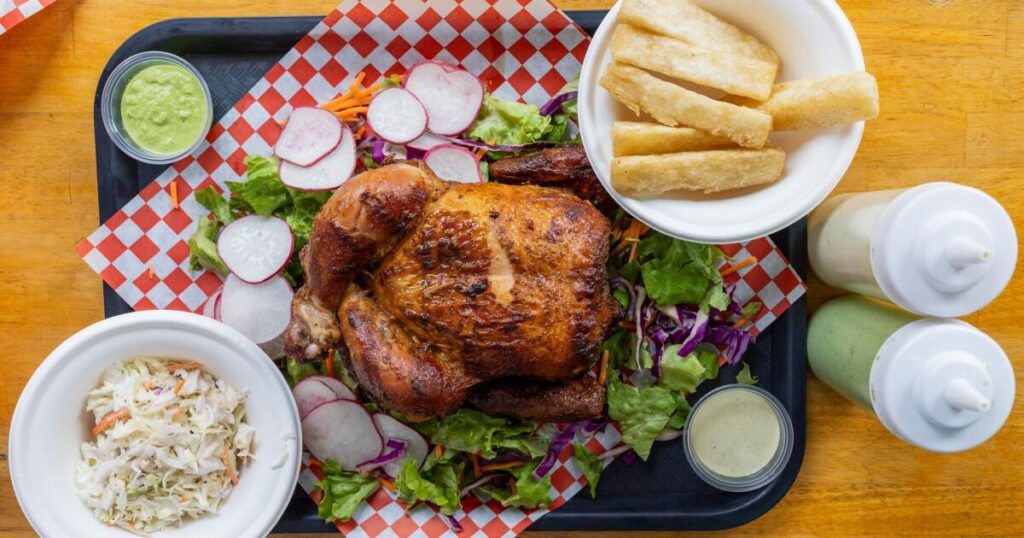
On a Saturday night, the parking lot at Loli Farms in Pasadena is a maze of cars. People triple park along the entrance to the former gas station. Someone blocks one of the driveways. Cars are left unmanned, hazard lights blinking while their owners rush in to retrieve takeout orders. Others simply lock their doors and head inside, praying they finish cleaning their chicken bones before the people they blocked in. The chicken here is worth the risk.
The restaurant is a temple to pollo a la brasa, the rotisserie chickens found at pollerías all over Peru. For decades, Pollo a la Brasa was the king of the genre in Los Angeles. Its parking lot at the corner of Western Avenue and 8th Street in Koreatown equally hellish. Maybe even more so. And the dining room sometimes so full of smoke, your eyes burn. But people come in droves. Tourists, policemen, students and your great aunt who lives in Hancock Park who heard that Nancy Silverton is a fan.
Loli Farms may be even better. The ventilation system more efficient. And the chicken, a lot more consistent.
Owners Sandra Loli and Mauricio Vincenzi met while working together at a Peruvian restaurant in Glendale. Vincenzi, a pastry chef from Argentina who trained in Peru, and Loli, a chef from Lima, opened Bodegon 69Peruvian restaurant in Old Pasadena together in 2021. The menu is an homage to the most celebrated Peruvian dishes, with big platters of ceviche and tiradito, saltados and rice with chicken, beef and seafood. But no pollo a la brasa.
The chickens require a wood-burning oven, but the permitting process to install the one Loli and Vincenzi procured from Italy proved too difficult at the restaurant. They decided to save it for a pollería, and opened Loli Farms in late 2024.
The oven is the heart of the restaurant, burning at around 750 degrees Fahrenheit, with a mountain of wood stacked nearby. The chickens slowly turn as glowing flames lap at their skin. The spits are tightly packed and constantly rotating, churning out 48 chickens every hour.
An intense, carnal need takes over mid-bite into a Loli Farms chicken leg. I inhale the smoke that wafts from the skin, a heady, sweet and earthy mix of pecan, apple and almond woods. The bronzed skin is tacky with the bird’s own fat and sugars, and beautifully caramelized along every ridge. My lips and fingertips are glossy before I finish excavating the bones.
Loli brines the chickens overnight, then marinates them in a blend of cumin, garlic, paprika and panca chiles from Peru for two days. Her chicken hums with a gentle smokiness and a complex, fruity chile flavor that’s warm, rounded and highly addictive. I have watched people of all ages and sizes plant their elbows on a table and demolish a whole chicken themselves, only pausing to reach for the two squeeze bottles of condiments.
One is aji verde, a fiery, electric green sauce made with Peruvian yellow peppers, and huacatay, a pungent, black mint with hints of tarragon and citrus. It stings with a sharp, immediate heat. The other is aji amarillo, a creamier, milder, pale yellow sauce fragrant with oregano and garlic.
Loli and Vincenzi intended for the restaurant to be a celebration of Peruvian culture, and most of the real estate in the dining room is devoted to a superette stocked with shiny packages of sweets, whole dried white potatoes, ground aji amarillo and plantain chips. A cooler along the east wall holds dozens of cans and bottles of Inca Kola, the neon yellow carbonated beverage that actually outsells Coca-Cola in Peru. Imagine Redbull infused with Dubble Bubble. If you’re watching your sugar, there’s diet, but that signature, cloying, herbal sweetness remains, without the calories.
Vincenzi uses the massive purple corn kernels, known as maiz morado, to make chicha morada, a warmly spiced drink of corn, pineapple, cinnamon and clove native to the Andean regions.
Large white kernels, or choclo, are boiled and served with slabs of tangy goat cheese, presented as one of a dozen or so sides for your chicken.
The coleslaw leans sweet, like the version at Kentucky Fried Chicken before they hack it up into itty bitty squares of cabbage and carrot. This comparison should read as the highest compliment. The same goes for the mashed potatoes, which have that same, uniform smooth texture synonymous with the potatoes from Colonel Sanders. Only at Loli Farms, they’re crowned with a ladle full of chicken drippings, instead of gravy.
The yucca frita are crunchy, golden tiles with fluffy, almost cheesy centers of cassava. The sweet potato fries can be limp at times, but the regular fries are dependably crisp and well-seasoned. They serve as the base for salchipapas, a street food found throughout South America that originated in Lima in the 1950s. At Loli Farms, the fries are barely visible under overlapping zigzags of mustard, ketchup and mayonnaise and coins of fried beef sausage.
Easily distracted by the rotating chickens, it took a handful of visits before I even noticed the sanguche portion of the menu. The sandwiches are served on crusty rolls that collapse into cutlets of beef Milanese, shredded chicken or lomo saltado. The last is a source of national pride in Peru, and one of the most recognizable expressions of how Andean ingredients melded with Cantonese stir-fry techniques introduced by the country’s Chinese immigrants. Strips of beef are cooked in a screaming hot wok with cherry tomatoes, onion and French fries, then seasoned with soy sauce and black pepper. It makes for an excellent sandwich filling, served with a cup of meat broth zippy with vinegar, hoisin sauce and cumin, for dipping.
At the moment, dessert consists of whatever packaged, chocolate-covered cookie catches your eye in the market, and a small case of alfajores, a shortbread and dulce de leche sandwich cookie that Vincenzi bakes for the restaurant. Soon, he plans to expand the bakery offerings with sweet breads and various jellos and marmalades.
For now, there’s plenty to warrant my weekly visits. Just remember to ask for extra sauce, and park on the street.
The post L.A.’s best rotisserie chicken may be at this former gas station in Pasadena appeared first on Los Angeles Times.