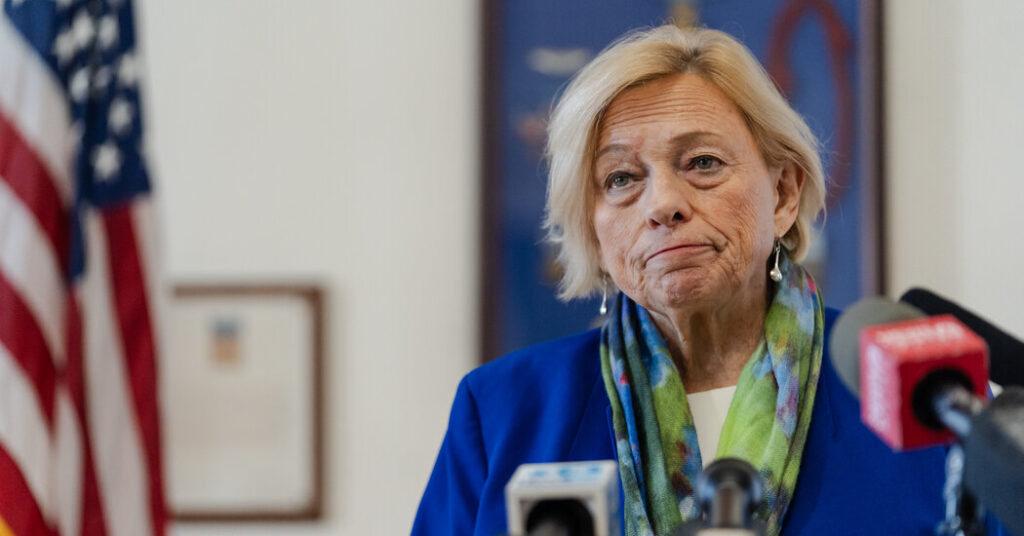
Gov. Janet Mills of Maine, the Democratic establishment’s choice to run for the Senate seat long held by Senator Susan Collins, a Republican, suspended her campaign on Thursday, saying she no longer had the financial resources to compete against Graham Platner, a progressive political newcomer.
Her exit paves the way for Mr. Platner, 41, an oysterman who has led her in polls, to become the Democratic nominee in a crucial Senate race that the party must win to regain control of the chamber.
“While I have the drive and passion, commitment and experience, and above all else — the fight — to continue on, I very simply do not have the one thing that political campaigns unfortunately require today: the financial resources,” Ms. Mills, 78, said in a statement.
She did not endorse Mr. Platner; in an interview on Monday, she had declined to commit to backing him if he became the nominee. A representative for Ms. Mills did not immediately respond to a request for comment on Thursday morning.
Surrounded by supporters, Mr. Platner claimed victory on Thursday morning in Augusta. After praising Ms. Mills’s experience in the state, he said his campaign was in the process of “taking back what is ours.”
“We will defeat Susan Collins,” Mr. Platner said. “We will go to Washington and we still start tearing down the system that for far too long has forgotten and written off the people who make Maine and this country what it is.”
The effective coronation of Mr. Platner as the Democratic nominee is a blow not only to the two-term sitting governor but also to Senator Chuck Schumer of New York and the Democratic Party establishment that he leads. Mr. Schumer, the minority leader, has for almost two decades chosen his party’s Senate candidates with little internal opposition, and he encouraged Ms. Mills to enter the race.
Her decision to withdraw reflects a political environment being rapidly reshaped by a restive Democratic grass-roots that is demanding a new, younger and far more combative generation of leadership. Her failure to gain traction also underscores how the mechanics of campaigns have shifted: Ms. Mills, who had insisted that the state already knew her well, struggled to break through Mr. Platner’s dominance on social media and liberal podcasts, and she did not try to match his far more robust campaign schedule.
Almost instantly, attention turned to the expected matchup between Mr. Platner and Ms. Collins, a battle-tested lawmaker who has repeatedly dashed Democratic dreams of seizing her seat during her three decades in office. Democrats argue that this year is different because of President Trump’s sinking approval ratings and Ms. Collins’s votes for some of his cabinet and Supreme Court nominees.
Mr. Platner’s candidacy has emerged as a key test of whether Democrats trying to flip Republican seats should run to the center or to the left.
Mr. Platner is aligned with the progressive wing of the Democratic Party, considers himself an ideological ally of Senator Bernie Sanders of Vermont and is running as an economic populist. Democrats hope he can appeal to blue-collar workers who have become disaffected with the party.
But he has also called to abolish Immigration and Customs Enforcement, strongly defended the rights of transgender Americans and promised voters that he would be arrested protesting Mr. Trump. His candidacy will measure how much sway cultural issues have among the working-class voters Democrats are trying to claw back.
Mr. Platner, who has a long history of making inflammatory statements online — he has apologized for many of them — is also untested on the national stage. At a campaign event on Tuesday night, at least two voters expressed concerns to him about whether he would be able to withstand the scrutiny and Republican attacks; he insisted he would.
“They will tear him apart if he’s the nominee,” Ms. Mills told The New York Times in an interview last month. In January, the main super PAC for Senate Republicans announced its largest-ever investment in Maine — $42 million — to support Ms. Collins.
On the ground, though, Ms. Mills’s struggles were palpable. And her light campaign schedule, complete absence from the airwaves and lagging fund-raising had worried and bewildered supporters from Washington to Maine.
They wondered why the pugilistic two-term governor — the daughter of a prominent political family who has spent decades in public life — wasn’t taking a more vigorous approach to a race that had appeared, for weeks, to be slipping out of reach.
She left the race just a week before the candidates were scheduled to meet for their first debate, a moment her supporters hoped could move the race back toward Ms. Mills.
The next big question is how rapidly the party coalesces around Mr. Platner.
Mr. Schumer and Senator Kirsten Gillibrand of New York, the chair of Senate Democrats’ campaign arm, praised Ms. Mills on Thursday as she departed the race.
“We are grateful for her hard-fought and principled campaign, and we respect her decision to continue her service to Maine as governor,” they said in a statement. “After years of allowing Trump’s abuses of power, Senator Collins has never been more vulnerable, and we will work with the presumptive Democratic nominee, Graham Platner, to defeat her.”
Ms. Mills had been more circumspect in an interview on Monday evening, saying she would not support Ms. Collins but declining to explicitly commit to backing his candidacy should she lose the primary race.
She had spent the day at a low-key housing policy round-table in a fluorescent-lit room, followed by a modest meet-and-greet at a brewery in Portland. There, she mingled with a mix of anxious supporters and other bar-goers, sipping a beer, snacking on popcorn and snagging a few fries from an attendee’s order. But she did not make remarks.
Even before Ms. Mills’s announcement, Mr. Platner’s campaign had all but declared victory in the primary race. At a town-hall meeting on Wednesday evening, he made no mention of his Democratic opponent, focusing his attacks on billionaires, technology moguls and Ms. Collins.
“I don’t know if we’re moving past — I don’t even know if we were ever, like, focused,” he said, when asked in an interview after the event if he was already looking beyond the primary. “The only time I really talk about the governor is when people ask what are the distinctions and I lay them out.”
The Democratic establishment’s challenges are becoming increasingly apparent. In a year when the party has grown increasingly bullish about its chances of winning back a Senate majority, some of Mr. Schumer’s preferred candidates have struggled to gain traction in their primary contests.
His explicit and subtle efforts to influence competitive primary races have prompted pushback from a group of liberal Senate colleagues who have made a point of endorsing rivals to his preferred candidates.
Several candidates have made opposition to Mr. Schumer’s leadership central to their campaigns. In Illinois in March, Lt. Gov. Juliana Stratton won her state’s Senate primary race while pledging to oppose a future Schumer bid to be party leader.
The rebuke will only grow stronger if those candidates do well in November, after which Mr. Schumer could face a serious challenge to his leadership post in the Senate.
Mr. Schumer has also recruited candidates in Alaska, North Carolina and Ohio who are on glide paths to the general election.
In Maine, Mr. Schumer saw Ms. Mills, an eighth-generation Mainer with deep political roots in the state, as a proven candidate with the renown and popularity to challenge Ms. Collins.
But Ms. Mills, whose delay in entering the race last year raised questions about her hunger for the job, could not catch up with Mr. Platner’s fund-raising or his standing in polls of Maine Democrats. Her campaign announced it had raised $2.6 million during the first three months of 2026, a relative pittance for a top-tier Senate candidate backed by Mr. Schumer and party leaders.
Ms. Mills and her allies tried to knock Mr. Platner out of the primary with a series of damaging stories and then advertisements about offensive things he had written online about women and rape, as well as a tattoo on his chest that resembled a Nazi symbol. Mr. Platner later obscured the image with a new tattoo.
Ms. Mills faced criticism from some fellow Democrats for pressing those issues, since they could potentially damage Mr. Platner if he became the Democratic nominee.
But in the general election, Ms. Collins and her Republican allies will face no such constraints as they try to defeat Mr. Platner.
“Washington Democrats always fall short in Maine and will again, because they just nominated a dishonest radical,” said Senator Tim Scott of South Carolina, the chairman of Senate Republicans’ campaign arm.
Lisa Lerer is a national political reporter for The Times, based in New York. She has covered American politics for nearly two decades.
The post Janet Mills Bows Out of Maine Senate Race as an Insurgent Democrat Rises appeared first on New York Times.