On the morning of April 7, President Trump began his day by threatening to destroy the entire civilization of Iran if the country did not agree to reopen a key oil route by that evening.
“God Bless the Great People of Iran!” Mr. Trump wrote, signing off on a threat that set off a global panic until he announced a cease-fire hours later.
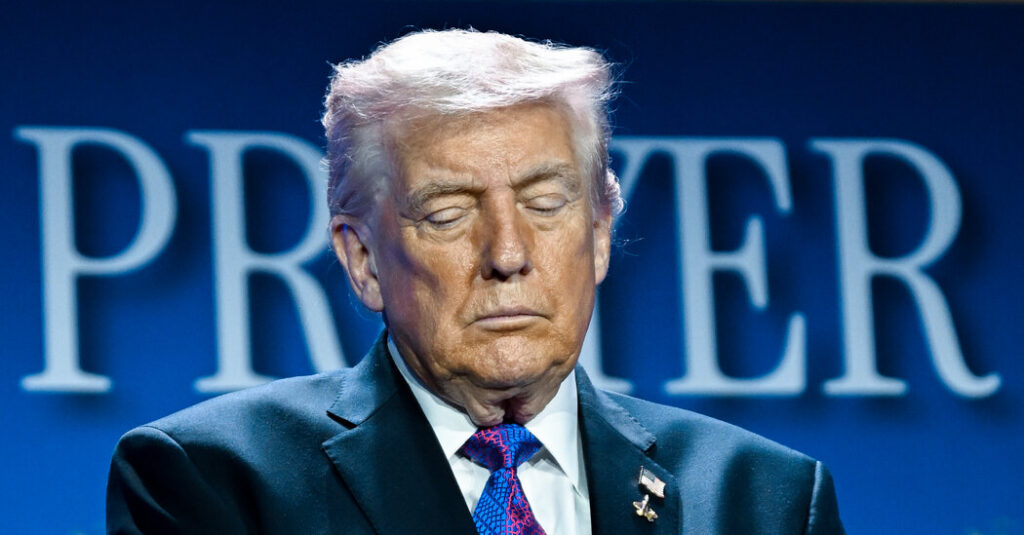
As he waited for the Iranians to negotiate that afternoon, Mr. Trump took a seat behind the Resolute Desk in the Oval Office and folded his hands over the Bible, a book he has called his favorite, followed by “The Art of the Deal.” He looked into a waiting camera and began reading scripture from the Old Testament book of II Chronicles.
His reading of that passage was published online last week for an event called America Reads the Bible, a marathon reading by religious and political leaders. Bunni Pounds, the event organizer, said she was told earlier this month that the video had been filmed and that the president would participate. At that time, Mr. Trump was facing criticism for attacking the American-born Pope Leo XIV, a vocal critic of the U.S. war in Iran, and for posting an image of himself as a Jesus-like figure.
“We don’t completely know where he is in his heart,” Ms. Pounds said in an interview when asked about Mr. Trump’s behavior. But, she added, “we do believe that he has at least a tenderness toward Scripture.”
Over the past decade, many white evangelicals have overlooked Mr. Trump’s complicated relationship with religion in favor of achieving political goals ranging from restricting access to abortion to hanging copies of the Ten Commandments in public school classrooms.
They are less likely than other religious groups to see a problem with the Trump administration’s handling of files related to the investigation of the convicted sex trafficker Jeffrey Epstein, the fallout from which has clouded Mr. Trump’s second term. And they have largely embraced the religious framing that administration officials have used to justify the war in Iran.
But Mr. Trump’s latest rhetoric, particularly on matters of faith as the war continues, has, according to polls and religious leaders, threatened to splinter a powerful coalition of religious voters who returned him to the White House, a group that includes white and Latino Catholics as well as Latino evangelicals, all of whom swung Mr. Trump’s way in 2024.
In a midterm election year, signs of declining support among those groups have raised questions about the prospects for candidates representing a Republican Party that has been forged in Mr. Trump’s image.
“He is the brand of the Republican Party, in a way that I think has not been true for other Republican presidents,” said Robert P. Jones, the president and founder of the nonprofit Public Religion Research Institute. “Whatever he does, they’re not going to be able to shake off in the midterms or in the next presidential election.”
Taylor Rogers, a White House spokeswoman, said that Mr. Trump’s track record speaks for itself.
“There has never been a greater president for Christian Americans than President Trump, and his strong record proves it,” Ms. Rogers said, adding that Mr. Trump had “ended the weaponization of the federal government against people of faith, proudly defended and expanded our religious rights, pardoned pro-life activists, stopped the chemical mutilation of our nation’s children, and protected parents’ rights.”
On ‘Shaky Ground’
The Oval Office Scripture reading illustrates another turn in what many see as a longstanding marriage of convenience between Mr. Trump and white evangelicals, a rock-solid part of his political base that has benefited from the president’s decision to significantly expand the power of Christian conservatives in government. He has installed them in his cabinet, and created a religious liberty commission that has been largely focused on safeguarding Christian religious freedoms.
Ms. Pounds said that she had no other reading in mind for Mr. Trump but the one he read, II Chronicles 7. Its central verse reads: “If My people, which are called by my name, shall humble themselves, and pray, and seek my face, and turn from their wicked ways; then will I hear from heaven, and will forgive their sin, and will heal their land.”
Many of Mr. Trump’s Christian supporters have interpreted the verse, about the reign of a king among the ancient Israelites, as a call to national repentance and subsequent blessing. It has been so embraced by Mr. Trump’s supporters that a central passage of it was shouted from a bullhorn during an attack on the U.S. Capitol on Jan. 6, 2021.
This spring, Mr. Trump and his advisers will participate in several events, including a national prayer event on the National Mall in May, that are meant to reassert the United States as a nation with Christian roots on the country’s 250th anniversary.
Mr. Jones said that the president was already on “shaky ground” with Catholic voters well before he attacked the pope, the leader of the world’s 1.4 billion Catholics. After weeks of war with Iran, Mr. Jones added, Mr. Trump is “underwater” with both white and nonwhite Catholics — a majority of whom oppose the war.
A February poll by Pew showed that the president had a 23 percent approval rating among Hispanic Catholic voters, who represent about 45 percent of American Catholics. Among white Catholics, Mr. Trump has a 52 percent approval rating. By contrast, Pew found that some 84 percent of Catholics had a favorable opinion of Leo.
Disapproval of Mr. Trump has climbed to the highest level of his second term, according to a New York Times polling average.
Mr. Jones said that because approval ratings are so closely tied to the president’s party’s success in a midterm election, even a small additional decline in support for Mr. Trump and his policies among Catholic voters — especially in states like Wisconsin, Pennsylvania and Texas, where there are high concentrations of white Catholics — could affect the outcome of races.
Swing Voters
For voters who helped reshape and revive Mr. Trump’s 2024 coalition, presidential rhetoric has not been nearly as damaging as some of the Trump administration’s policies.
The Rev. Dr. Gabriel Salguero, the president and founder of the National Latino Evangelical Coalition, a group of several thousand evangelical churches, said that church attendance was down as much as 30 percent in some congregations because of immigration enforcement actions taken by the administration.
Mr. Salguero, who has called Latino evangelicals “the quintessential swing voters,” said their congregations had borne the brunt of trying to take care of separated families, by delivering meals to people afraid to leave home or by shuttling children to school. He said that many Latino evangelicals favor immigration enforcement but not “indiscriminate” raids that he said had swept up pastors and congregants alike.
“There is a strong feeling of disillusionment and frustration around indiscriminate immigration enforcement actions,” said Mr. Salguero, who lives in Florida. “I feel very strongly that there will be a reckoning come midterms.”
For people who have been supportive of Mr. Trump, his showman’s approach to Christianity was not always such a deal breaker.
In Mr. Trump’s first term, after demonstrators spent days at a park near the White House protesting the police killings of Black men, the president ordered the park cleared out so he could pose with a copy of the Bible in front of St. John’s Church. During the 2024 campaign, Mr. Trump sold “God Bless the USA” Bibles for $60. At his second inauguration, he declined to put his hand on the Bible when he was sworn in — not a requirement, but not something presidents, newly shouldered with the weight of the world, tend to skip.
He has dodged questions about his favorite verse or preferred testament.
Divine Intervention
Mr. Trump says he sees divine intervention in his return to political power, particularly after a gunman’s bullet grazed his ear during a campaign rally in Butler, Pa., in the summer of 2024.
“I believe that my life was saved that day in Butler for a very good reason,” Mr. Trump said in a joint address to Congress last year. “I was saved by God to make America great again. I believe that.”
But Mr. Trump’s threat to the Iranian people on Easter Sunday — in which he signed off in a profanity-laden social media post with “Praise be to Allah” — caused Tucker Carlson, a longtime confidant who had tried to persuade the president against bombing Iran, to publicly criticize Mr. Trump, whom he felt was mocking the idea of faith. Mr. Trump has since called Mr. Carlson “low I.Q.”
In an interview, Mr. Carlson said that he believed the president was under pressure and acting out in ways meant to bring his opponents to heel. “We are watching Donald Trump intentionally transgress in ways that display power,” said Mr. Carlson. “What he’s saying is, ‘I’m more powerful than the pope.’”
Mr. Carlson called the result a “caricature of Christianity” that “is melting away” key parts of the president’s 2024 coalition. It is a group that the 2028 Republican presidential nominee would need in order to keep the White House.
Mr. Trump’s defenders, including the prominent evangelist Franklin Graham, have said that his willingness to protect religious liberties for Christians outweighs the concerns about his behavior. The president’s enemies, Mr. Graham wrote on X last week, were “always foaming at the mouth at any possible opportunity to make him look bad.” He added that he hoped Mr. Trump and the pope could meet at some point. The pontiff, for his part, has suggested that the news media had blown some elements of the conflict with Mr. Trump out of proportion.
Ms. Pounds, who organized the Bible reading event and is the founder of Christians Engaged, a group that encourages American Christians to vote, said that she was not hearing the same level of disengagement among people participating in get-out-the-vote activities.
“We’re hearing, ‘Well, you know, yes, I’m disappointed in this or that, but at the end of the day, you know, it’s not the alternative,’” she said.
Katie Rogers is a White House correspondent for The Times, reporting on President Trump.
The post Trump Tests the Limits of His Most Faithful Supporters appeared first on New York Times.