The Justice Department on Tuesday announced charges against a former top adviser to Anthony S. Fauci who officials say skirted public records laws and hid his communications to thwart inquiries into the origins of the coronavirus pandemic.
Prosecutors said David M. Morens — who worked under Fauci from 2006 to 2022 — deliberately concealed emails he exchanged with the president of a virus-hunting nonprofit group whose work with Chinese scientists had drawn scrutiny from the public and Congress.
Morens, 78, was charged in an indictment unsealed this week with conspiracy against the United States and destruction and concealment of records in a federal investigation. He was released on his own recognizance after a brief appearance in federal court Monday in Maryland.
The allegations — which acting attorney general Todd Blanche described Tuesday as “a profound abuse of trust” — arise amid a long-simmering debate over what sparked the pandemic that quickly spread across the globe in spring 2020, and efforts by Republicans in Congress ever since to paint Fauci and his staff as complicit in covering up the truth.
Many scientists, though far from all, believe that the coronavirus jumped naturally from bats to humans via an intermediate animal of some kind. President Donald Trump and some of his supporters, however, have promoted an alternate theory that the virus escaped from a Chinese government lab, which could arguably lay blame on a rival country.
The case is also the latest in a string of recent actions under Blanche that are sure to appeal to Trump and others in his party with certain long-held grievances. In recent weeks, Blanche has moved to accelerate cases against Trump’s political enemies and has released a string of reports reflecting long-standing Republican complaints about the Justice Department.
In a statement on Morens’s indictment Tuesday, Blanche said, “Government officials have a solemn duty to provide honest, well-grounded facts and advice in service of the public interest — not to advance their own personal or ideological agendas.”
Morens did not immediately return requests for comment on the indictment against him Tuesday. His attorney, Timothy Belevetz, declined to comment.
Fauci, the former director of the National Institute of Allergy and Infectious Diseases, is not accused of wrongdoing in the case. He emerged as the face of the government response to the pandemic and a primary target for Trump and his allies as they sought to question the origins and severity of the disease.
Fauci has repeatedly dismissed accusations that he sought to hide information on the virus as “simply preposterous” and, during a 2024 congressional hearing, distanced himself from Morens, saying they had not worked closely together.
For his part, Morens has previously acknowledged that he improperly sought to keep some communications off his government email account so they would not be accessible under public records laws.
After some of his emails came to light as part of a 2024 congressional inquiry — including one message in which he wrote that other National Institutes of Health staff members taught him “how to make emails disappear” — Morens apologized for the embarrassment he had caused the agency.
Morens said he initially sought to move some of his communications to private channels as part of a misguided effort to protect Fauci from public threats and to stop misinformation about the virus from spreading.
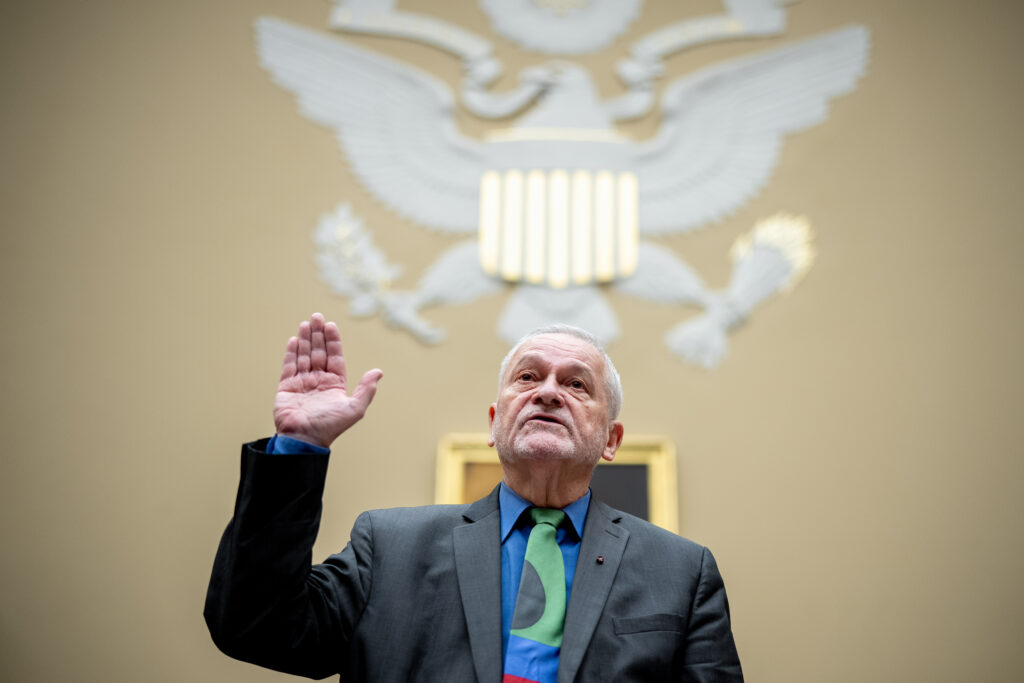
“I can’t put the toothpaste back in the tube,” Morens said during a 2024 Senate hearing in which he faced bipartisan criticism for his actions. Several lawmakers, including Sen. Rand Paul (R-Kentucky), had urged the Justice Department to consider criminal charges against him.
Much of the indictment centers on Morens’s communication with the president of a New York-based nonprofit who received a controversial NIH grant in 2014 to study the emergence of bat coronaviruses.
Although the indictment does not mention the executive or his organization by name, records previously released as part of a congressional investigation indicate he is Peter Daszak, the former president of EcoHealth Alliance. His nonprofit worked closely with the Wuhan Institute of Virology, a Chinese lab that has faced questions over whether it played any role in the virus’s emergence.
During the early months of the pandemic, the NIH and NIAID were bombarded with requests under the Freedom of Information Act (FOIA) for internal communications about that grant and related research.
“We all dread these FOIAs, they take up so much time,” Morens wrote Daszak in an April 2020 email, according to the indictment.
Over the course of the next several months, Morens, Daszak and another man — who previously released records indicate is Gerald Keusch, a former associate director of Boston University’s infectious-disease lab — repeatedly discussed keeping their conversations to private email services so they could speak freely, the indictment says. Morens several times discussed scrubbing his government accounts of communications that could stoke controversy, it alleges.
“[I] learned from our foia lady here how to make emails disappear after I am foia’d but before the search starts, so I think we are all safe,” Morens wrote to them in an April 2021 email quoted in the indictment. “Plus I deleted most of those earlier emails after sending them to gmail.”
Neither Daszak nor Keusch has been accused of a crime. They could not be immediately reached for comment Tuesday.
Republicans, however, were quick to hail the charges Tuesday as a validation of their long-held concerns.
“We caught Dr. Morens red-handed as he boasted in emails about how the ‘FOIA lady’ coached him on how to hide records and cover-up information,” Rep. James Comer (R-Kentucky) said in a statement. “I applaud the Trump Justice Department for taking action to hold this public official accountable for hiding information from the American people.”
The debate over the virus’s origin remains unsettled, and the issue has divided the intelligence and medical communities. Early scientific consensus had largely favored a natural origin via a spillover from wild animals sold in a market as the explanation. But in the absence of conclusive evidence, the debate has become increasingly contentious, as some contend the virus probably escaped from the Chinese lab.
Since Trump’s return to office, the White House has overhauled its covid.gov site that once offered resources for information on testing, treatment and vaccines. It now largely consists of criticism of the government response of the pandemic, including under Trump’s watch.
The site also now promotes what is known as the “lab leak” theory, which holds that the virus originated from Chinese experiments, despite an ongoing split among the scientific community and federal agencies.
Carolyn Y. Johnson and Dan Diamond contributed to this report.
The post Former Fauci aide charged in alleged effort to thwart inquiries into pandemic appeared first on Washington Post.