In recent weeks, members of Congress, arts donors and journalists have been whisked through a red-carpeted grand hall in the Kennedy Center and down into its less dignified underbelly to tour the institution’s most serious maintenance needs.
They’ve seen rusted steel and degraded concrete in the building’s loading docks, defunct machinery in its cobweb-ridden river pump room and deteriorating fireproofing in its parking garage.
The tour guide has been the center’s new leader, Matt Floca, the former vice president of operations, who is seeking to convince Washington that the performing arts institution is in bad enough shape to warrant the two-year closure announced by President Trump.
“From compromised structural systems to end-of-life equipment, the needs are real and urgent,” Mr. Floca said last week in a news release, which featured a photo of an electrical vault riddled with rust.
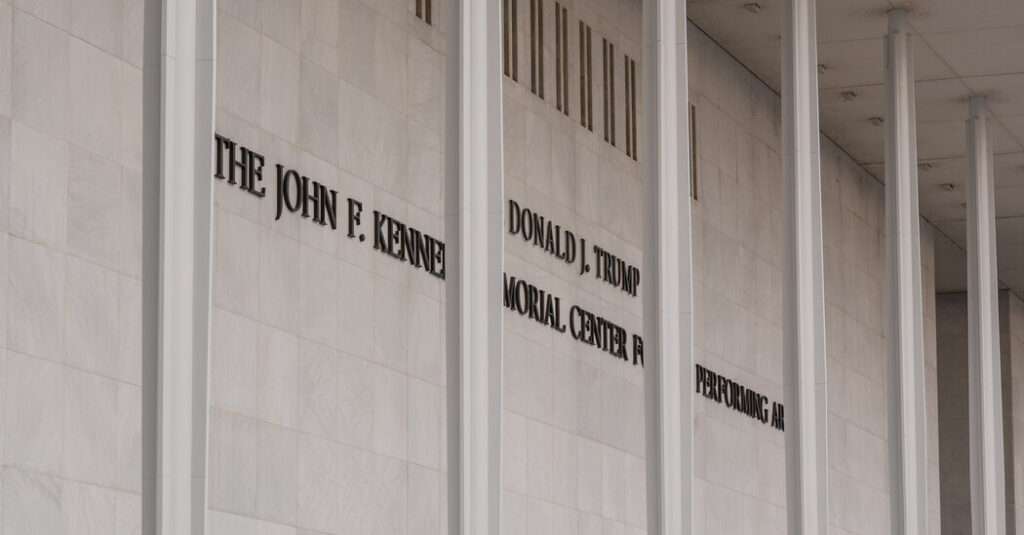
In the second year of President Trump’s takeover of the John F. Kennedy Center for the Performing Arts, convincing the world of the center’s severe disrepair has become a top priority as officials try to rebut claims that the institution was driven to closure by depressed ticket sales and fleeing artists. No one disputes that the center could use some fixing up, but whether or not it is necessary — or wise — to shutter the center for those repairs has become the subject of public debate and litigation in federal court.
The closure has been championed by Mr. Trump himself, who helped secure $257 million from Congress for repairs. The president, who is also chairman of the center’s board and a developer by trade, has taken such an interest in the minutiae of the Kennedy Center’s appearance that, last year, he personally picked out the type of white paint to cover its gold columns.
In Federal District Court in Washington, Kennedy Center officials are facing two major lawsuits that are seeking to halt plans to close the institution starting in July.
One of the suits, filed by Representative Joyce Beatty, Democrat of Ohio, asserts that the center unlawfully bypassed Congress in embarking on renovations that Mr. Trump had forecast as a “complete rebuilding.” The other, brought by cultural heritage and architectural organizations, argues that the center has not done its due diligence for such a project under federal historic preservation laws.
Both say they worry that without the court’s intervention, a demolition like that of the White House’s East Wing could occur without proper review.
Kennedy Center officials have disputed those claims, insisted that no demolition is being contemplated and argued in court that a shutdown is the most responsible and efficient way to restore the 54-year-old building.
At a hearing in Ms. Beatty’s case on Tuesday, lawyers clashed over the proposed closure.
Lawyers representing Ms. Beatty, an ex officio member of the center’s board of trustees, said at the hearing that the decision had jeopardized the center’s future, its donor network and reputation, all to rush through a vanity project for the president.
“Once you lose your audience it’s very hard to bring them back,” said Nathaniel Zelinsky, one of Ms. Beatty’s lawyers.
The center’s lawyers on Tuesday stressed the building’s condition, and described the litigation as standing in the way of needed improvements.
Mr. Trump’s decision to shutter the building has already begun to transform the institution, long considered Washington’s pre-eminent venue for the performing arts. Widespread layoffs began last month, and Kennedy Center officials have said only a bare-bones work force will be retained during the closure. Staff are searching for new venues to host concerts for the National Symphony Orchestra and the Kennedy Center Honors, the institution’s marquee event.
Mr. Floca has sought to assure the court and lawmakers that there is no reason for alarm, outlining more modest renovations than Mr. Trump’s language had suggested.
He has explained that many of the institution’s structural problems stem from water intrusion: degrading roof overhangs, discolored marble on the building’s exterior. To fix structural decay in the center’s service tunnel, he has said, they will need to shut down the center’s main entrances.
To bolster his assessments, Mr. Floca has cited reports on the building’s maintenance needs that were conducted in recent years by outside consultants.
Officials have said that the renovations will also address outdated stage equipment, such as decades-old rigging and a worn stage floor in the opera house. They’ll update an elevator system that regularly runs into problems because of the age of its technology. Seats in several theaters are scheduled for updates. (Mr. Trump has taken a particular interest in the selection of armrests, favoring a white marble.)
The case brought by Ms. Beatty has questioned the true motivations of the closure, which was announced as boycotts from artists mounted after the center’s board voted to add Mr. Trump’s name to the center. The announcement took many at the center by surprise.
Ms. Beatty’s suit says that only weeks earlier, Richard Grenell, then the president of the center, had addressed the planned maintenance in a staff meeting and discussed how renovations might require them to temporarily relocate, but did not mention the possibility of a full multiyear closure.
The closure, Ms. Beatty’s lawsuit argues, is a “pretext to hide the fact that the Kennedy Center is failing as a direct result of his unprecedented and unlawful actions since taking control of the Board,” referring to Mr. Trump.
Kennedy Center officials have acknowledged that attendance from local patrons in Washington took a hit after Mr. Trump took over, but they have also touted achievements in fund-raising and overall cost cutting. In January, Mr. Grenell said that since Mr. Trump stepped in, the center had raised more than $130 million, crediting corporate donors and Mr. Trump’s influence.
Audited financial statements covering the fiscal year that ended in September 2025, roughly half of which came after President Trump became chair of the center’s board, are expected to be released in the coming months.
Mr. Floca has said his recommendation to close the building was based in the realities of its maintenance needs.
In a declaration filed with the court, Mr. Floca wrote that work on the stage will render the building unusable for rehearsals or performances, and inviting in patrons in amid dust, noise and “erratic climate control” would compromise the center’s reputation.
“A full two-year closure is the only responsible path forward,” Mr. Floca wrote in the filing.
The recent tours of the building’s disrepair have involved legislators from both parties, including John Thune, the Senate minority leader, and Chuck Schumer, the Senate minority leader. For those who were not invited on the tour, the Kennedy Center posted photos of the disrepair on social media, writing that it was the result of “decades of damage.”
Kennedy Center officials have made assurances that there are no plans to change aspects of the building that are dedicated to John F. Kennedy, the slain president who championed the establishment of a national cultural center. Mr. Floca has said the eight-foot bronze bust of Kennedy will remain where it is, as will quotes of his that are inscribed on the building’s marble exterior.
Julia Jacobs is an arts and culture reporter who often covers legal issues for The Times.
The post Kennedy Center Works to Make the Case That Repairs Are Urgent appeared first on New York Times.