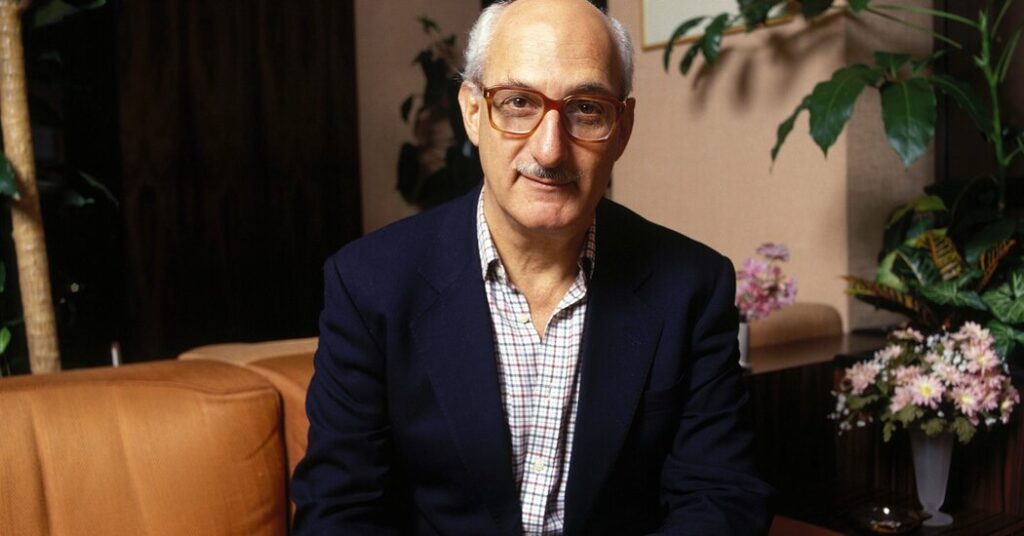
David Malouf, a writer whose poetic vision of Australia’s dual nature — a nation defined by its British Empire heritage, yet sheltering in an untamed outback — played out across prizewinning novels, short stories, poems and opera librettos, died on Wednesday in Gold Coast, in Queensland, Australia. He was 92.
His death, in a hospital, was announced by his publisher, Penguin Books Australia.
Mr. Malouf, who in 1997 was named to the initial list of 100 living national treasures by the National Trust of Australia, was saluted on social media by the country’s prime minister, Anthony Albanese, for having “captured the harsh, vast and intense beauty of our land and the lives it shaped.”
In nine novels, Mr. Malouf reached back into Australia’s past to explore how the country’s uncompromising landscape and the combative mentality of its early settlers had shaped its collective psychology.
Beginning with “Johnno” (1975), a semi-autobiographical account of his Brisbane upbringing, and continuing with books that blended history, memory and fiction, like “The Great World” (1990), “Remembering Babylon” (1993) and “The Conversations at Curlow Creek” (1996), Mr. Malouf looked at how the country’s founding as a penal colony in a hostile land extended into a more genteel present.
He looked back into history for his themes, but not grand history. He was after the smaller lives he imagined playing out beneath the larger narrative.
“When we talk about history, of course what history really is, is what is told and recorded,” he told the Australian filmmaker Don Featherstone in a 1997 documentary. “What fiction is really interested in is all those paths that don’t get recorded.”
His work also drew on his own diverse background: His father’s family was from Lebanon, and his mother was from a Portuguese Sephardic Jewish family that had long lived in England.
“I have always written, I think, out of this early sense of seeing and feeling in one hemisphere and reading in another, or of doing both at the same time, and from the oddness of being plainly neither Anglo-Saxon nor Celtic in a place that was in those days 95 percent either one or the other,” he once wrote, referring to his boyhood in World War II-era Brisbane.
Bookish and introverted from an early age, Mr. Malouf remained this way as an adult, in an environment more fiercely committed to carving a nation out of wilderness than to creating works of art. For many years, he spent months each year living in a small Italian village. After his death, The Sydney Morning Herald described him as “openly but discreetly gay.”
“In Malouf’s Australia, the man of sensibility is walled in,” the Australian critic and writer Clive James wrote in The New York Review of Books in 2000.
“He is not necessarily in a closet,” Mr. James added, “but he is certainly in a cell, and without his yearning vision of someone wild in the street outside he would never dare to attack the bars in the window with that file he found in the cake.”
That duality — the man of “sensibility” playing off his doppelgänger, “someone wild” — finds its way, again and again, into Mr. Malouf’s fiction, as critics have noted. In “Johnno,” there is the literary-minded Dante, a character modeled on Mr. Malouf, and his unrestrained, reckless friend Johnno. In the epic wartime novel “The Great World,” perhaps Mr. Malouf’s most important work, there is the reflective Digger and the impulsive Vic, fellow prisoners of war in a Japanese internment camp. In “The Conversations at Curlow Creek,” set in colonial-era Australia, Adair and Fergus are another pair of men who are opposites in character.
The Australian novelist Janette Turner Hospital noted that the twinned characters were iterations of Mr. Malouf’s own dual nature — “a single self engaged in an inner dialectic,” as she put it, a view which the novelist did not disagree.
“This conceptual principle gives rise both to the considerable strengths (the poetic language, the beauties of structure and form) and to the weaknesses (the solipsism, the sketchy characterization, the narrative inertia) of Malouf’s novels,” Ms. Hospital wrote in The London Review of Books in 1996.
Other critics also observed that Mr. Malouf’s poetic gift sometimes led him astray. “One has the sense that Mr. Malouf should try to cram less meaningful cogitation onto every page and allow his striking story to unfold unhindered,” the critic Richard Bernstein wrote in The New York Times in 1997.
Australia, in Mr. Malouf’s telling, is by definition a land of myth, a place still haunted by its past. Often, in his work, as Mr. James put it, “the urge to create a legend came first, and then the events were made up to fit.”
That tendency is displayed in “The Valley of Lagoons,” a long story in the 2000 story collection “Dream Stuff,” about a teenage boy’s initiation-ritual trip into a remote, watery spot in the outback. Mr. Malouf’s classics-infused imagination renders it a kind of journey to the underworld. (Two of his books, “An Imaginary Life,” from 1978, and “Ransom,” from 2009, are based on Ovid and Homer.)
The Lagoons “was there, but only in our heads,” the narrator says. “It had a history, but only in the telling: in stories I heard from fellows in the playground at school, or from their older brothers at the barbershop or at the edge of an oval or on the bleachers at the town pool.”
David George Joseph Malouf was born in Brisbane, in Queensland, Australia, on March 20, 1934, the older of two children of George Malouf, the prosperous owner of a grocery delivery business, and Welcome Wilhelmina (Mendoza) Malouf. His father’s parents had emigrated in the 1880s; his mother’s, in 1913.
He grew up in what he called “a green, subtropical weatherboard city of mango trees, cannas and giant weeping figs,” a childhood he chronicled in the 1985 memoir “12 Edmondstone Street.”
He attended Brisbane Grammar School, graduating in 1950, and the University of Queensland, graduating with a B.A. in English in 1954. He went to Europe in 1959, worked as a teacher in London and the north of England, and returned to Australia in 1968 to teach English at the University of Sydney.
A 1962 collection, “Four Poets,” which including a section of Mr. Malouf’s work, introduced him to readers. He went on to publish nine volumes of poetry. Mr. Malouf also wrote the librettos for several operas, including an adaptation of Patrick White’s novel “Voss,” with music by Richard Meale, which was first performed in Adelaide in 1986.
He was shortlisted for the Booker Prize for his 1993 novel “Remembering Babylon,” a historical drama set in the 1850s, about the confrontation of a group of Australian settlers with a white man raised by Aboriginal people.
That book won the inaugural International Dublin Literary Award in 1996. Mr. Malouf won the French Prix Femina Étranger in 1991 for “The Great World,” and was awarded the Australia Council Award for Lifetime Achievement in Literature in 2016.
He leaves no immediate survivors.
Mr. Malouf saw himself as filling a void in what he called the “consciousness of Australians,” who were largely unconcerned with the country’s history. The Australian past was the subject matter of his books.
He saw his preoccupation as inevitable. You had to understand Australia’s origins as a colony of criminals, he believed — the intentional antithesis of Britain — to get at its dual nature. From the beginning, he wrote, it was “a colony that was intended to exist in two places, a real geographical antipodes and at the same time an antipodes of the mind.”
Adam Nossiter has been bureau chief in Kabul, Paris, West Africa and New Orleans and is now a writer on the Obituaries desk.
The post David Malouf, Novelist of Australia’s Divided Heritage, Dies at 92 appeared first on New York Times.