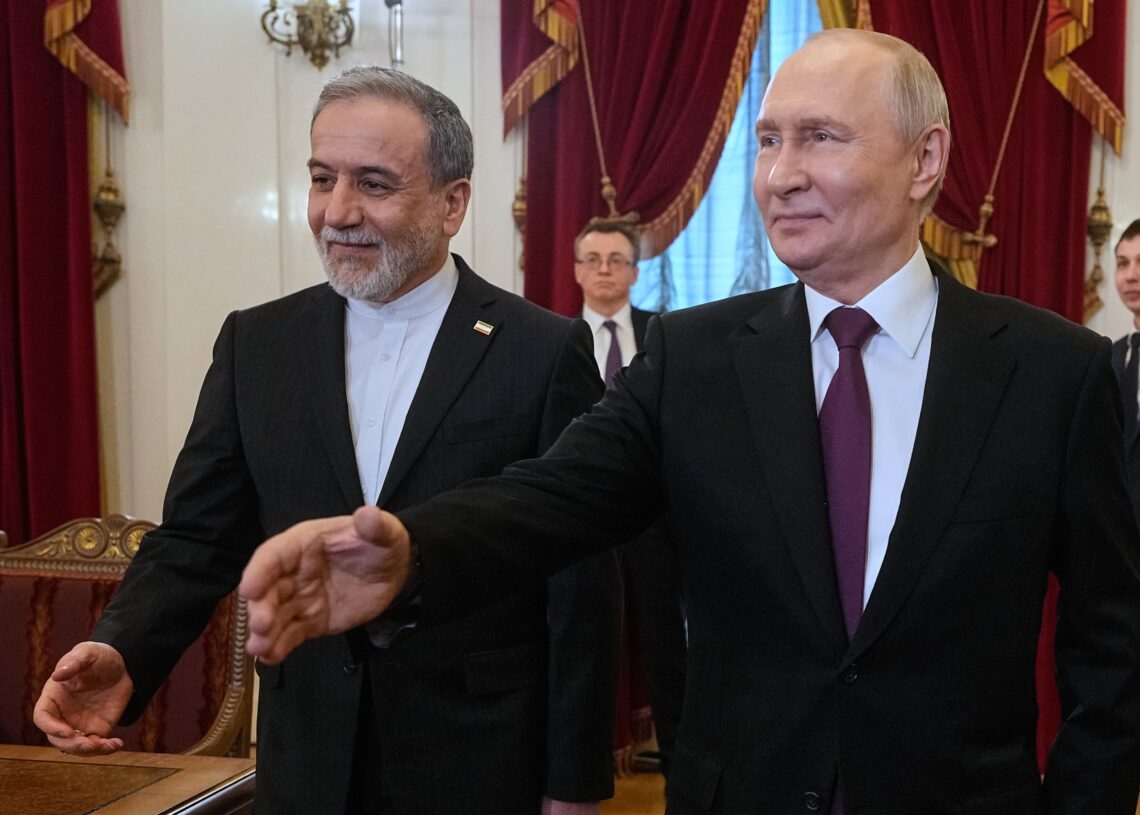
Iranian Foreign Minister Abbas Araghchi met Monday with Russian President Vladimir Putin, who pledged to do “everything” possible to bring peace to the Middle East, amid stalled talks between Iran and the United States.
Araghchi arrived in St. Petersburg early Monday after stops in Oman — like Russia, a key diplomatic mediator for Iran — and Pakistan, which has been hosting on-again, off-again peace talks. Hopes of a deal dimmed over the weekend after President Donald Trump at the last minute called off plans to sendto Pakistan envoys Steve Witkoff and Jared Kushner, Trump’s son-in-law.
Iran continues to block traffic through the Strait of Hormuz and the United States continues its blockade against the nation, with severe consequences for the global economy and no clear end in sight.
Russian state media did not report what kind of support, if any, Putin pledged to Araghchi behind closed doors. Iran and Russia have long been close strategic partners, and Moscow has so far extended limited support to Iran in its war with the United States and Israel, providing Tehran with targeting information for U.S. forces including warships and aircraft in the Middle East, Western officials have said.
At the same time, Putin, hopeful of negotiating a peace deal in Ukraine favorable to Russia, has tried to avoid upsetting relations with Trump and has sought to assure him that Moscow is not sharing targeting information with Tehran. Russia has long been seeking to offer its services as an intermediary in negotiations between Iran, the U.S. and Israel, in hopes of leveraging its relationship with Iran to bolster its standing with the Trump administration and potentially secure concessions on Ukraine.
“We very much hope that, relying on this courage and the aspiration for independence, the Iranian people, under the leadership of the new leader, will get through this difficult period of trials — and that peace will come,” Putin told Araghchi, according to state news agency RIA Novosti. “For our part, we will do everything that serves your interests and the interests of all the peoples of the region in order to ensure that this peace is achieved as soon as possible.”
Iranian state run media reports have said that Araghchi’s visits to Pakistan and Russia were not related to nuclear talks, but the reports said the foreign minister did raise the Strait of Hormuz and “the imposition of a new legal regime” there.
While the fragile ceasefire this month between the United States and Iran has largely held, the sides, which have made little apparent headway in their sporadic peace talks, continue to use the Strait of Hormuz for leverage, severely restricting the vital passageway for oil and gas shipments. Tehran has tightened its grip on the choke point with gunboats and reportedly at least 20 mines, while Trump has ordered a U.S. Navy blockade of Iran-linked ships. U.S. Central Command has said it has redirectedat least 37 vessels since it began its blockade.
A prolonged blockade could send energy prices and fertilizer shortages spiking further and raise the political peril for Republicans in November’s midterm elections. After markets opened Monday, the price of Brent crude oil touched $108 a barrel, even though reports had emerged beforehand of Iran submitting a new ceasefire proposition.
Iranian negotiators have floated a proposal that would separate the Strait of Hormuz from talks regarding Iran’s nuclear program and a larger peace deal, according to a Pakistani official briefed on the matter, who spoke on the condition of anonymity to share sensitive details.
Under the proposal, which was first reported by Axios, Iran is asking for the United States to lift its blockade of Iranian ports in exchange for Tehran reopening the strait to maritime traffic.
The official did not specify whether Tehran would still require vessels to coordinate passage with the country’s military, or pay a toll.
Peace talks have also faltered in Lebanon, where Hezbollah and Israel — allies of Iran and the United States, respectively — continued to fire at each other despite efforts by Washington to broker a deal. Israel renewed airstrikes on Monday in Lebanon’s Bekaa Valley after seeing casualties among its ground forces, which are occupying a swath of southern Lebanon. The death toll in Lebanon surpassed 2,500 over the weekend.
Continued fighting between Israel and Hezbollah could strain the U.S.-Iran talks: Lebanon remains a major sticking point, along with Hormuz and the fate of Iran’s nuclear program. Hours after Washington and Tehran reached an initial ceasefire agreement on April 7, Israeli Prime Minister Benjamin Netanyahu launched massive airstrikes targeting more than 100 sites in Beirut, the Bekaa Valley and southern Lebanon, infuriating Iran just days before Vice President JD Vance was set to meet with Iranian officials. A second round of talks involving Vance was set for April 21, but Trump announced at the last minute that it would be postponed indefinitely.
“Too much time wasted on traveling, too much work!” Trump wrote Saturday on Truth Social. “Besides which, there is tremendous infighting and confusion within their ‘leadership.’ Nobody knows who is in charge, including them. Also, we have all the cards, they have none! If they want to talk, all they have to do is call!!!”
In the meantime, both Iran and the U.S. have seized vessels in the region. Between April 21 and April 24, five or fewer tankers or dry bulk vessels per day transited the Strait of Hormuz, according to maritime intelligence firm Kpler. The longer the vital oil passageway is constrained, analysts and traders have warned, the larger the oil supply shocks. Some countries have already seen oil price spikes and crippling fuel shortages.
Catherine Belton, Susannah George and Shaiq Hussain contributed to this report.
The post Iranian foreign minister meets with Putin as U.S.-Iran talks falter appeared first on Washington Post.