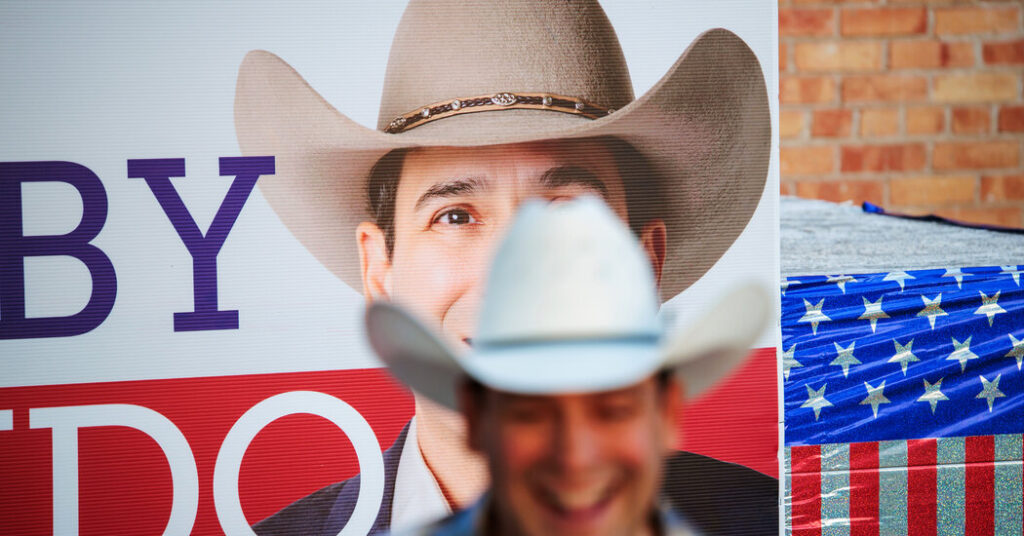
Bobby Pulido stood on a glossy white dance floor in a ballroom bedecked with crystal chandeliers, towering flower arrangements and yards of pink bunting. As he crooned to scores of spellbound guests, the real star of the evening, Hailey Hernandez, a petite 15-year-old in a rosy meringue of a dress, swayed and beamed before him alongside her parents. Her dad, Juan, kept bursting into song. When Mr. Pulido reached the chorus of his 1995 hit, “Desvelado,” he extended the mic toward the crowd, inviting it to join in. Seemingly every phone in the place was aloft and recording.
This was Mr. Pulido’s second birthday bash of the night. As a musician, he is really too established for this kind of hustle. He won his second Latin Grammy just last year. But these are not ordinary gigs. They are campaign events.
Mr. Pulido, who turns 53 this month, is a Democrat running for the House in Texas’s 15th Congressional District, a heavily Hispanic border region that swung hard toward President Trump’s Republicans in recent years.
After a couple of songs and a stroll around the dance floor with Hailey, Mr. Pulido gave her a pink ball cap that read “Make Quinceañeras Great Again.” Wishing the room good night, he mentioned he is running for Congress and thanked everyone for their support. Then he and his team slipped out, leaving the party to rage on.
In this year’s high-stakes midterm elections, the Democratic Party is desperate to persuade voters who supported Mr. Trump, including many former Democrats, to give the blue team a try. The president’s unpopularity presents a huge opportunity. But to capitalize on this, Democrats need candidates who understand and can connect with voters in their districts who may have soured on the party’s national brand — candidates like Mr. Pulido.
Quinceañeras, coming-of-age celebrations for girls turning 15, are a big part of Latino culture. They have also become a big part of Mr. Pulido’s campaign in his South Texas district, where about 80 percent of the electorate is Hispanic. For this, Mr. Pulido credits his Republican opponent, Representative Monica de la Cruz. Reacting to Mr. Pulido’s win in the March Democratic primary, Ms. de la Cruz mocked his fitness for the job, saying the race “isn’t about who you want performing at your niece’s quinceañera.”
Mr. Pulido clapped back. He accused Ms. de la Cruz of disrespecting the community’s heritage. Then his campaign put out a video asking families to invite him to their quinceañeras. Within 24 hours, Team Pulido had 1,000 requests. By mid-April, that number had reached 3,000 and included invitations to quinceañeros (the boy version), birthday parties for older adults, weddings, proms, graduations and even a baptism. Mr. Pulido is trying to accept as many as possible. His record so far is seven in one weekend.
Team Pulido’s quinceañera project has earned the candidate a flood of positive attention and emphasizes some of the ways he diverges from the stereotypical national Democrat. “Change is a tricky thing. Cities — progressive cities — love change,” he told me over breakfast in Edinburg, his hometown. “My area is rural. It’s about tradition. It’s about culture.”
When the 15th flipped to the Republicans in 2022, it was a blow to Democrats, who had held it for well over a century. Two years later, the district went for Mr. Trump by almost 18 points.
The quinceañeras offer Mr. Pulido a chance to connect with working-class people who often don’t have the time or inclination to follow politics closely. In these settings, he looks less like an out-of-touch celebrity than a guy who remembers his roots. Better still, the clips are reposted all over social media, earning him the kind of free media most candidates would die for.
The parties are great, but Mr. Pulido stressed that he is campaigning “on policy and not celebrity.” Health care is a big issue for him. The Republicans’ cuts to Medicaid will hit low-income areas like his extra hard, he said. He himself lacks health insurance and has gotten medical procedures done in Mexico. A lot of people in the area do that, a campaign aide noted.
Mr. Pulido said he was not surprised when the Democrats lost the district in 2022. The party had grown complacent and “did not defend” its interests across the Rio Grande Valley, he argued. What’s more, its candidate that year had a message that struck him as too progressive for the district.
This is the land of God, guns, fossil fuels and giant trucks — preferably diesel-powered. “Because if you’re going to pull something, a trailer, you need the torque!” said Mr. Pulido. “And if you start hearing, ‘We’re going to ban fracking,’ you go, ‘Hey, ho, ho, ho! Hold on. You’re going to take away my jobs.”
The 15th is one of the state’s poorest districts, and “upward mobility” is always top of mind here, he said. Democrats “have to talk more in the economic language that people understand, about how can I provide for my family?”
“I feel like Democrats focus on the poor, but a lot of people here do not consider themselves poor. They consider themselves broke,” he added. “There’s a big distinction, because if you consider yourselves poor, you’re kind of accepting your fate. We’re not like that here. We say, ‘We’re broke, but tomorrow we’re going to make it.’” Many voters in the district gave Mr. Trump a chance “because of the promise of a better life for their own families.”
”Now the backlash is going to be very, very big,” he predicted.
Michelle Renee Rangel certainly has had enough. The owner of a Mexican bistro in Falfurrias, she was a staunch Democrat until Mr. Trump came along. “He promised a lot of things,” Ms. Rangel said at a Thursday night meet-and-greet she had organized for Mr. Pulido. The president’s message of economic opportunity won over her and her husband, who both stayed up late to cheer his victory on election night. “We made a mistake,” she said.
Ms. Rangel also has been surprised by Mr. Trump’s brutal, indiscriminate immigration policies. She used to work at a feedlot where most of her co-workers were Mexican. “When I voted for Trump,” she said, “I didn’t think that my friends were in danger.”
I asked Mr. Pulido how people in the district were viewing the administration’s border and deportation policies. “Those are two separate issues,” he said. “Everybody says, ‘It’s a good thing that we don’t have a bunch of people coming over.’ That’s chaos, and nobody wants that.” But “the enforcement issue” has the community “paralyzed.”
These are not the sort of distinctions you tend to hear from Democrats more in tune with the national activist class.
Mr. Pulido has his warts and rough spots. He sounds a smidge defensive when he talks about the Republicans’ efforts to paint him as a misogynistic sleazeball. His opponents have been combing through appearances, associates and social media posts from Mr. Pulido’s decades in the music business, dredging up things like gross jokes he made and tour appearances several years ago with an old bandmate from the 1990s who served time for a child sex crime in the 2010s. (The campaign has said Mr. Pulido “was never made aware” of the man’s sex-offender registration and “would never knowingly associate” with someone “with that kind of history.”)
Here again, the quinceañeras come into play. Mr. Pulido told the crowd in Falfurrias that if he were a “creep,” there is no way thousands of parents would invite him to their teenagers’ events. This reasoning isn’t airtight. But it points to how important the quinceañera project has become to his campaign.
After the Hernandez birthday bash, the members of Team Pulido gathered outside the event hall, decompressing and discussing their schedule. Mr. Pulido had a new request to play at a birthday party for a bunch of older women who had not had quinceañeras as teenagers. “They called seven times,” said Jimmy Montez, Mr. Pulido’s business manager turned campaign volunteer.
The candidate looked tired, his smile strained beneath his white straw cowboy hat. It had been a long Saturday, and he still had more than six months and countless quinces to go before Election Day. But, as he sees it, making these connections with voters is a key to victory. “This is relational campaigning,” he said. “The Rio Grande Valley is two degrees of separation.”
If Mr. Pulido can manage an upset, clawing back this one-time stronghold, it will be a jolt of energy for his party. And while it is impossible to say how the political winds will be blowing in 2028, Democrats who build the right profile now will be better positioned to hold their districts.
In Mr. Pulido’s case, he’d owe Ms. de la Cruz a big thank-you for her quinceañera crack. Maybe he could even sing at her niece’s birthday.
Michelle Cottle writes about national politics for Opinion. She has covered Washington and politics since the Clinton administration. @mcottle
The Times is committed to publishing a diversity of letters to the editor. We’d like to hear what you think about this or any of our articles. Here are some tips. And here’s our email: [email protected].
Follow the New York Times Opinion section on Facebook, Instagram, TikTok, Bluesky, WhatsApp and Threads.
The post How Bobby Pulido Could Bring Texas Latinos Back to the Democrats appeared first on New York Times.