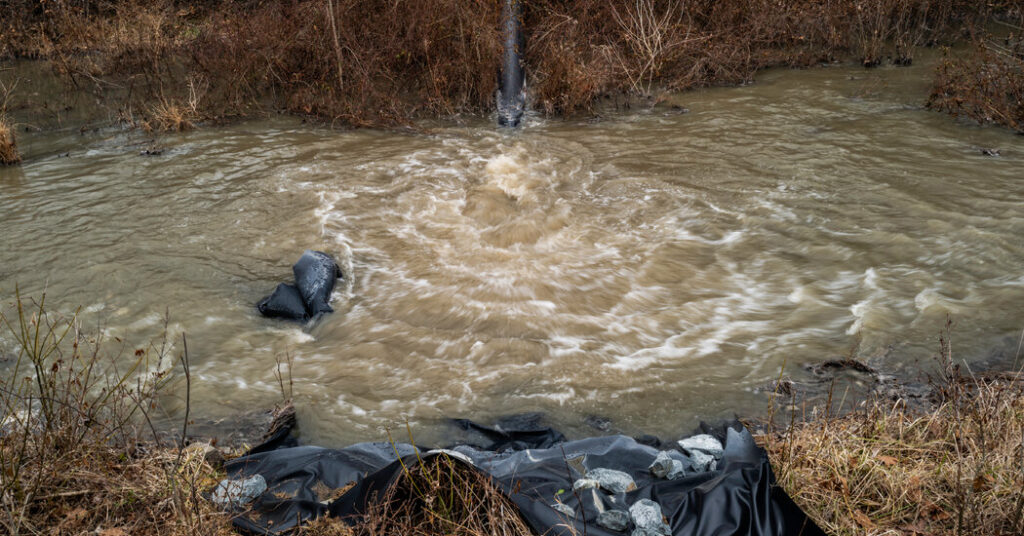
The Environmental Protection Agency and Maryland regulators filed separate lawsuits Monday seeking to hold the Washington, D.C., public water utility responsible for at least 240 million gallons of sewage contamination that flowed into the Potomac River this winter.
The utility, D.C. Water, was in the process of updating the Potomac Interceptor, a 60-year-old pipeline that carries up to 60 million gallons of sewage daily through Virginia, Maryland and the District of Columbia, when a section of the tunnel collapsed in January near the Cabin John area of Montgomery County, Md., about five miles upstream of Washington.
Scientists said the contamination represented the largest surge of sewage pollution into the river since the advent of wastewater treatment nearly a century ago. The pollution prompted the environmental advocacy group American Rivers to name the Potomac the nation’s most endangered river in a report released this month.
The lawsuits argue that the utility failed to properly maintain the pipeline despite knowing it was dilapidated. Even as D.C. Water built a bypass system to carry wastewater and allow it to rebuild the collapsed pipeline, raw sewage continued to flow into the river, the E.P.A. and the Justice Department said in announcing their lawsuit filed in federal court.
That response “fell far short of adequate mitigation,” the federal agencies said.
D.C. Water officials said they were “fully committed to the long-term rehabilitation of the Potomac Interceptor” and defended their response to the sewer collapse. Utility crews contained most of the sewage overflow within five days, and all of it within three weeks, while completing repairs to the broken pipeline in 55 days. The E.P.A. oversaw the cleanup after President Trump issued a federal emergency declaration for the Potomac on Feb. 23.
“Although the lawsuits are still under review, they underscore our commitment to advance the planned repairs for the entire 54-mile pipeline, including the impacted segment,” D.C. Water officials said in a statement.
The lawsuits are seeking civil penalties, recovery of costs associated with cleaning up the site of the sewer collapse, and orders to assess and rehabilitate infrastructure.
In announcing the federal lawsuit, the E.P.A. took a swipe at Gov. Wes Moore of Maryland, a Democrat and possible 2028 presidential candidate who has sparred with President Trump, saying the state had “refused to hold D.C. Water accountable” for the sewage leak.
Maryland’s separate lawsuit, announced minutes earlier and filed in the Circuit Court for Montgomery County, also asks the court to order the area around the sewer collapse to be environmentally restored. Maryland has jurisdiction over the river because its state line falls along the waterway’s southern and western banks, along its shores in West Virginia and Virginia, rather than in the center of the river.
D.C. Water officials stressed that testing results showed low levels of bacteria in the river near the site of the sewer break and improved water quality measures downstream.
But according to Maryland’s lawsuit, state environmental regulators observed sewage contamination along the riverbanks as recently as April 14. The state is accusing D.C. Water of “gross negligence.”
“D.C. Water knew this aging infrastructure was corroding, yet it delayed repairs and failed in its duty to protect this treasured waterway,” the Maryland attorney general, Anthony G. Brown, said in a statement.
Scott Dance is a Times reporter who covers how climate change and extreme weather are transforming society.
The post E.P.A. and Maryland Sue D.C. Utility Over Potomac River Sewage Spill appeared first on New York Times.