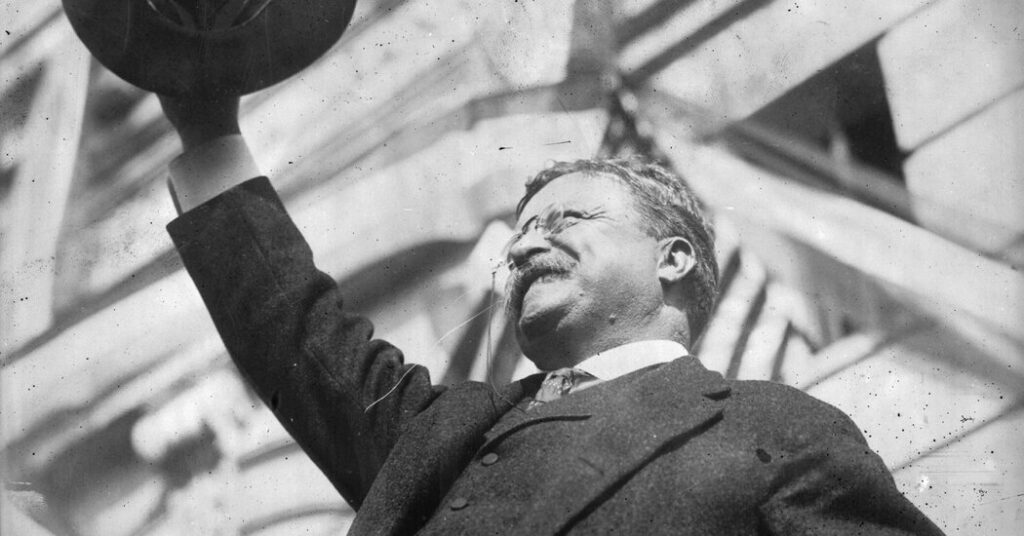
Interior Secretary Doug Burgum said last week that Theodore Roosevelt belonged in the Pro Football Hall of Fame.
At a panel event previewing the Theodore Roosevelt Presidential Library, which is set to open this summer in North Dakota, Mr. Burgum said, “Keep your fingers crossed, but I think we’re going to see Theodore Roosevelt inducted.”
A cabinet secretary suggesting that a president who left office 117 years ago should receive a sports-related honor may seem puzzling. We’ve got answers to your questions.
What does Roosevelt have to do with football?
Football was a much more violent game in the years after it was invented in the 19th century, with less padding and significantly more injuries — and even deaths. While some people called for the sport to be banned, Roosevelt was an admirer and felt the game could be reformed instead.
Professional football was marginal at the time. It was colleges, especially those in the Northeast, that were the epicenter of the early game. In 1905, Roosevelt brought the presidents of Harvard, Yale and Princeton to the White House and urged safety reforms.
(In its front-page story on the meeting, The New York Times took a slightly snarky tack: “Having ended the war in the Far East, grappled with the railroad rate question and made his position clear, prepared for his tour of the South, and settled the attitude of the administration toward Senator Foraker, President Roosevelt to-day took up another question of vital interest to the American people. He started a campaign for reform in football.”)
Nevertheless, the meeting led to rule changes ranging from the invention of the forward pass to the formation of the National Collegiate Athletic Association.
Without Roosevelt, football historians will tell you, the game might have been banned or simply fizzled out.
Who is the ‘interior secretary’ and why is he weighing in?
Mr. Burgum leads the Interior Department, which primarily manages public land and handles issues related to Native Americans. But it has a broad remit, and is sometimes considered to be the department that covers whatever is not covered by the other federal departments. That has not traditionally included recommendations for sports halls of fame, but the secretary waded into the territory anyway during the panel at the National Portrait Gallery.
“I think we’re going to see Teddy Roosevelt inducted into the Pro Football Hall of Fame.” Mr. Burgum said Thursday. He suggested it could happen on the National Mall when the N.F.L. draft is held there next spring. “I’m manifesting: It’s going to be announced on the Mall,” Mr. Burgum added.
Mr. Burgum was the governor of North Dakota from 2016 to 2024, and helped bring the Roosevelt Library to the state.
Is this related at all to the current president?
President Trump has not commented specifically on Roosevelt joining the Hall of Fame, but he has signed two executive orders related to college sports, laying out rules for athletes’ eligibility and compensation. The effect of the orders would be to limit some of the freedoms that athletes have gained in recent years, including earning money and changing schools.
“President Trump is a visionary and iconic president who is saving college sports just like President Roosevelt saved American football,” the Department of the Interior said in a statement. “As we approach America’s 250th, we are blessed to have President Trump fight so hard for our country’s legacy.”
Who gets into the Pro Football Hall of Fame and how?
The Pro Football Hall of Fame, in Canton, Ohio, elects players, of course, and coaches. There is also a “contributor” category, for which Roosevelt could be eligible. Currently, that category includes owners and commissioners, but no presidents.
“Anyone can nominate a candidate for election to the Pro Football Hall of Fame,” the Hall said in a statement. “Submitted names are forwarded to the Selection Committee for consideration. Each election cycle concludes with the announcement of the new class during Super Bowl week.”
The Hall is just now entering a new election cycle that will culminate in early 2027. Nominations will be whittled down, and a contributor committee will vote for one person to be put forward to the main voting body, which consists mostly of news media members.
A Hall spokesman said that the institution had a defined process for announcing inductees, and that there were no plans for an announcement on the National Mall during the draft, as Secretary Burgum had suggested.
Maybe the College Football Hall of Fame would be a better spot for T.R.
Roosevelt, who was in office from 1901 to 1909, was a lot more focused on college ball than the nascent professional game. For one thing, he had a son at Harvard who had gotten a black eye and bruises from the sport. (That son, Ted Roosevelt Jr., perhaps proved his father’s belief that football was a platform on which to build great accomplishments in later life. The president’s son became a renowned World War II hero as the oldest man on the beach on D-Day.)
Roosevelt might seem a better candidate for the College Football Hall of Fame, in Atlanta, although it, too, is primarily composed of players and coaches. The National Football Foundation, which selects the inductees for the college hall, declined to comment.
So he made Mount Rushmore, but I guess Hall of Fame enshrinement has thus far eluded Roosevelt.
Not so fast. Roosevelt is a member in good standing at the Hall of Fame for Great Americans.
The first “hall of fame” in the United States, founded in 1900, it can be found on the campus of Bronx Community College in New York City. It has fallen on some hard times, electing its last three members in 1976 (and failing to fund busts of them).
But there Roosevelt is, in all weather, alongside Thomas Jefferson, Susan B. Anthony and Elias Howe, inventor of the modern sewing machine. It isn’t Canton, but it may have to do for now.
Victor Mather, who has been a reporter and editor at The Times for 25 years, covers sports and breaking news.
The post Could the Next Football Hall of Famer Be … Teddy Roosevelt? appeared first on New York Times.