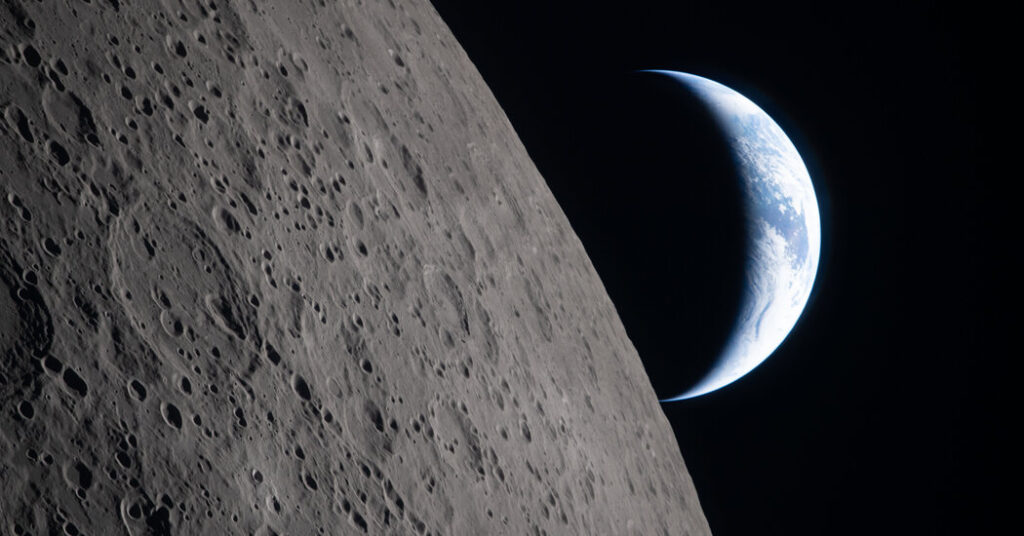
As astronaut Victor Glover made his way to the moon earlier this month on NASA’s Artemis II mission, he reflected on the incredible miracle that is planet Earth.
“You are special,” Glover told an interviewer. Space, he said, “is a whole bunch of nothing.”
But in the midst all that nothing, Glover could see a bright blue dot out the window of his spaceship. “You have this oasis,” he said, “this beautiful place that we get to exist together.”
Glover is right. The only planet in the universe known to be capable of supporting life, our common home is one lonely speck of extraordinary abundance in a cold, infinite vacuum.
On the climate and environment team at The Times, we spend a lot of time documenting the myriad ways in which human activity is wreaking havoc on Earth’s ecosystems. And there’s no question it’s been another tough year for the planet. Temperatures keep rising. Biodiversity loss is increasing. The United States has withdrawn from global action against climate change.
But ahead of Earth Day tomorrow, we also wanted to highlight some of the many things that are going right in the push to slow global warming and protect the planet.
The energy transition
Curbing climate change will require replacing substantially all of the energy produced by fossil fuels with energy produced by clean sources, like solar and wind power. And on this front, there’s much to celebrate.
While the growth of clean power has slowed in the United States as a result of the Trump administration’s policies, the adoption of renewable and low-carbon energy sources is booming around the world.
For the first time, a renewable source — solar — was the biggest single contributor to new energy supply worldwide, accounting for more than 25 percent of energy growth last year, according to data released this week by the International Energy Agency.
Globally, electric car sales jumped 20 percent last year, to more than 20 million vehicles. And installations of new wind energy jumped 40 percent over last year with more than 160 gigawatts installed in 2025.
“The economics of clean energy are now on our side,” said Manish Bapna, chief executive of the Natural Resources Defense Council. “Today, clean energy is the cheapest and quickest way to meet our growing energy demand. As a result, we’re seeing bright spots of hope all over the world.”
With rollout of renewables on the rise, emissions have started to fall in some key markets.
In the European Union, greenhouse gas emissions fell 3 percent between 2023 and 2024. With that drop, the E.U.’s total emissions are 40 percent lower than 1990 levels, even as the population and economy have grown substantially.
In China, carbon dioxide emissions fell by 1 percent in the final quarter of 2025, according to an analysis by Carbon Brief. That likely will result in a slight overall decline in annual emissions, meaning that the world’s biggest polluter has managed to keep its CO2 emissions either “flat or falling” for nearly two years now.
And in India, emissions were flat for the first time since the 1970s, excluding the pandemic years. Wind and solar installations in India jumped nearly 60 percent last year, the largest increase among major nations.
“It’s not a matter of ‘if’ but ‘when’ the world transitions to clean energy,” Bapna said, “and what countries will lead the way and reap the economic reward.”
Corporate action continues
Earlier this year, I wrote about how Wall Street turned its back on climate change. That dynamic hasn’t changed. But elsewhere in the corporate world, many businesses continue to take action.
A record $2.3 trillion was allocated to clean energy projects last year, according to BloombergNEF, and more than 10,000 companies now have goals to reduce their emissions.
“That’s not retreat,” said Mindy Lubber, chief executive of Ceres, a nonprofit organization that helps companies with sustainability efforts. “That’s acceleration.”
Lubber added that while some Wall Street firms have gone quiet on climate issues, many institutional investors continue to assess climate risk and publicly held companies are required to track the issue. “Fiduciary duty hasn’t changed, and neither has their focus,” she said.
And across the country, states including California, Illinois and Massachusetts are implementing policies that will push businesses to reduce emissions, even as some Northeast states are pulling back.
“This isn’t a straight line, and it’s definitely not fast enough,” Lubber said. “But overall, the direction is clear: markets, companies, investors, and policymakers are still moving forward.”
A resilient blue dot
There’s some good news from around the planet, too.
Scientists have found that rainforests can recover from deforestation in mere decades, my colleague Sachi Mulkey reports. A large-scale study, conducted across two nature reserves in Ecuador, found that hundreds of millions of acres of formerly deforested land are thought to be regrowing.
Trump Administration: Live Updates
Updated
- In a tense House hearing, Kennedy refuses to support Trump’s C.D.C. nominee on vaccines.
- A Florida Democrat facing federal charges resigns from Congress.
- Senate Republicans released a measure that would fund ICE for three years.
“This is a message of hope,” one tropical forest ecologist said of the study. “The exciting thing is that nature is capable of recovering by itself.”
From Oregon to Maine, rivers are being restored, allowing salmon to return. (California, for its part, is building literal bridges for wildlife.) And citizens in all 50 states are coming up with innovative fixes to climate problems large and small.
None of these developments alone will single-handedly stop climate change, or reverse the damage that has already been done. But together, they offer promise that even in challenging and complicated times, humanity can summon the will to care for our common home.
“You guys are talking to us because we’re in a spaceship really far from Earth,” Glover said while zooming away from the planet. “But you’re on a spaceship called Earth, that was created to give us a place to live in the universe and the cosmos.”
Ask NYT Climate
How can I protect my car when the weather is scorching?
The mercury is starting to rise outside. While that may be welcome news for gardeners and beachgoers, higher temperatures can take a toll on your car.
“Heat is a stressor on the vehicle, and in many ways, a much greater stressor than even cold temperatures,” said Greg Brannon, director of automotive engineering and research at AAA. “It affects nearly every system.”
Here’s how you can prepare your car for what’s shaping up to be a hot summer. — Susan Shain
And read more from our Ask NYT Climate series.
In case you missed it
The climate policy case that remade the Supreme Court
In 2016, the Supreme Court issued a cryptic, one paragraph ruling that sent both climate policy and the court itself spinning in new directions.
For two centuries, the court had generally handled major cases at a stately pace that encouraged care and deliberation, relying on written briefs, oral arguments and in-person discussions. The justices composed detailed opinions that explained their thinking to the public and rendered judgment only after lower courts had weighed in.
But this time, the justices were sprinting to block a major presidential initiative. By a 5-to-4 vote along partisan lines, the order halted President Barack Obama’s Clean Power Plan, his signature environmental policy. The justices acted before any other court had addressed the plan’s lawfulness. The decision consisted of only legal boilerplate, without a word of reasoning.
At the time, the ruling seemed like a curious one-off. But that single paragraph turned out to be a sharp and lasting break. The ruling marks the birth, many legal experts believe, of the court’s modern “shadow docket,” the secretive track that the Supreme Court has since used to make many major decisions. — Jodi Kantor and Adam Liptak
More from ‘The Shadow Papers’:
-
The Docket newsletter: Aftershocks from ‘The Shadow Papers’
Climate law
Environmental groups sue to block BP’s plan to drill in deep Gulf waters
Environmental groups sued the Trump administration on Monday to stop the British oil giant BP, which operated the Deepwater Horizon drilling platform that exploded in 2010, from starting a new $5 billion drilling project in ultra-deep waters in the Gulf of Mexico.
The Kaskida project, which was approved last month by federal officials, would be about 250 miles off the coast of Louisiana at a depth of nearly 6,000 feet. BP projects it will produce 80,000 barrels of oil per day from six wells starting in 2029 in a section of the seafloor that is estimated to hold 10 billion barrels of crude.
Opponents say the new project poses greater risks than the Deepwater Horizon rig did. — Lisa Friedman
The Climate Quiz
This question comes from a recent Times climate article. Click an answer to see if you’re right. (The link is free.)
For more than 1,200 years, Japanese noblemen, monks and bureaucrats have carefully recorded one of the most eagerly awaited days of the year — when cherry blossoms bloom in the ancient capital, Kyoto. But man-made climate change has helped make early blooms more frequent. And in 2021, the peak bloom in Kyoto happened on March 26, its earliest arrival in 1,200 years. How much earlier did Kyoto’s peak bloom happen in 2021?
More climate news from around the web:
-
Sales of electric cars were up 51 percent in Europe last month, The Guardian reports as fuel costs have soared during the Iran war.
-
The Washington Post, citing a previously unaired video, reports that just a few months before she died, Jane Goodall, implored the world to take action. “Just do something,” the famed conservationist said.
-
The U.S. military may no longer mention climate change, Bloomberg reports, but it is certainly preparing for it.
Read past editions of the newsletter here.
If you’re enjoying what you’re reading, please consider recommending it to others. They can sign up here.
Follow The New York Times on Instagram, Threads, Facebook and TikTok at @nytimes.
Reach us at [email protected]. We read every message, and reply to many!
David Gelles reports on climate change and leads The Times’s Climate Forward newsletter and events series.
The post For Earth Day, a Few Signs of Hope for Our Planet appeared first on New York Times.