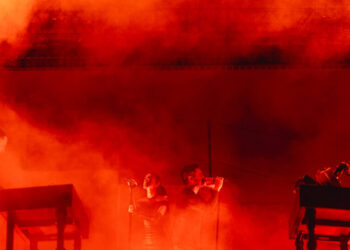
At the end of “Sleepers Awake,” Gregory Spears’s new operatic spin on “Sleeping Beauty,” chorus singers gather to celebrate the fairy tale’s happy couple, who join in with soaring voices. But they’re all so spirited, they exhaust themselves into another mass slumber.
Audience members may feel like they’ve seen this before, just a half-hour ago actually. The story’s climax is an echo of its midpoint, in which everyone onstage drifts back to sleep after a heroic stranger wakes them up. It seems as if the opera has shown two turns of a cycle that could go on forever.
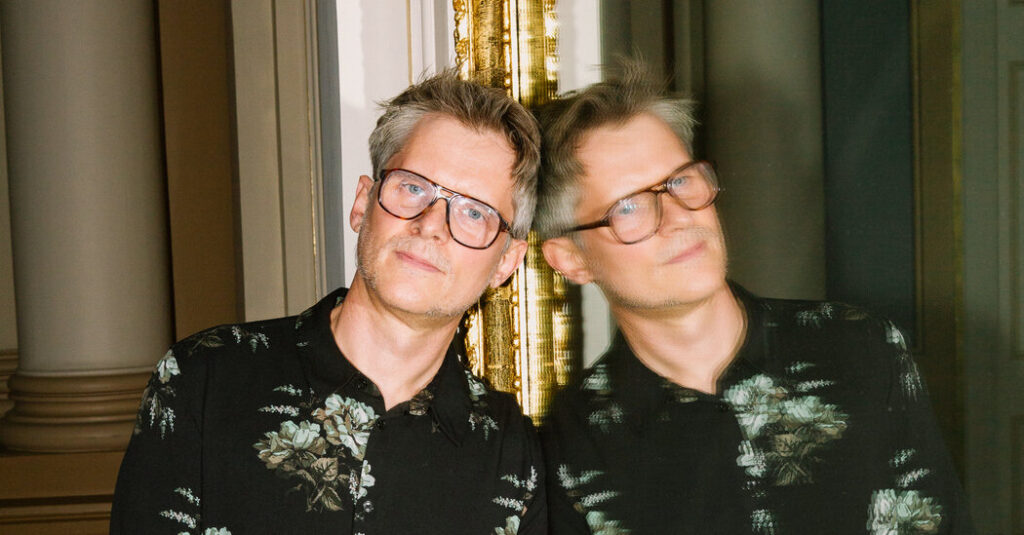
Time is a funny, enigmatic thing in “Sleepers Awake,” and the same could be said about much of Spears’s work. He has dramatized the passage of time but also looped it into sculpture and space. His sound flattens music history into a single plane shared by medieval song, Minimalism and more. Even his remarkably boyish appearance, as he nears 49, seems to defy the norms of time passing.
Still, as the years go by, Spears has steadily carved out a place for himself in American music, with a schedule that speaks for itself. “Sleepers Awake,” which premieres on Wednesday at Opera Philadelphia, follows the recent premiere of another piece, “Secrets,” at the Frick Collection. And the 10th anniversary of his popular adaptation of “Fellow Travelers” is being observed with a national tour that continues this summer at San Diego Opera and the Glimmerglass Festival in Cooperstown, N.Y.
You can trace a direct line from those works to his earliest experiences with music, while growing up in Virginia. As a child learning piano, Spears was fascinated by the way scores, he said in an interview, opened “a whole world that was different from ours.”
“There is something about being able to play a piece of music,” he added, “and feeling like you’re actually recreating some sort of ceremony or ritual from years and years ago.”
When he started to write music as a teenager, he was attracted to the way an abstract art form like this could allow him to express yet conceal himself. Spears described himself as “a weird kid” who was also gay and didn’t want to be judged for it; composing provided an outlet, for both his emotions and his athletic skills at the keyboard.
As he moved on to a prestigious education, first at the Eastman School of Music then in programs at Yale and Princeton, he found himself working to reconcile two incompatible loves: for Gustav Mahler’s profuse, post-Romantic style and for Steve Reich’s time-suspending Minimalism.
“Minimalism is about trying to take a moment and preserve it for eternity, about how to turn a musical moment into space,” Spears said. Mahler has moments of that but is otherwise profoundly different. “So, I was grappling with this contradiction: How could I love these things in the same piece?”
That question has shaped Spears’s artistry, along with a fondness for complexity and mystery. He was also awed, while writing his Requiem (2010), by hearing the voice of Ruth Cunningham, from the quartet Anonymous 4. “It sounds like I’m listening to a 13th-century troubadour singer or a nun, and at the same time it sounds like a synthesizer,” he said. “To me that’s beautiful because it’s deeply mysterious and contradictory and paradoxical.”
Spears’s works could be described in similar terms. A litany in “Secrets” argues for this type of sacred music as an early form of Minimalism. He reconciled Mahler and Reich, so to speak, by just combining them, as in “Sleepers Awake,” which has moments of gorgeous lyricism in voices supported by pulsating rhythms in the orchestra. There is Baroque ornamentation alongside repetitive phrases in Spears’s first full-length opera, a 2013 adaptation of the Willa Cather story “Paul’s Case,” and a clash of troubadour and Puccini-esque melodies in “Fellow Travelers” (2016).
“Fellow Travelers,” with a libretto by Greg Pierce adapted from Thomas Mallon’s novel, recounts the impossible love story of two male federal employees during the McCarthy-era Lavender Scare, a moral panic and purge of queer government workers.
Spears likes to think about how he can take something out of its natural habitat. While composing “Fellow Travelers,” he said, “I was going back to traditions that are, for lack of a better word, heterosexual, like courtly music or a Puccini love duet, and put them in this different context and sensibility.”
The result, Mallon wrote in an email, has made him cry “at some moment” during every production of the opera he has seen.
“The romance between Fuller and Laughlin is necessarily so clandestine and claustrophobic that when they sing to each other — behind locked doors and in considerable danger — their voices seem to explode, as if all this furious energy and emotion that they spend their days tamping down is allowed release,” he said. “There’s a kind of shock to that, and I think it may be something unique to opera, something that the novel or the television adaptation can’t really provide.”
“Fellow Travelers,” which had a long initial run at Cincinnati Opera, may be the most widely performed American opera of the past decade. Its fans include Francesca Zambello, the artistic director of Washington National Opera, who in an interview praised the way Spears uses the orchestra to tell a story.
Zambello had programmed “Fellow Travelers” for this season, bringing a very Washington story home to the Kennedy Center. But days before she announced the revival, Mallon pulled it.
He did not want his work at the Kennedy Center, which had recently become politicized as a cultural arm of the Trump administration. “In hindsight, it wouldn’t have mattered,” Zambello said of Mallon’s push to withdraw the opera. “We ended up leaving, too.” (Now that the company is independent of the center, the production has been scheduled for a future season, she said.)
In the years since “Fellow Travelers,” Spears has expanded his distinctly American brand of opera with the poet Tracy K. Smith, who said his music makes her feel like she’s “in the presence of something enrapturing.” Their first collaboration, “Castor and Patience,” premiered at Cincinnati Opera in 2022; then came “The Righteous” at Santa Fe Opera in 2024; and a third is on the way. So far, these works have contended with immense themes of American history, faith and politics.
“We both have this wish for the way art operates,” Smith said in an interview, “that it invites the listener into a kind of laboratory space where you feel implicated.”
There are ways in which “Sleepers Awake” seems like a swerve. Instead of naturalism it is a fairy tale, with Spears’s own libretto based on a variety of texts, including Robert Walser’s irony-laced treatment of “Sleeping Beauty.” But the opera also builds on Spears’s earlier stage works, mostly experimenting with something new by telling swaths of the story with the chorus, as in an oratorio.
That was intentional, said Corrado Rovaris, Opera Philadelphia’s music director. He saw “The Righteous” and, impressed by Spears’s choral writing, suggested a commission for a choral opera.
“He really knows what he’s doing,” Rovaris said of Spears. “He is an opera lover, and he knows a lot of the repertoire. That makes a huge difference.”
Like a true theater artist, Spears also works closely with the cast. Susanne Burgess, who is singing the cursed-princess role of Thorn Rose, described him as “a dream.” They had video calls about what she could do with her voice, and she demonstrated early music techniques like straight tones and goat vibrato.
In a recent rehearsal, Burgess incorporated those bits of Renaissance and Baroque music into her performance, but in the finale she suddenly sounded like the bel canto star of a Bellini opera. At the same time, the chorus let out rhythmic and punchy lines out of something by Steve Reich. It was as disorienting as anything Spears’s has written.
“For this piece, I wanted to make a fairy tale that we thought was familiar mysterious again,” Spears said. “I like Robert Walser because in his writing, everything is mystified in a playful way. Something that is ordinary like sleep, which is a kind of repetitive ceremony, becomes all the sudden really unusual. Which, I think, is the way it actually is, but we get used to looking at it a different way.”
Joshua Barone is an editor for The Times covering classical music and dance. He also writes criticism about classical music and opera.
The post A Composer Who Loops Musical Time and History appeared first on New York Times.