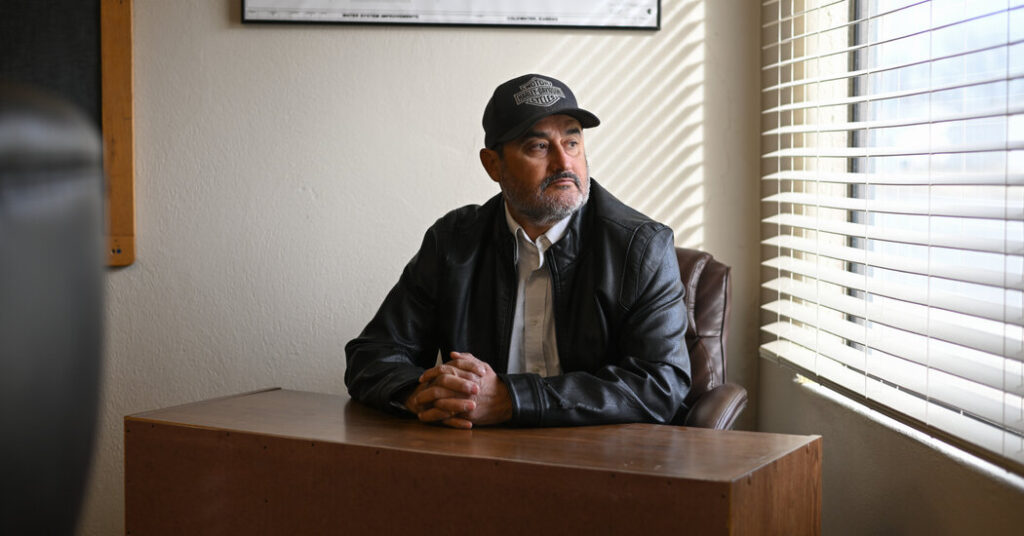
The hearing lasted just five minutes. The defendant pleaded guilty to three misdemeanors. The prosecutor recommended a $2,000 fine with no time in jail. The judge quickly agreed.
But it was no ordinary Monday in Comanche County District Court.
Just a few months ago, that defendant, Joe Ceballos, was the mayor of Coldwater, a speck of Kansas prairie where he had lived for decades, built a career as a utility lineman and raised his family.
Then last November, on the same day that Coldwater voters elected him to another term, Mr. Ceballos was charged in state court with voting illegally as a noncitizen. Within days, he went from a part-time politician unknown outside of his small town to a face of the Republican Party’s national campaign against illegal voting.
After he was charged, Mr. Ceballos, who was born in Mexico and holds a green card, resigned as mayor and admitted to anyone who asked that he had indeed voted in American elections, always choosing Republicans. He said that he did not know he was breaking the law by doing so as a permanent U.S. resident without citizenship.
That defense did not stop the Trump administration from holding Mr. Ceballos, 55, up as an example of election misconduct. The administration pledged to seek to have him deported if he was convicted.
“This alien committed a felony by voting in American elections,” a Department of Homeland Security spokeswoman said in November. “If convicted, he will be placed in removal proceedings.”
But as state and national Republicans drew attention to the case, residents of Coldwater, an overwhelmingly Republican town, rallied to their former mayor’s defense. They described his work to help the community: hanging up American flags on Main Street, stopping by City Hall after work, installing a Christmas tree downtown. As many of them saw it, the voting was an honest misunderstanding that should have been resolved with a slap on the wrist, not with felony charges and deportation threats.
Bright yellow yard signs appeared with a simple message: “PLEASE SUPPORT JOE CEBALLOS!!” The local newspaper lit up with letters and ads attesting to Mr. Ceballos’s contributions in Coldwater. A standing-room-only crowd packed the courthouse for his first appearance in December.
On Monday morning, as sun beamed into the second-floor courtroom, the seats were nearly full again as Mr. Ceballos, dressed in a white shirt and khaki pants, returned to the defendant’s table. This time, the mood in the courthouse was noticeably lighter. Courthouse staff greeted residents. A couple of spectators wore T-shirts from the truck mud runs that Mr. Ceballos organizes in his pasture outside town.
As the hearing started, Mr. Ceballos stood and answered “yes sir” when Judge Sidney R. Thomas asked if he understood the plea agreement and wished to plead guilty to three misdemeanor counts of disorderly election conduct, which carry far lower penalties than the felonies with which Mr. Ceballos had originally been charged. He could have faced years in prison.
A prosecutor from the Kansas attorney general’s office indicated her approval of the plea agreement. Mr. Ceballos’s lawyer, Jess Hoeme, noted that the deal included a suspended jail sentence of six months, which will not require Mr. Ceballos to spend time behind bars.
When Judge Thomas signed off on the deal, the courtroom erupted in applause and a few loud cheers.
“That’s perfectly fine in this court because I do think that’s justice,” Judge Thomas said from the bench as the clapping died down.
After Mr. Ceballos hugged or shook hands with most everyone in the courtroom, he said in an interview that he felt great, like “this is all behind us now.”
Outside the courtroom, Roger Boisseau, a rancher who has known Mr. Ceballos for decades, said the result was “probably as good as you could expect,” though he still questioned the need for any prosecution at all.
“Everybody has to save a little face,” he said.
The Kansas attorney general, Kris W. Kobach, said in a statement after the hearing that “this case demonstrates the very real personal and community consequences of having no citizenship verification” for voters.
Mr. Kobach, a Republican, has long focused on illegal voting and helped elevate the issue to national prominence. He added in his statement that “a plea is in the public’s best interest” in the case against Mr. Ceballos, and that his office “has no role in Mr. Ceballos’s citizenship, residence or deportation proceedings.”
Republicans have focused on individual cases of illegal voting to suggest that the practice is common. Studies have suggested that voter fraud is in fact rare, and that an exceedingly low percentage of ballots are cast by noncitizens. Mr. Ceballos said the federal government learned about his voting when he admitted it as part of an application to become a U.S. citizen.
With his state case resolved, Mr. Ceballos said he hoped to move forward with his life after a difficult few months.
It is unclear whether the federal government will take any action against him. As a permanent resident who is in the United States legally, Mr. Ceballos is on firmer ground than many other immigrants convicted of crimes. But after President Trump won a second term promising to crack down on immigration, his administration has taken a hard line with some people who would likely have been allowed to stay in the past.
Mr. Hoeme, the lawyer, said it was “always a concern” that the federal government might still come after his client. He said he was not aware of any federal criminal investigation into Mr. Ceballos, and that he had not heard from immigration officials about the case.
“It is hard to tell what Homeland Security is thinking sometimes, and so it is a legitimate concern,” Mr. Hoeme said.
Officials with the Department of Homeland Security did not immediately respond to questions about the case on Monday.
Mr. Ceballos said he hoped the plea agreement would allow him to try again to become a United States citizen.
“It would be very important to me, because obviously I would be able to vote,” Mr. Ceballos said of becoming a citizen. “And obviously I would be able to run for office — maybe be mayor again, if the citizens here would allow that.”
Mitch Smith is a Chicago-based national correspondent for The Times, covering the Midwest and Great Plains.
The post Former Kansas Mayor Accused of Illegal Voting Pleads Guilty to Lesser Charges appeared first on New York Times.