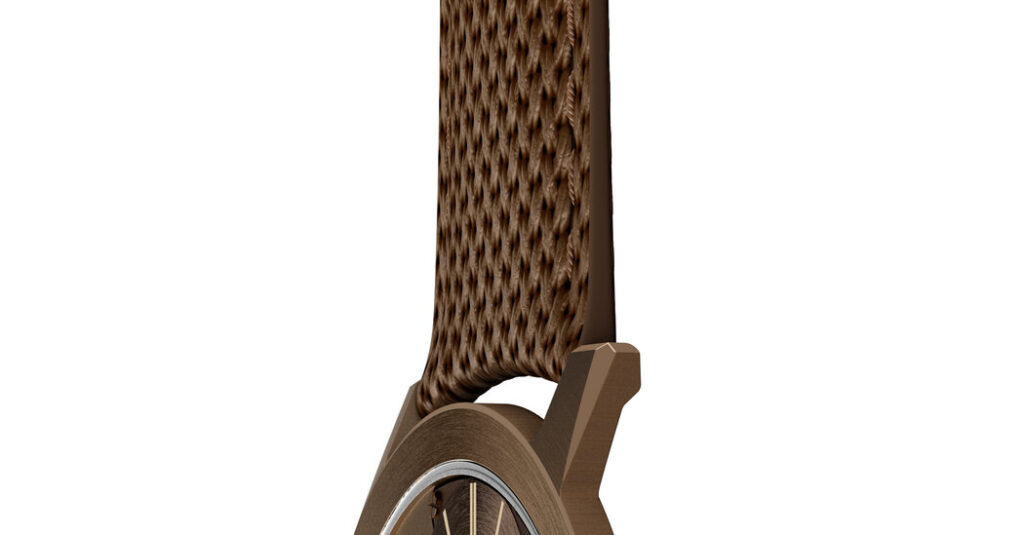
Skeleton watches seemed to take center stage at this year’s Watches and Wonders, with no fewer than three brands unveiling new models, along with a few twists and turns. These new models aren’t just about displaying their inner workings — the show-and-tell approach — but about finding a more specific role for various parts of the watch, thus signaling a shift in the flashy skeleton watch sector.
The skeleton approach has always been about showing off the workings and details, the second-to-second physicality, of a high-end mechanical watch; think of the cogs in a giant clock being brought to life, as in the dystopia of the 1927 film “Metropolis.” Now, new technology is allowing luxury brands not usually associated with skeleton watches to join the parade.
Once the preserve of more traditional brands such as Blancpain and Breguet, the traditional skeleton technique has been seized by brands like Richard Mille and Hublot and turned on its head, as contemporary finishes and materials are used to create more modern timepieces.
Hermès, Piaget and Panerai have also joined the party, unveiling their new skeleton watches in Geneva on April 14.
Hermès
Hermès redesigned its H08 to make the skeleton an integral part of the design, creating an entirely new movement out of titanium (the H1978 S) with the manufacturer Vaucher, adding touches of diamond-like carbon coating and ceramic.
“We didn’t want to make a skeleton watch just for the pleasure of having something open, or transparent. We wanted to go a little further,” Philippe Delhotal, creative director of Hermès watches, said in a recent video interview. “We didn’t just put a skeleton in this H08 watch; this skeleton has a real reason to exist in relation to the graphic story of this watch.”
That story, he explained, was about finding a role for the pieces that make up the skeleton, not merely for the wearer to marvel at the ongoing performance of the watch itself, always on display.
“We are not in the approach, as other brands might be, to having the lightest, thinnest or most delicate skeleton,” Mr. Delhotal said. “We are the opposite of that because, firstly, the H08 is a sporty watch, so we needed a skeleton that was, let’s say, structured and built to the wearing standards of a sports watch.”
The new Hermès H08 Titanium Skeleton is 39 by 42 millimeters and has versions in blue and gray (straps available in five colors), with Arabic numerals, 168 components and 26 jewels. The price is about $23,320.
Piaget
At Piaget, the task of designing a new skeleton watch was about finding the right balance of utility and decoration. Although known for a few skeleton models, such as the Piaget Polo Skeleton, the maison wanted to experiment more with size and weight by peeling away a few layers, revealing the inner workings of the watch.
The result was the Altiplano Ultimate Concept Tourbillon Tiger Eye, a hard stone riff on the two-millimeter hand-wound timepiece, integrating a flying tourbillon within a cobalt alloy case Piaget had released for its 150th anniversary in 2024.
For this year’s model, Piaget added an ultrathin slice of tiger’s-eye ornamental stone, recalling the dials it was famous for in the 1970s. Measuring 41.5 millimeters wide, it’s priced at around $750,000.
“Skeletonization was ultimately used to shave micromillimeters off the thickness of the watch, so it was very much a practical and functional choice,” Rémi Jomard, director of product and innovation at Piaget, said in a recent video interview. “The combination between a special cobalt alloy for the case and ornamental stone for the dial is an unusual play.”
Piaget wanted the tiger’s-eye to be an integral part of the function and the beauty, since a skeleton watch is a combination of both. The crystal is 0.2 millimeters thick, rather than the usual 0.8 found on many watches.
“The thickness of the watch serves a very aesthetic purpose because, in this case, with this new A.U.C., the tiger’s-eye hard stone dial serves to expose the use of hard stone,” Mr. Jomard explained. “The tiger’s-eye hard stone is a very beautiful stone, and skeletonization minimizes the thickness of the case and the dial.”
Panerai
For Panerai, with its new Panerai Luminor 31 Giorni, the idea was to lure the devoted customer while creating a new canvas on which to portray the brand. The new model’s big achievement is a monthlong power reserve; it is framed in 44 millimeters of Panerai’s Goldtech and limited to 200 pieces. It’s priced at $107,000.
By adding 31 days of power through four barrels containing springs of almost 11 feet in total length, the skeleton approach allowed the watch not to take on extra weight.
“As in some other watches we’ve done in the past, the skeletonized version allows you to limit the weight of the movement and therefore the watch,” Jérôme Cavadini, chief operating officer of Panerai, said in a recent interview. “Panerai creates big watches, 44 millimeters average, and therefore it can be seen as sometimes a bit heavy, so the skeleton lightens the feeling on the wrist.”
That lighter feeling, and the chance to always check in on the inner workings of the watch, are signatures of a skeleton.
“Inviting the client to discover what happens inside a watch is also a kind of invitation to be curious and to let him understand how it all works,” Mr. Cavadini added.
“The skeleton drives you through this journey.”
The post With These Watches, It’s Not Just What’s on the Inside That Counts appeared first on New York Times.