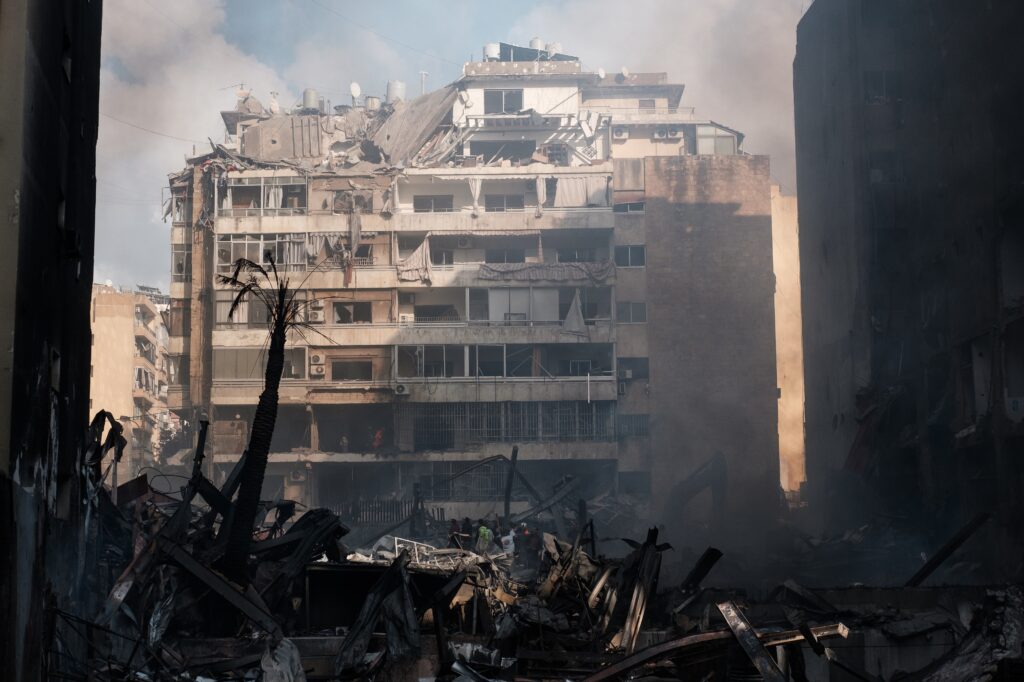
The evacuation warnings came late in the morning on April 8. “Urgent alert to residents of the southern suburbs,” an Israel Defense Forces official wrote on Telegram and X, listing neighborhoods in greater Beirut where military operations against Hezbollah were imminent. “The IDF does not intend to harm you, and therefore, to ensure your safety, you must evacuate immediately.”
A little more than 2½ hours later, the Israeli military began its attack, hitting at least a dozen locations in Beirut’s southern suburbs, according to the Lebanese Civil Defense. But the military also began bombing central Beirut, where there had been no warnings, according to a Washington Post analysis that used videos to map the airstrikes and then compared those locations with the neighborhoods where residents were urged to evacuate. The strikes in central Beirut — some as far as two miles from the southern suburbs — affected at least five neighborhoods, the analysis shows, including the popular commercial area Corniche al-Mazraa.
While 61 people were killed in the southern suburbs, more than 90 people died in central Beirut, according to a preliminary toll from the Lebanese Civil Defense, which did not distinguish between civilians and the Hezbollah militants whom Israel has said it was targeting in the strikes that day.
“There was no warning at all before the strike,” said Abir, 40, the owner of a grocery store in Corniche al-Mazraa, who spoke on the condition that only her first name be used out of fear of reprisal. Two Post reporters who live in central Beirut also said there was no warning.
“There were so many civilian casualties that we could not count. I was saved by a miracle from God,” Abir said.
In response to questions from The Post, the IDF acknowledged striking five of seven sites in central Beirut where videos and photos captured explosions or damage. It said four of those strikes hit Hezbollah targets, including command centers, and a fifth killed Ali Yusuf Harshi, a security adviser to the group’s leader. It said it had no record of strikes at two locations, one of which damaged buildings across the street from the home of the speaker of the Lebanese parliament.
“Some of these targets were deliberately embedded in civilian population areas,” the IDF said in a statement, adding that “strike-specific warnings would have allowed the targets to flee and undermine the operation.” The IDF said warnings were therefore not required under the law of armed conflict. It confirmed that all of its advance warnings are posted to the X account reviewed by The Post.
The IDF said that precautions, including the use of precision munitions, were taken to reduce civilian harm. “The IDF does not target Lebanese civilians,” the statement said.
The strikes were part of a wave of attacks across Lebanon on April 8, the deadliest day in the Israeli war with Hezbollah that began March 2. The Lebanese Ministry of Public Health said the death toll from the strikes that day has risen to 357 people across the country, including at least 110 women, children or elderly people.
The Israeli military has said it struck around 100 targets across the country on military infrastructure and command centers belonging to Hezbollah, the Iranian-backed Shiite militant group that has fought Israel for decades. In its statement to The Post, the IDF said that more than 250 of those killed belonged to Hezbollah.
Prime Minister Benjamin Netanyahu said Thursday that Israel has agreed to a 10-day ceasefire in Lebanon.
The strikes last week in Beirut marked a sharp escalation in the conflict that was then five weeks old. The bombs fell on densely populated areas in central Beirut, some of which had been spared in rounds of Israeli strikes against Hezbollah in recent years. Among those residing in those parts of the city were people who had evacuated the southern suburbs, which have long been under Hezbollah’s sway, or who had been displaced from south Lebanon, The Post has previously reported.
The IDF has repeatedly told people to leave the southern suburbs in recent weeks, and south Lebanon has been under heavy bombardment amid an Israeli ground invasion.
The IDF in recent years has often provided warnings before attacking targets in Lebanon. Leaflets were dropped during Israel’s 2006 war with Hezbollah. Warnings were posted to social media starting in 2024, during the last round of conflict between Israel and Hezbollah. In the past month, the Israeli military issued warnings to evacuate specific buildings in central Beirut in advance of limited strikes on those targets. The strikes on April 8 in the central part of the city were widespread and came without warning.
Beginning around 2:15 p.m. and continuing into the evening, bombs leveled parts of at least two multistory buildings, sending plumes of thick gray smoke into the clear skies, videos showed. According to a visual analysis by The Post and munitions experts, 2,000-pound bombs appear to have been used in at least two strikes, and smaller, more targeted munitions appear to have been used in others.
Workers at the Habib restaurant in the bustling Corniche al-Mazraa were serving customers and cleaning the kitchen when blasts rocked the area. Surveillance video captured at least five explosions in the span of 11 seconds — as people screamed and ran for safety while the business filled with smoke.
Witnesses told The Post that at least five bombs were dropped on a multistory building and parking lot less than 100 feet away. “That moment, we were lost. We could not see each other anymore,” said Imad Hamad, 18, the son of the restaurant’s owner, who was working there that day. “We never, ever expected the area to be struck.”
The IDF said the strike at Corniche al-Mazraa involved an unspecified Hezbollah military target.
Video footage captured a munition as it plummeted to the ground near the restaurant. Weapons analysts who reviewed the video at The Post’s request said the munition appeared to be a 2,000-pound bomb. Another video showed that one of the bombs that hit that location was fitted with a U.S.-made Joint Direct Attack Munition (JDAM), a kit in Israel’s arsenal that equips bombs with precision guidance, according to N.R. Jenzen-Jones, the director of Armament Research Services.
It exploded next to an Al Rifai, a popular confectionery chain that sells nuts and dried fruit. Visuals of the aftermath showed burned-out frames of vehicles amid mounds of concrete rubble. A part of a building’s roof had collapsed. The destruction stretched for about a city block in length, and thick smoke darkened the sky.
The strike killed an Al Rifai employee named Nader Khalil, 52, who had previously evacuated from the southern suburbs.
“In March, when the war emerged, my mother, brother and I fled from Bourj el-Barajneh in the southern suburbs of Beirut to this area [central Beirut], as it is safe,” said Nadim Khalil, 51, Nader’s brother. “Everyone liked [my brother], even the policemen at the corner of the street were his friends.”
A doorman who worked at a business nearby said it took four hours after the attacks for rescue workers to retrieve Khalil’s body. The doorman, who spoke on the condition of anonymity out of fear of retaliation, told The Post that the parking lot had been used to distribute aid products that were stored in underground floors, though he and another witness said there were rumors of Hezbollah fighters and weapons in the area.
Nadim Khalil said he and his mother plan to move even farther north to the city of Tripoli after his bother’s funeral. “We think it is safe there, hopefully,” he said. “It is our second displacement.”
Kamel Ismail, 36, said he was in Corniche al-Mazraa near the Al Rifai in his car when the first strike hit. “I remember the first strike. I was still upright,” Ismail said. “Then the second one came, and I ducked below the steering wheel.”
“By the fourth boom, I surrendered myself to God,” he said. Ismail suffered injuries to his hand from car glass, and the person in the car in front of him was killed in the blast, he told The Post.
A block from the Corniche al-Mazraa strike, 13-year-oldNaya Fakih was filming a Snapchat video, a heart-filled puppy filter over her face, while walking home from basketball practice with her father. Her video captured her father noticing something in the sky.
“What’s that?” he asked, followed by the sound of a half-dozen blasts as they ran into an open lobby to take cover.
Naya’s mother, Ghida Margie Fakih, told The Post that Naya and her father stayed there for a minute longer before they ran in the opposite direction of the strikes for safety.
“They were hearing strikes everywhere,” Fakih said. She said the attack shook the walls of their home, where her other children were at home with their nanny. Fakih said they received no warnings.
In Beirut’s upscale Tallet el-Khayat neighborhood, video shows the remains of an apartment building collapsed onto a street and smoke filling the air after an Israeli airstrike that evening. A portion of the 10-floor building was sheared off, each story flattened on top of another. The predominantly Sunni Muslim neighborhood had been spared Israeli strikes in the 2024 war. The IDF said Harshi, the adviser to Hezbollah’s leader, was killed in this strike.
The strike came within 100 feet of west Beirut’s only water reservoir.
Rahul Udoshi, an air-launched weapons senior analyst from the security intelligence firm Janes who reviewed video of the attack’s aftermath, said the damage was characteristic of a precision-guided munition, likely a 2,000-pound bomb.
The building was home to Khartoun Ibrahim Salma, a Lebanese poet, and her husband, Mohamad Fadel Kharshat, an engineer. Their daughter, Ghida Kharshat, said she was too shaken to say much. “I lost them,” she said. “What could I ever say?”
Time-stamped videofrom security cameras at a building across the street from the home of Parliament Speaker Nabih Berri showed multiple, near-simultaneous explosions at 2:15 p.m. just as the coordinated Israeli strikes began. Berri, the head of the Hezbollah-allied Amal Movement and the main intermediary between the U.S. and Hezbollah, was not injured.
Udoshi said video of the explosions and aftermath showed the effects of what was likely a small-diameter bomb. These bombs generally weigh about 250 pounds and have a smaller explosive payload that is intended to reduce collateral damage. A small-diameter bomb was also probably used at a site a mile northwest, he said, which the IDF told The Post was a Hezbollah command center.
The IDF said it had no record of the strike near Berri’s house and another site, an oceanfront residential building that was partially destroyed.
Amaël Kotlarski, who leads the weapons team at Janes, reviewed video of the strike near Berri’s house and a photo of the aftermath of the second site. “Whilst we can’t say for sure what weapon was used to inflict the damage, the only plausible explanation is via the use of airdropped munitions,” Kotlarski said.
The day after the strikes, Lebanon’s cabinet voted to submit a complaint to the United Nations Security Council. In the letter, the government wrote that the strikes targeted densely populated residential areas during peak hours and without prior warning. There were “hundreds of casualties, the majority of whom were unarmed civilians,” the letter read.
Ismail, who survived the Corniche al-Mazraa strike, said the two pastry shops he operated, one near the Al Rifai store and the other in a neighborhood called Mar Elias, were both affected.
“I feel like I saw death in my eyes,” he said. “It’s hard to see everything you built in your life destroyed in minutes.”
Lee reported from Washington, El Chamaa and Haidamous from Beirut, Oakford from New York and Piper from London. Meg Kelly contributed to this report.
The post Israel told people to evacuate Beirut’s southern suburbs — then hit city’s center appeared first on Washington Post.