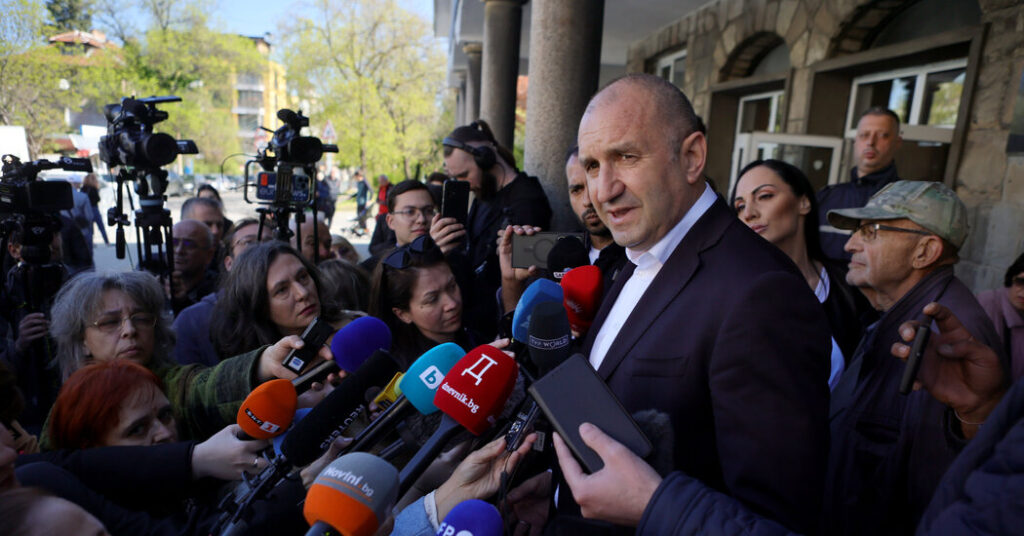
A runaway victory in Bulgaria’s election by a former president, Rumen Radev, has given the country its best chance in recent history to do away with the stranglehold of corruption and the weak, unstable governments that have plagued it for decades.
The size of the win in Sunday’s voting by his coalition, Progressive Bulgaria, was much bigger than projected and will allow Mr. Radev to form a government quickly, with his coalition having secured a majority of seats in Parliament, official results showed Monday.
The election for a new Parliament came four months after mass protests over economic mismanagement and corruption filled the streets of Sofia and forced the previous government to resign. The protesters largely got what they wanted in these elections, delivering a drubbing to the parties that previously held power.
The strong result offers Mr. Radev the opportunity, if he combines efforts with a liberal alliance of parties that came in third, to enact structural and constitutional reforms to tackle the corruption that has stymied Bulgaria’s institutions.
Yet many Bulgarians, weary of promises from previous governments to tackle corruption, were holding judgment. Mr. Radev’s campaign financing was far from transparent, said Anna Budakov, 23, a prominent activist and candidate for the We Continue the Change alliance. “Let’s see what he does,” she said.
Official results from the Central Election Commission showed that Progressive Bulgaria won with more than 44 percent of the vote and 130 seats in Parliament. An alliance of liberal parties, We Continue the Change-Democratic Bulgaria, came in third, with 12 percent and 37 seats.
Mr. Radev’s surge to power, after forming his coalition only one month ago, reflected the anger of voters against the political partnership that had dominated politics for the last decade.
His rivals — a former prime minister, Boyko Borissov, and a former media mogul turned politician, Delyan Peevski — received a reduced vote at the polls. Both men have been accused by their opponents of overseeing a failing economy amid rampant corruption.
The Bulgarian Socialist Party, the successor of the old Communist Party, failed to reach the 4 percent threshold and for the first time since Soviet times will not be represented in Parliament. An ultranationalist pro-Russian party, Revival, did win a place in Parliament.
The extent of Mr. Radev’s win has concerned some in Bulgaria and beyond, because of his perceived pro-Russian and Euroskeptic stance on many issues.
A 62-year-old former fighter pilot and former Commander of the Bulgarian Air Force, Mr. Radev has supported dialogue with Russia and a continuation of energy projects with the country. He opposed military assistance to Ukraine.
President Aleksandar Vucic of Serbia was among the first to congratulate him on his win. The Kremlin spokesman, Dmitri S. Peskov, said Moscow was encouraged by Mr. Radev’s victory and his call for dialogue with Russia.
But some analysts said Mr. Radev’s past positioning on Russia and during the campaign had been a calculated balancing act to draw support from voters from all sides. Analysts also said that in the largely ceremonial position as president, to which he was elected twice, he did not have make executive decisions. Once he holds executive power, he will have to clarify his positions.
Vessela Tcherneva, deputy director at the European Council on Foreign Relations, said that Mr. Radev would be unlikely to seek to be disruptive in relations within the European Union like Viktor Orban, the prime minister of Hungary, who was himself soundly defeated in elections on April 12.
“After Orban’s defeat in the Hungarian elections, Radev would have no anchor around the European Council table to present a blocking factor,” she said in a statement. “In the coming economic crisis, he would not risk the freezing of E.U. funds.”
Maria Simeonova of the Sofia bureau of the European Council on Foreign Relations added that Mr. Radev’s Euroskeptic speech was aimed more for people at home.
“His criticism, particularly regarding financial and military support for Ukraine or sanctions against Russia, will be aimed primarily at the domestic audience,” she said.
In his first comments to journalists Sunday night, he showed his ability to be pro-Europe while making a sideswipe to register some skepticism.
“Bulgaria will pay efforts to continue its European part,” Mr. Radev said in English, while adding, “Europe has fallen a victim to its own ambition to be a moral leader in a world without results.”
His critics among opposition politicians said the test would be in his actions.
“He is the uncontested winner — he can form a government on his own and do what he wants,” said Velislav Velichkov, founder of the Justice for All Initiative, a nongovernmental group working against corruption in the judiciary in Bulgaria.
Mr. Velichkov, who has long campaigned for judicial reform and ran for Parliament with the We Continue the Change-Democratic Bulgaria alliance, said there was a possibility the two groups could combine to bring far-reaching reforms, particularly to the judiciary.
He hoped those conversations could “start in coming days,” he said, “so that we can fast-track whatever we are planning to do in terms of reform.”
Boryana Dzhambazova contributed reporting.
Carlotta Gall is a senior correspondent, covering the war in Ukraine.
The post A Decisive Win Raises Bulgarians’ Hopes for Change appeared first on New York Times.