At the end of Paul Thomas Anderson’s 2007 movie, There Will Be Blood, Daniel Day-Lewis’s oil-baron character, old now and richer than Croesus, beats Paul Dano’s preacher to death with a bowling pin. Dano’s Eli Sunday, a nemesis of Day-Lewis’s Daniel Plainview during his seminal, wealth-building years, has come to sell Plainview the oil-rich land that he once coveted. But Plainview doesn’t need the land anymore, because—as he explains in one of the most famous monologues in modern cinema—he has sucked out all the oil hidden beneath it from an adjoining property, like a milkshake.
Desperate for money, Eli begs for a loan. Instead, Plainview chases him around a bowling alley and murders him with great enthusiasm. Once it’s over, a butler comes to see what all the noise was about. “I’m finished,” Plainview yells.
No matter how many times I watch that movie, and I watch it a lot, I have never once taken those words to mean I’m done for. There will now be consequences for my actions. Quite the opposite: They mean that Plainview has completed his journey, through the acquisition of wealth and power, to a realm outside the moral universe. He’s finished, in other words, pretending that the rules of human society apply to him.
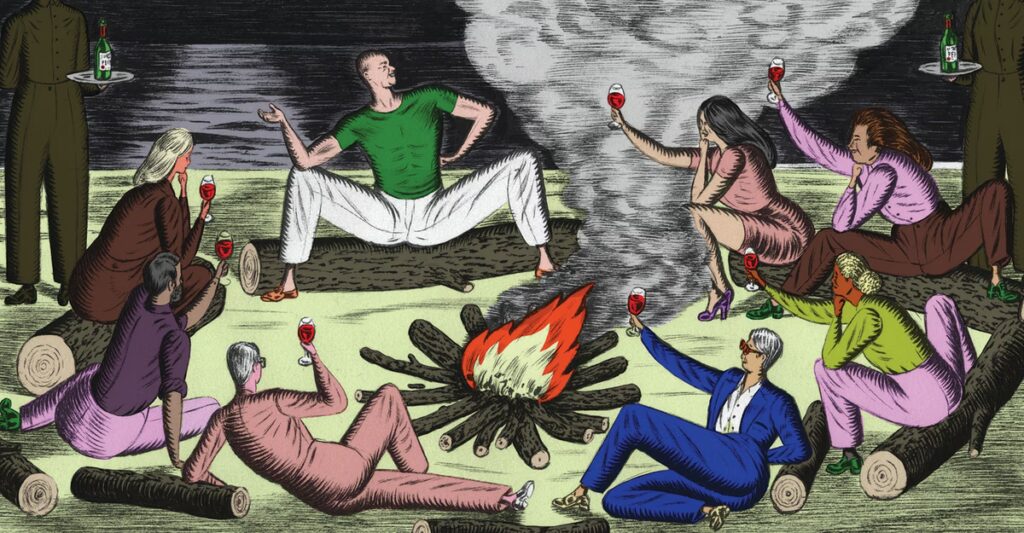
In 2018, I was a guest at Jeff Bezos’s Campfire retreat in Santa Barbara, California. It’s an annual event in which the Amazon founder invites 80-plus guests—celebrities, artists, intellectuals, and anyone else he thinks is interesting—to spend three nights at a private resort. I had recently been approached by Amazon about moving my film-and-television business over from Disney, and although I had declined (or maybe because I had declined), Bezos’s team invited me to Campfire, perhaps keen to impress me with the power of his reach.
[From the March 2024 issue: The rise of techno-authoritarianism]
On a warm October Thursday, a fleet of private jets was dispatched to airports in Van Nuys and New York to shepherd guests to Santa Barbara in style. At that point I had only a vague sense of who else was coming—famous people, rich people, influential people, and me. A guest list, I was told, would be given to us once we arrived. Families were invited; an on-site nanny would be provided for each child.
So my wife and I got our two children from Austin to Los Angeles and took a 45-minute jet ride north, with a television mogul and a comedian on board. Bezos had bought out the entire Biltmore resort for the weekend, as well as the beach club across the street. He had brought in a security firm from Las Vegas to ensure our safety and privacy. Even the weather felt expensive, and when we were shown to our rooms, the designer gift bags we found were filled with luxury goods.
[Alexandra Petri: The 10 things the Bezoses are almost certainly grateful for each morning]
Each morning, we gathered in a lecture hall to hear presentations. If you’ve ever seen a TED Talk, you understand the format. The year I went, a sitting Supreme Court justice was interviewed, and a neurologist talked about technological advances in prosthetics. In the afternoons and evenings, we were encouraged to exchange ideas over drinks and four-course meals, with no set purpose—to network, in other words, with some of the most rarefied talent on Earth. The most common question I heard was “Why am I here?”
“Why am I here?” asked the 1980s hair-metal singer. “Why am I here?” asked the Pulitzer Prize–winning novelist, the famous anthropologist, the presidential historian. Only the movie stars and the billionaires didn’t ask: They had done this kind of thing before. It turns out there is a circuit of idea festivals. Many tech billionaires host one, and if you find yourself on the right list, you can spend much of the year traveling the world, eating Wagyu, and discussing how to make the world a better place with the most famous talk-show host in history.
That’s how the weekend started. Here’s how it ended: My wife broke her wrist slipping on wet grass, and both children and I came down with hand, foot, and mouth disease. This is not a joke. One of us went home with her arm in a sling; the other three developed itchy, painful red blisters all over our faces and extremities. If you’re looking for a sign from God as to whether hanging out with the richest man on Earth is right for you, pay attention when he sends you not one plague, but two. Suffice it to say we have never been back to Campfire, nor have we ever been invited.
At drinks on the second night, the head of a major talent agency asked me what I thought of the weekend. I said, “I’ve spent my whole career trying to figure out how the world works. I didn’t realize I could just come here and ask the people who ran it.” On some level I was kidding. The lead singer of an alt-country band didn’t run the world, nor did a noted author who would later be accused of impropriety. But finding myself at that resort by exclusive invitation, I now knew exactly what people meant when they talked about the elite.
Sitting in the lecture hall, pencils out, listening to a famous chef explain his humanitarian work, it was easy to feel like the solution to the world’s problems lay within our grasp. And yet, looking around at faces I had only ever seen in a magazine or on-screen, I had an unsettling revelation: This is the hubris of accomplishment. To be declared a genius at one thing is to begin to believe you are a genius at everything.
Here we were, 80 individuals with a combined net worth that was greater than a small city’s yet infinitesimal compared with the wealth and dominion of our host. How did he view this exercise—as a first step toward changing the world, or as a performative display of his reach and influence?
Bezos was everywhere that weekend—in a tight T-shirt, laughing too loudly, arms thrown around his teenage sons. He had recently become the world’s second centibillionaire, his net worth hovering somewhere around $112 billion, about half of what it is today. That number, previously unimaginable, had made him unique on a planet of 8 billion people, and you could feel it in the room. Even the richest and most famous among us were drawn to the energy of this impossible wealth.
[Martin Baron: Where Jeff Bezos went wrong with The Washington Post]
Though we didn’t know it at the time, Bezos’s first marriage would be over a few weeks later. My defining impression of his wife that weekend was sadness, even though Bezos made a big show of performing the role of family man. In hindsight, it is that performance that sticks with me. The Jeff Bezos of 2018 acted as if he still believed that people’s impression of him mattered, that his financial and social value could be affected by negative publicity. He still believed that his actions had consequences. He had not yet freed himself—the way Daniel Plainview freed himself—from the rules of men.
Eight years later, Bezos and two of the world’s other richest men—Mark Zuckerberg and Elon Musk—have clearly left the world of consequences behind. They float in a sensory-deprivation tank the size of the planet, in which their actions are only ever judged by themselves.
The closer I’ve gotten to the world of wealth, the more I understand that being truly rich doesn’t mean amassing enough money to afford superyachts, private jets, or a million acres of land. It means that everything becomes effectively free. Any asset can be acquired but nothing can ever be lost, because for soon-to-be trillionaires, no level of loss could significantly change their global standing or personal power. For them, the word failure has ceased to mean anything.
[Adam Serwer: How America chose not to hold the powerful to account]
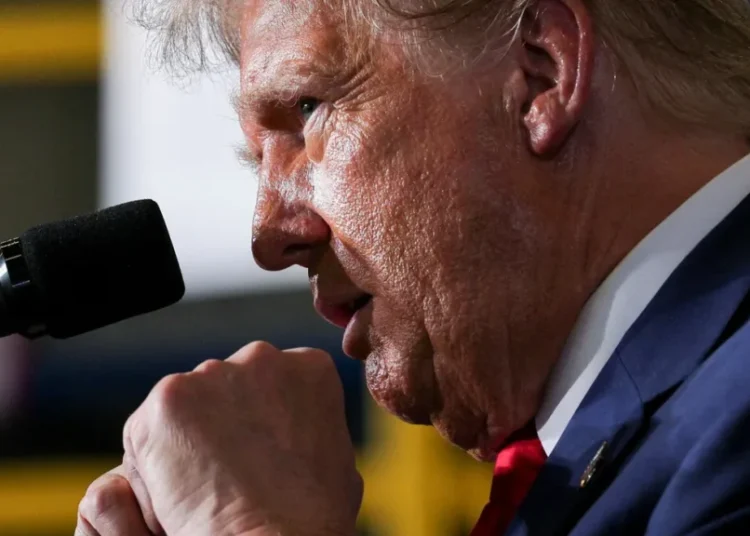
This sense of invulnerability has deep psychological ramifications. If everything is free and nothing matters, then the world and other people exist only to be acted upon, if they are acknowledged at all. This is different from classic narcissism, in which a grandiose but fragile self-image can mask deep insecurity. What I’m talking about is a self-definition in which the individual grows to the size of the universe, and the universe vanishes. Asked recently if there is any check on his power, President Trump—himself a billionaire, and by far the richest president in American history—said, “Yeah, there is one thing. My own morality. My own mind. It’s the only thing that can stop me.” Not domestic or international law, not the will of the voters, not God or the centuries-old morality of civic and religious life.
Decades of research in developmental psychology have shown that moral reasoning develops through consequences—not punishment, necessarily, but experiencing the effects of your actions on others, receiving honest feedback, having to accommodate reality as it actually is rather than as you wish it to be. It’s not that the wealthy become evil; it’s that their environment stops teaching them the things that nonwealthy people are forced to learn simply by living in a world that pushes back. When you can buy your way out of any mistake, when you can fire anyone who disagrees with you, when your social circle consists entirely of people who need something from you, the basic mechanism by which humans learn that other people are real goes dark.
[Thomas Chatterton Williams: The very powerful men who think introspection is dumb]
When Peter Thiel said, “I no longer believe that freedom and democracy are compatible,” he wasn’t talking about your freedom. He was talking about his own. You don’t exist. When Musk took a chainsaw to the federal government as part of the inside joke he called DOGE, he did so with the air of a man who believed that nothing matters—poverty, chaos, human suffering. He was having fun. It didn’t even matter that the entire destructive exercise ultimately yielded no practical financial gains. For him, the outcome was a foregone conclusion: He could only win, because losing had lost its meaning.
Since the 2024 election, there has been a philosophical shift on the right, and especially among tech billionaires, to vilify the idea of empathy. Musk has called empathy “the fundamental weakness of Western civilization.” He sees it as a weapon wielded by liberal society to bludgeon otherwise rational people into operating against their own interests. Empathy is something done to you by others—a vulnerability they exploit, a back door through which they gain access to your resources and will. This rejection of empathy as a human value gives cover to people who don’t want to feel anything at all. If empathy is the problem, then lack of it isn’t a deficiency—it’s an advantage.
[Elizabeth Bruenig: The conservative attack on empathy]
I finally met Bezos on the last day of Campfire, at lunch, after my wife had broken her wrist. I went over to thank him for having us, and he asked how our Campfire experience had been. I told him that it was great, but that unfortunately my wife had broken her wrist that morning when she slipped on the wet grass while kicking a ball with our 6-year-old son.
The night before, we’d all stood by the pool at the beach club watching a cadre of synchronized swimmers execute a flawless water routine. I had spoken with a famous novelist, who said, “I just don’t understand why I’m here.” A famous rock star was about to start an acoustic set. The famous chef had made paella. Somewhere deep under my skin, a brutal pox was beginning to form.
The next morning, my wife fell, and I found myself in a black SUV with a team of private-security contractors, who whisked us to the back entrance of a Santa Barbara emergency room, where she was seen and treated right away. We made it back in time to watch the Supreme Court justice Zoom in from Washington, D.C.
How was your Campfire? Bezos asked me an hour later, and because I am an honest person, and because I have been a host myself, I decided he would want to know that there had been a problem, but that his team had reacted quickly and been extremely helpful. To be clear, I was in no way blaming him, nor was I shaking down the richest man on Earth. Instead, I was simply offering Bezos, also a husband and father, a brief human connection.
But when I told him what had happened, Bezos looked horrified. He did not say “I’m so sorry.” He did not say “Do you need anything?” Instead, he made a face, and in an instant, an aide came and whisked him away. When presented with the opportunity for empathy, even performative empathy, he chose escape.
A few hours later, on the private plane home, a famous movie producer offered my wife a blanket. My children’s faces were covered in spots. Under my fingernails, red welts were beginning to rise.
The world has always been run by rich men. The robber barons of the Gilded Age were known for their ruthlessness in the accumulation of wealth—hiring Pinkertons to shoot striking unionists. But they directly engaged with the world around them, using their wealth and power to muscle it into its most profitable form. And although today’s billionaires are clearly manipulating society to maximize their own profit, something else is also happening—a disassociation from the reality of cause and effect, from meaning and history. These men no longer feel the need to change the world in order to succeed, because their success is guaranteed, no matter what happens to the rest of us.
“I’m finished,” yells Daniel Plainview, perched happily on the polished floor of his own celestial kingdom. Though he has just committed a crime, he has never felt so free.
This article appears in the May 2026 print edition with the headline “Everything Is Free and Nothing Matters.”
The post What I Learned About Billionaires at Jeff Bezos’s Private Retreat appeared first on The Atlantic.