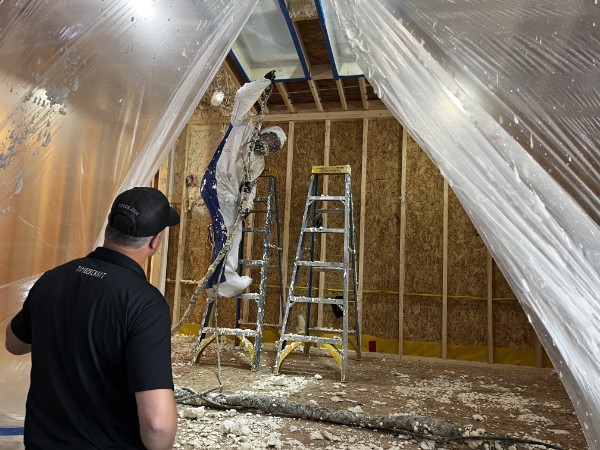
GUNTERSVILLE, Ala. — Inside the warehouse, the construction workers at Timbercraft Tiny Homes finish building a new house every eight days.
The houses are all under 400 square feet, some with a loft for more living space. They roll out fully equipped — with refrigerators and dishwashers and air conditioning, cabinets and fireplaces and porches — ready for people to live in them.
“Factory-built homes are the way of the future,” Timbercraft owner Doug Schroeder said. “I think in the next 10 years, you’re going to see a lot more mobile and modular options. Site-built is kind of going to be old-fashioned.”
As Schroeder walked the factory floor on a recent morning, a team of workers lifted the wooden frame of a roof high into the air and settled it into place. Nearby, employees were affixing trim, spraying foam insulation and painting the walls of other tiny houses.
Schroeder, like many tiny home advocates, believes these structures can help address America’s affordable housing shortage.
Tiny homes generally go for between $100,000 and $200,000, while the median price of all U.S. homes has climbed above $400,000. Small prefab homes can make ownership possible for young adults just starting out. They can also provide an option for seniors who want to downsize, live near their grandchildren or budget for a fixed retirement income.
These small-footprint houses have relatively low climate impact. And companies like Timbercraft have been figuring out how to make them sturdier and more efficient.
But although they have been trendy for years, with HGTV dedicating five different shows to the subject, tiny homes remain something of a curiosity.
So Schroeder is trying a new tactic to help them go mainstream: building not just the house, but the whole neighborhood.
The problem, he explains, is that even if you can build a house, you can’t legally put it in many places.
Most towns’ and cities’ zoning codes won’t allow for a miniature factory-built home, especially if it’s on wheels. Some jurisdictions require new-home inspections at several points during construction — a foundation inspection, framing inspection, mechanical inspection — and won’t approve a fully built house delivered from a factory. Others have specific codes — like 12 inches of insulation — that tiny homes can’t meet.
Schroeder recalls a customer in Upstate New York who ended up having to resell his tiny home once he realized he couldn’t legally live in it since its three-inch foam insulation and other elements didn’t meet local codes.
“I can’t tell you how many tiny home sales we could have and have lost because of a place to put them. Having that is a game changer,” Schroeder said.
Two miles from the company’s factory, Timbercraft bought a former RV park. The site was preapproved to host homes that are small and mobile. As a huge cost-saver, it had an existing water main.
Right now, the property is just an empty field of grass, with one solitary tiny house and a sweeping view of Alabama’s largest lake.
But when Schroeder shows prospective buyers around, he points out all he plans to build: the community pickleball court here, the dog park there.
The first house was designed to show off what can be packed in — heated floors in the bathroom, a built-in sound system on the porch, a gas fireplace in the living room. That model, the largest house built by the company at about 600 square feet including a loft, sells for $196,000.
Once the neighborhood of two dozen tiny homes is up and running, Schroeder plans to charge under $800 in rent each month for each lot. He hopes young professionals who work in fast-growing Huntsville, a 30-minute drive away, might choose a tiny home over Guntersville’s half-a-million-dollar condos.
Schroeder acknowledged that lenders have been reluctant to offer mortgages for tiny homes, which takes prefab houses out of the realm of affordability for some. But he found a local bank that will work with people who can put 20 percent down, so the homes don’t have to be sold only to buyers who can pay in cash.
His goal is that someone eventually will buy the whole neighborhood from him as a profitable investment, with rental income bringing in more than $150,000 a year. He envisions developers all over the country building similar tiny house communities.
Schroeder is the kind of businessman brimming with ideas — he also runs a four-cabin getaway resort in Guntersville, and has plans to sell look-alike vacation cottages to other developers who will run resorts around the country under his branding.
If other developers want to build their own tiny home neighborhoods, he’ll sell them the houses. “I really want to get into building communities and resorts, more than individual homes,” he said. “I think it’s going to be easier to go through the zoning for a tiny home community than it would be to get legalization for one or two of these. … You’re basically putting in an upscale RV park. And there’s zoning for that.”
Jonathan Palley, who founded Clever Tiny Homes and is on the board of the Tiny Home Industry Association, noted that the places that allow tiny homes don’t tend to be located near major cities. Many younger buyers who would like a tiny house as their starter home envision fitting it into a city landscape. They’re deterred when they realize they can’t live near work.
“Sometimes I’m killing people’s dreams,” Palley said. “The way we design cities, it’s just not something that we have zoning for. … It’s a great form of housing solution that we’d love to see, and would do a lot for younger generations in urban job centers. But it’s hard to get those developed.”
As a result, most tiny home buyers are seniors, according to several people in the industry. They often want to move into a one-story house as they age, and want a place that will be easier to clean and maintain.
Designated tiny home neighborhoods and clusters that cater to these residents are scarce.
It’s the kind of community-oriented place that Renee Powers, 67, was searching for as she started thinking about retiring from her job in construction.
She wanted to stay in California, and full-size houses weren’t within her retirement budget. So she contacted two tiny home builders homes to inquire about buying one. When they both told her they might raise their prices soon because of new tariffs on construction materials, she decided to just go ahead and purchase.
“It was really scary to spend over $100,000 on something and not actually have a place to put it,” she said.
She ended up moving it into an RV park, which she worried would be more transient than she wanted. But the owners are in the process of converting it to a tiny home neighborhood.
The post He builds affordable tiny houses. The problem is where to put them. appeared first on Washington Post.