Johnson Masase discovered long ago that when you’re a dwarf, people tend to laugh at just about anything you do: when you run, when you jump, when you dance. And, certainly, when you emerge — as he did in January — from a black hatchback sporting a schoolgirl’s dress, a loose tie and thick-framed glasses.
It was a back-to-school themed party for adults in a village about two hours north of Botswana’s capital, Gaborone, and Mr. Masase was there with his three-man dance crew as the hired entertainment.
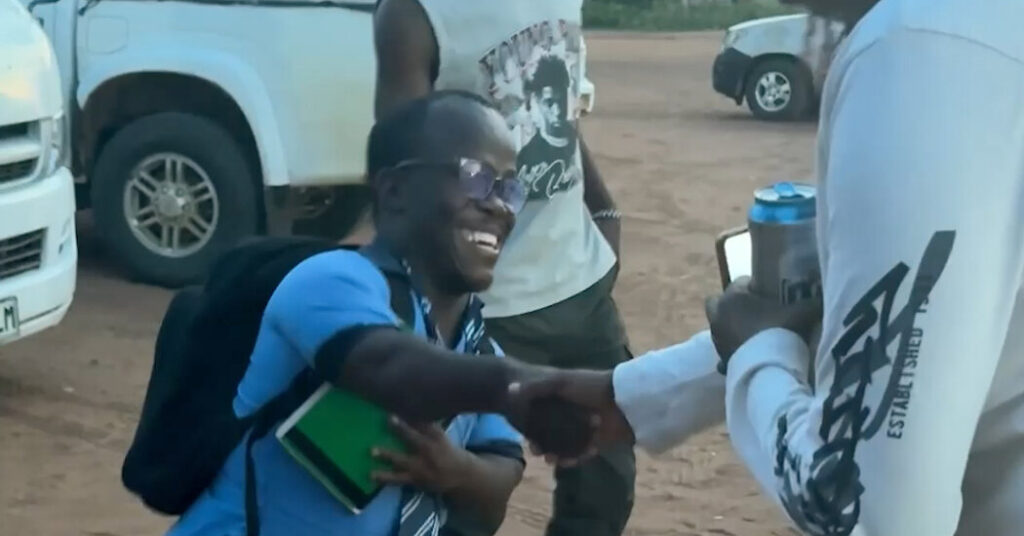
He ambled across a dirt lot outside a bar where a few dozen revelers — already several drinks in — greeted him with glee. They pulled him in close for pictures and squealed like schoolchildren when he wiggled his hips and dipped to the ground to a soundtrack of local music known as house kwasa.
There’s a fine line between making people laugh and allowing them to mock your genetic condition that causes a short stature and, in some cases, body parts to grow disproportionately. Mr. Masase, 38, has made a name for himself by pushing that boundary. He has evolved into a social media star in recent years with comedy that is crude, self-deprecating and, to him, liberating.
“For me, it’s always an opportunity to teach people about dwarfism,” he said. “I make comedy from their ignorance, and they love it in the end.”
Known better as Mojoni (a play off Johnson) or Six Six (a play off another comedian named Seven Seven), Mr. Masase has amassed nearly a quarter million followers on Facebook. His short video skits include him jumping in a futile effort to reach clothes hanging from a clothesline; another dwarf getting on his shoulders to try to screw in a lightbulb; and joking that while God may have “denied us height, he gave us something down here,” gesturing between his legs.
To Mr. Masase, he is not selling out his dignity for laughs; he says he’s educating people. He knows people stare and wonder all sorts of things about how he operates in his 3-foot-4-inch frame. So why not tackle the stereotypes head on? And by doing so, demystify what it’s like to live with dwarfism, which by some estimates occurs in one in every roughly 21,000 births worldwide.
“I decided that I’m at peace with myself and my dwarfism a long time ago,” he said. “No one has the power to steal my peace.”
Other dwarfs in Botswana say they appreciate what Mr. Masase is doing.
The more visible he is online and in popular culture, the more people in Botswana will feel like they know dwarfs and the more unremarkable it becomes when they see them in the flesh.
“He makes dwarfism trendy,” said Gaolaolelwe Phalalo, a dwarfism activist in Botswana.
Mr. Masase was born and raised in Serowe, a town about four hours north of Gaborone, at a time when discrimination against dwarfs was so vicious they could barely participate in everyday social settings.
Things have improved, with Botswana having passed laws to protect persons with disabilities from discrimination. Still, dwarfs and human rights organizations say those laws are not always enforced.
Social stigmas persist in Botswana, as they do elsewhere.
People still sometimes dismiss dwarfs as unintelligent, stare at them like a sideshow figure and view their condition as something of a spiritual curse. Female dwarfs say some men fetishize them. Although job discrimination is outlawed, dwarfs say they sometimes have to go the extra mile to prove they are capable of performing a job.
Raised by his grandmother, Mr. Masase said he was treated with love at home and told he could do anything in life. But the insults from outsiders stung.
When he was a little child, “he was afraid of people,” said his grandmother, Monica Masase, adding that he would hide when he saw people coming. “When people stared at him, he would look at them with an angry expression.”
Mr. Masase started shedding that self-consciousness as he grew older, he said, and the outside world began seeing his confidence a little more than a decade ago when he got into entertainment as a dancer and singer. He started getting paid for performances, though not a lot.
Some of his friends in the music industry encouraged him to try comedy because he was always cracking jokes. And so he got his start as a comedian about two years ago by posting videos online.
Although he is trying to squash stereotypes through laughter, Mr. Masase still has to confront them in his own life.
When his second child was born five years ago, the mother, who does not have dwarfism, could not accept that the baby girl was a dwarf. So one day, when the child was 3 months old, the mother dropped her off at Mr. Masase’s home and never returned.
“Initially, it was painful,” he said. “I got to see this can happen to any one of us little people.”
Mr. Masase has two other children — an 11-year-old boy and 3-year-old girl — who are also dwarfs. Their mothers are not.
Mr. Masase met his current partner, Tiroyamodimo Molepo, the mother of his youngest child, at a mall.
Ms. Molepo said she recognized him because of his social media celebrity and had no problem with his dwarfism because her cousin is a dwarf. Her loved ones tried to dissuade her from dating him, though, questioning how she would go out with him in public and how they would kiss, she said.
“He has a good heart and he loves me so much,” she said.
These days, Mr. Masase is getting plenty of love all around.
As he strolled up to a shopping center near his home in Serowe, bystanders recognized him amid the busy foot traffic. A 5-year-old girl rushed over to meet him — her mother said she watches his videos all the time.
A few sidewalk vendors shouted his name: “Six Six!”
“Our president,” one of them said.
“He’s a breath of fresh air,” said another.
For Mr. Masase, it was confirmation he’d been dealt a good hand in life.
“I think it’s an advantage for me,” he said. “I would rather be a dwarf. Others wish they were me.”
John Eligon is the Johannesburg bureau chief for The Times, covering a wide range of events and trends that influence and shape the lives of ordinary people across southern Africa.
The post ‘I Would Rather Be a Dwarf’: A Comic in Botswana Prizes His Difference appeared first on New York Times.