At first glance, the horde of pedestrians — mostly young women — circling the streets of Santa Monica in late January appeared to be a run club. Indeed, many were dressed for it, wearing tennis shoes and baseball caps to evade the sweltering sun.
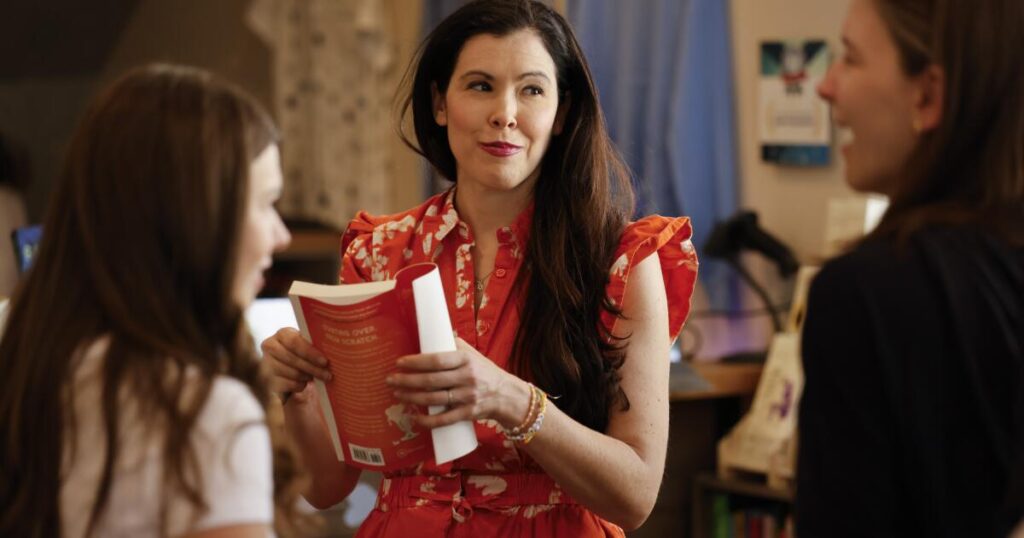
Upon closer inspection, though, the clues were visible: the group’s relaxed pace, the bountiful tote bags, the occasional flash of a paperback. This was no run club, but instead the Preoccupied literary social calendar’s Walking Book Club, a monthly L.A.-based event where readers take a 40-minute (or so) stroll with a featured author, followed by discounted shopping at a local bookstore.
January’s pick was Ali Rosen, who was promoting her romance novel, “The Slow Burn,” at one of the more unconventional stops on her book tour. Although these days, as many fan-facing authors know, the “unconventional” book event is becoming increasingly, well, conventional. Driven by Gen Z and millennial organizers eager to shed the isolation of the pandemic era, events ranging from book crawls to silent reading parties are successfully turning time spent with literature into happening social occasions.
The book crawl
When Allison Ambili Kumar moved to L.A. in 2023, she said she was “overwhelmed in a good way” by the sheer volume of local bookstores and authors. But she also noticed that the market was saturated with author panels and conversations while lacking spaces where book lovers could interact with each other more organically.
This led Kumar to launch a book crawl, inspired by her reading of “The Art of Gathering: How We Meet and Why It Matters” by Priya Parker. In Kumar’s book crawls, a traveling party of literary buffs bookstore hop, usually visiting at least three in one L.A. area. The idea is that readers can connect in a casual, welcoming environment, all the while increasing visibility for independent bookstores.
Kumar hosted her first book crawl in 2024 in Culver City and has since taken the event to Long Beach, Hollywood and Pasadena. Selected bookstores included legacy shops like Chevalier’s Books and Vroman’s as well as newer ventures like Village Well Books & Coffee and Bel Canto Books. (Book crawls are also a national trend beloved by many a TikToker, with last April marking the first synchronized Global Book Crawl.)
Some of Kumar’s favorite parts of the events are the “book hauls,” when, after each stop or at the end of the day, participants share what they picked up, show-and-tell style.
“I definitely think there’s a heightened joy in sharing what we love about the stories we love, and it also allows us a deeper level of understanding, given that you and I could read the same book and love it, hate it, feel differently about it, have different things that resonated with us from it,” Kumar said.
While Kumar’s book crawls on average draw about 20 attendees each, she said the community that’s formed around them is much larger.
“Events are wonderful,” she said, “but it’s also taken on a life of its own, where people who’ve met on the book crawls are sharing a hotel room together for a romance conference this weekend, and we have our group chat, where people ask if anyone’s going to events at Village Well or the Ripped Bodice, so they can sit together.”
Danielle Dutta, who attended Kumar’s first book crawl in Culver City, began multiple friendships that way: messaging mutual social media connections about whether they were attending an upcoming book event.
“I mean, how else do you make friends as an adult?” Dutta said with a laugh.
The Walking Book Club
Samantha Dockser and Morgan Messing of the Preoccupied launched their literary platform in 2024 to provide a centralized resource for book lovers and authors to keep track of all the “bookish” events, as they call them, happening around L.A.
The duo started their monthly event as an audiobook walking club — a structure which has seen success in other L.A. locales — but quickly realized their attendees were too invested in chatting with their fellow book lovers to maintain the imposed quiet.
“We were trying to think of a structure for an event that would be a low lift for an author and also encourage potential new readers of an author to join,” Dockser explained. With a casual setting and minimal enforced structure, the walking book club format felt right.
Messing said she sees the reading community as “age-blind,” and the club’s attendance reflects that. Still, many regulars fall in the Gen Z to millennial range.
“I 100% agree that the strongest voices in shaping what the book space looks like are people that are in their 20s currently or were when TikTok popped off in 2020,” Dockser said, at least when it comes to fiction.
To that demographic, self-identifying as a reader is about more than “the literal act of reading a book,” she said. It means you see book-buying as a hobby, frequent book events and share a social circle with other readers.
Ironically, those most invested in the in-person elements of the reading hobby often had their first exposure to the book community online.
Early in the reign of social media, Messing said, there was much fearmongering about how these digital platforms spelled the death of reading.
“It’s actually done just the opposite,” the co-founder said. “It’s given readers community and introduced non-readers to books and even brought people to physical bookstores because people want to post their books on their social media.”
L.A.-based author Joss Richard, who promoted her swoony second-chance romance “It’s Different This Time” with the Preoccupied’s Walking Book Club in October, said events like Dockser and Messing’s are great for reader engagement and bring a welcome dose of fun. And while it can be tricky to navigate these more atypical formats, especially ones that involve parading down local streets with a swarm of buzzing fans at your back, Richard said most attendees of the Preoccupied’s club knew the drill.
“Rarely is it anyone’s first time going to one of those things,” the author said. That’s especially true of romance readers, who are generally regarded as the social butterflies of the book community.
Richard is sure to see many book event frequenters when she speaks on a romance panel at the L.A. Times Festival of Books April 18.
The silent reading party
The first meeting of Martha Esquivias’ reading club LB Bookworms consisted of the club founder and one of her friends casually reading together at a coffee shop. In the months that followed, Esquivias’ pet project grew into a series of what she called “reading picnics.” She and a few others would read outside in a format she credited to the international Silent Book Club, which has several chapters across L.A.
Esquivias liked that the structure diverted from that of a traditional book club, which requires significant commitment and coordination.
“With this option, it feels like it’s less pressure and more ‘come and go,’” she said.
Coming of age during the social media boom, Esquivias said she always felt like she wasted her childhood on screens when she should have been playing outside or exploring hobbies. In many ways, plugging into the literary community and falling in love with reading again have healed that sense of loss.
“After the pandemic, there’s been huge talk about finding third spaces or community spaces. I think people crave that more,” she said, adding that she’s proud LB Bookworms has provided that to so many people.
Sanaz Tamjidi, owner of Sunny’s Bookshop in Tarzana, last year hosted a silent reading event in collaboration with the L.A. chapter of “reading party” organizer Reading Rhythms.
Tamjidi, a self-proclaimed “zillennial,” said her bookstore’s events are popular among younger customers, who are increasingly seeking out social gatherings that don’t involve drinking or partying.
When Tamjidi told some older customers about the silent reading party, she said they were perplexed, asking, “Wait, so they would come and sit with each other, not talk, but just read silently?”
“They were like, ‘Times have changed,’” Tamjidi said, “and that’s the beauty of it.”
The post These Gen Z and millennial readers are reimagining L.A. book clubs appeared first on Los Angeles Times.