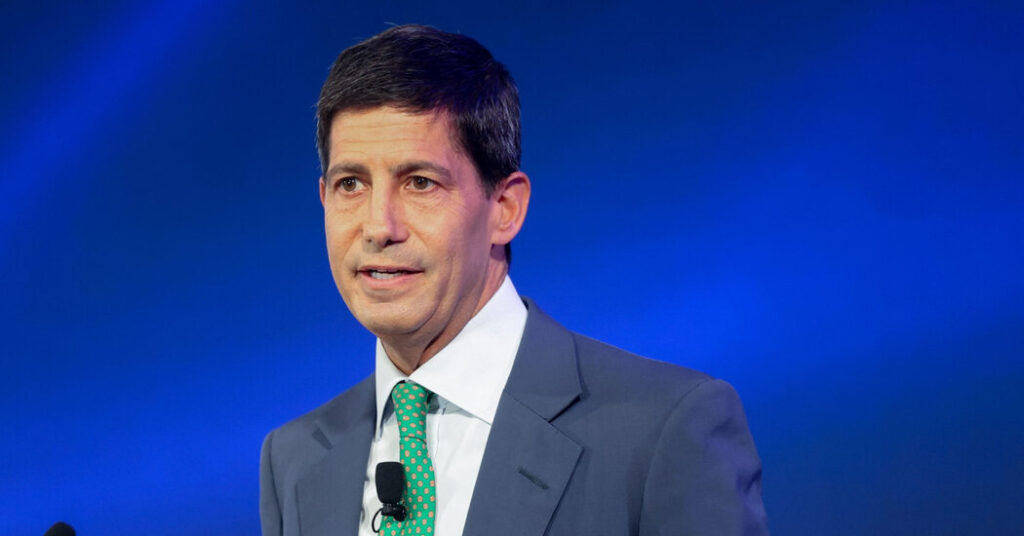
All 11 Democrats on the powerful Senate Banking Committee joined in a final push to delay the confirmation hearing of President Trump’s nominee to lead the Federal Reserve, Kevin M. Warsh, ahead of his scheduled appearance on Tuesday.
In a letter sent on Thursday to Senator Tim Scott, Republican of South Carolina and the chairman of the committee, the group said Mr. Warsh’s nomination should not proceed until criminal investigations into two sitting Fed officials, Jerome H. Powell, the chair, and Lisa D. Cook, a governor, are closed. Instead, they called for public hearings into Mr. Trump’s involvement in those inquiries.
“Both investigations appear to be part of the Trump administration’s broader effort to take control of the Fed,” the Democrats wrote in the letter reviewed by The New York Times.
They said it would not only be “inappropriate” to move forward with Mr. Warsh’s nomination under the current circumstances, but also “unreasonable to take the president at his word and assume — despite all of his thinly veiled assertions to the contrary — that he is uninvolved in the prosecution of Chair Powell.”
The administration is involved in two legal disputes with the central bank, an institution Mr. Trump has repeatedly derided for its unwillingness to lower borrowing costs as much as he would like.
The president announced last year that he was firing Ms. Cook, whose term as governor does not officially end until 2038, citing unsubstantiated allegations of mortgage fraud. Ms. Cook, who has not been charged with a crime, sued to keep her job, a case that has since been taken up by the Supreme Court. While the justices have not delivered a ruling, they appeared concerned in oral arguments in January about the implications for the Fed’s independence if her attempted ouster was allowed to stand.
Trump Administration: Live Updates
Updated
- Robert F. Kennedy Jr. will testify before Congress for the first time this year.
- 3 are killed in a boat strike in the Pacific, the Pentagon says.
- John Eastman is disbarred for his efforts to overturn 2020 election for Trump.
The Justice Department has also simultaneously begun a criminal investigation into Mr. Powell and his handling of $2.5 billion renovations at the central bank’s headquarters in Washington. A federal judge recently quashed subpoenas issued by prosecutors to the central bank regarding the project, a decision that Jeanine Pirro, the U.S. attorney for the District of Columbia and a longtime friend and ally of Mr. Trump’s, said she would appeal.
Members of Ms. Pirro’s team made an unannounced visit on Tuesday to the Fed’s active construction site, suggesting her department has little intention at the moment of dropping the case.
The president endorsed the investigation on Wednesday and said it also served as an inquiry into Mr. Powell’s “incompetence,” as he threatened to fire him if he did not depart after his term as chair ends. Mr. Trump initially maintained that he had no involvement in the investigation. But this week, Kevin Hassett, the White House’s top economist, told Axios that the way the Justice Department got involved “was that the president wanted to investigate the cost overrun.”
The investigation is standing in the way of a smooth transition to a new chair, raising the chance that Mr. Warsh is not confirmed by the Senate by the time Mr. Powell’s term as chair ends on May 15. Senator Thom Tillis, a North Carolina Republican on the Senate Banking Committee, has vowed to block any Fed nominee until the legal threats against Mr. Powell end.
Republicans have only a narrow 13-to-11 majority, meaning Mr. Tillis’s opposition would halt Mr. Warsh’s advancement to a full Senate vote.
If Mr. Warsh is not confirmed in time, Mr. Powell has stipulated that he will serve as chair on a temporary basis, an arrangement he said was justified by both the law and precedent. Still, there are mounting concerns that the Trump administration will seek to challenge this claim and instead try to install another member of the board in his place.
Legal experts point to two primary reasons they expect Mr. Powell’s interpretation to hold.
The Fed’s board has delegation authority, meaning that in the event of a vacancy for chair, the board has the latitude to delegate its responsibilities to a single member to serve temporarily. Moreover, three separate legal cases just last year concluded that when an agency position requires Senate confirmation, as is the case with the chair position, the president cannot appoint an acting person without the chamber’s support.
Colby Smith covers the Federal Reserve and the U.S. economy for The Times.
The post Democrats Make Final Push to Delay Confirmation Hearing of Trump’s Fed Pick appeared first on New York Times.