Though it’s often the way we tell it, no one’s life story, creative or otherwise, really moves in a straight line. We crisscross forked paths, turn back on ourselves, spiral and branch, and then swing in one direction only to later try another.
At the Fondation Louis Vuitton in Paris, a life-affirming exhibition of the pioneering artist Alexander Calder has it both ways. Running through Aug. 16, the show unfolds chronologically, but begins with a hint that, although the American sculptor’s career followed a dedicated strand of ideas about form, movement, volume, balance and harmony, it was anything but linear.
Soaring high above the lobby is “Triumphant Red” (1963), a hanging sculpture, nearly 20 feet wide, made of painted sheet metal, rods and wire. Originally called “Black with One Red,” the work is made of three branches, from which extend delicately balanced black shapes, like petals or fronds. (To describe Calder’s biomorphic abstractions, one often reaches for organic terms.) The piece appears different from every angle, and it twists and turns when moved by gusts of air produced by movement below. One larger red piece extends just higher than its fellows (triumphant!), like a cheerful exaltation.
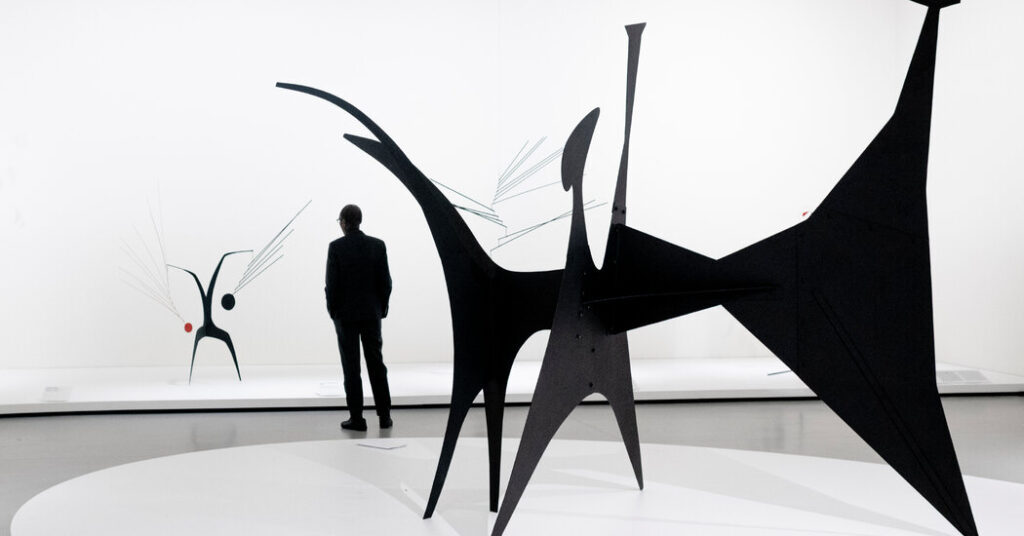
On the lawn just beyond the museum’s vast glass windows sit two of the sculptor’s late, monumental works made in the years leading up to his death in 1976. “Black Flag” (1974) and “Five Swords” (1976), each made of painted sheet metal joined together with heavy bolts, stand stolid and striking — one jagged black, the other curving red — against the green surrounds.
These two sculptural modes — hanging, moving; standing, immobile — have come to define Calder’s best-known output, and were given names by artists in the rich circle of peers he encountered when he moved to Paris in the 1920s. The polymath Marcel Duchamp offered “mobiles” for the fluid, suspended forms, and the Dada sculptor Jean Arp dubbed the fixed, often hulking forms “stabiles.”
Calder’s journey to these works was filled with experiment and straddled the Atlantic, various art historical movements and the tumultuous politics of the 20th century. Downstairs at the Fondation Louis Vuitton, we begin at the beginning, with two small sculptures the artist, aged 11, gave to his parents for Christmas in 1909: a dog and a duck, made from cut and folded brass sheets. The dog, economically formed, has a curly tail and pointed ears, and the duck’s tail feathers, if pressed, cause the little bird to rock back and forth.
Born in Philadelphia in 1889, Calder grew up in a creative family. His father and his paternal grandfather (both also named Alexander Calder) were successful sculptors, and his mother, Nanette, was a Sorbonne-educated painter. Not all children of artists follow in their parents’ footsteps, but Calder’s early ventures with metal and simple lines to create moving forms are a great origin story for a kinetic artist.
After studying for a degree in mechanical engineering, Calder enrolled at the Arts Students League in New York, where he painted, in the muted Ashcan School tones of the time, busy shipyards, crowded streets and then the circus — a subject that would dominate his next five years. Two canvases, “The Flying Trapeze” (1925) and “Circus Scene” (1926), show Calder’s interest in sinuous lines and figures in motion, casting the big top as an alternate dimension in which performers battled gravity and played the crowd with humor and pathos.
In the summer of 1926, Calder arrived in Paris, entering the vibrant melee of the Montparnasse arts scene. Until 1931, he worked on what came to be known as the “Cirque Calder” — a miniature circus made of wire characters: sword swallower, lion tamer, acrobats, tightrope walkers, bull fighter, lassoing cowboy, exotic dancer, spear thrower and more.
Eventually growing to fill five suitcases, the forms were regularly animated by Calder, with music, in performances that could last up to two hours. Friends and peers gathered, rapt, and the artist used the entrance fees to cover his studio rent.
New Yorkers, and visitors, may have seen aspects of Calder’s circus permanently installed at the Whitney Museum, which recently staged a special exhibition to celebrated the Cirque’s centennial. Here, it returns to Paris, where it was made and delighted so many, as it will today. (It is impossible not to grin watching the films on display of Calder playing his varied cast.)
At the same time, the artist — known in Paris as the “King of Wire” — was making bigger forms with the same material, including portraits of Montparnasse celebrities like the performer Josephine Baker and the muse and model Kiki de Montparnasse. Brightly lit, these works throw shadows on the walls behind them that are almost as extraordinary as the pieces themselves and allow us to see the wire figures from different angles simultaneously.
An October 1930 visit to the Dutch painter Piet Mondrian’s studio catapulted Calder’s vision into expanded dimensions. Mondrian had squares in primary colors stuck to the walls all around him, as if the room itself were an immersive version of his pared-back paintings. (A selection of works by Mondrian, as well as other influential figures for Calder — Picasso, Fernand Léger, Joan Miró, Paul Klee, Barbara Hepworth — are interspersed throughout the displays.) Calder saw that an abstract work could surround, and effectively incorporate, the viewer’s body and mind.
He immediately turned to wire abstractions: spheres with colored balls suspended inside, tripods with dangling constellations, and, as in “Small Sphere and Heavy Sphere” (1932-33), a work that could literally be animated. In this piece, two spheres hang low from the ceiling, with bottles, a tin can, a wooden box and a small gong on the floor nearby. When the balls swing around, these objects could get knocked over, emit hollow thumps or smash. Even when static, they fill the imagination with dynamic potential.
From here, the works take flight. The familiar mobiles are arrayed in swarms, clouds and constellations, dangling and weaving, hovering like ethereal beings or flowing like organic matter, through the winding galleries. Some are spiky, others are smooth; some resemble animals, others are abstractions with evocative names like “A Japanese Effect” (1941), or “January 31st” (1950), a blizzard of oscillating white and black.
The pieces of sheet metal and wire in the mobiles are finer than you would imagine from reproductions or afar. In the show’s opening weeks, the galleries will probably be crowded, filled with visitors whose movements will bring the sculptures to life. (Touching them was disallowed after visitors at a 1964-65 Guggenheim retrospective were too rough, but light air currents still work wonders.)
This interactive aspect of Calder’s work, which seems so simple, is the most compelling. We as viewers — and as humans in the world — have unavoidable relationships with everything around us. To coexist with something carefully and harmoniously balanced is magnificent. It demands a respect for life, whose potential, like the possible configurations of each mobile, is infinite. Walking out into the Paris spring, you might imagine them swirling and twirling — a blizzard, a shower of petals, a color coming at you from nowhere. It’s a kind of freedom too rarely encountered.
Calder: Dreaming in Equilibrium Through Aug. 16 at the Fondation Louis Vuitton in Paris; fondationlouisvuitton.fr.
The post A Sculptor’s Life, in Constant Motion appeared first on New York Times.