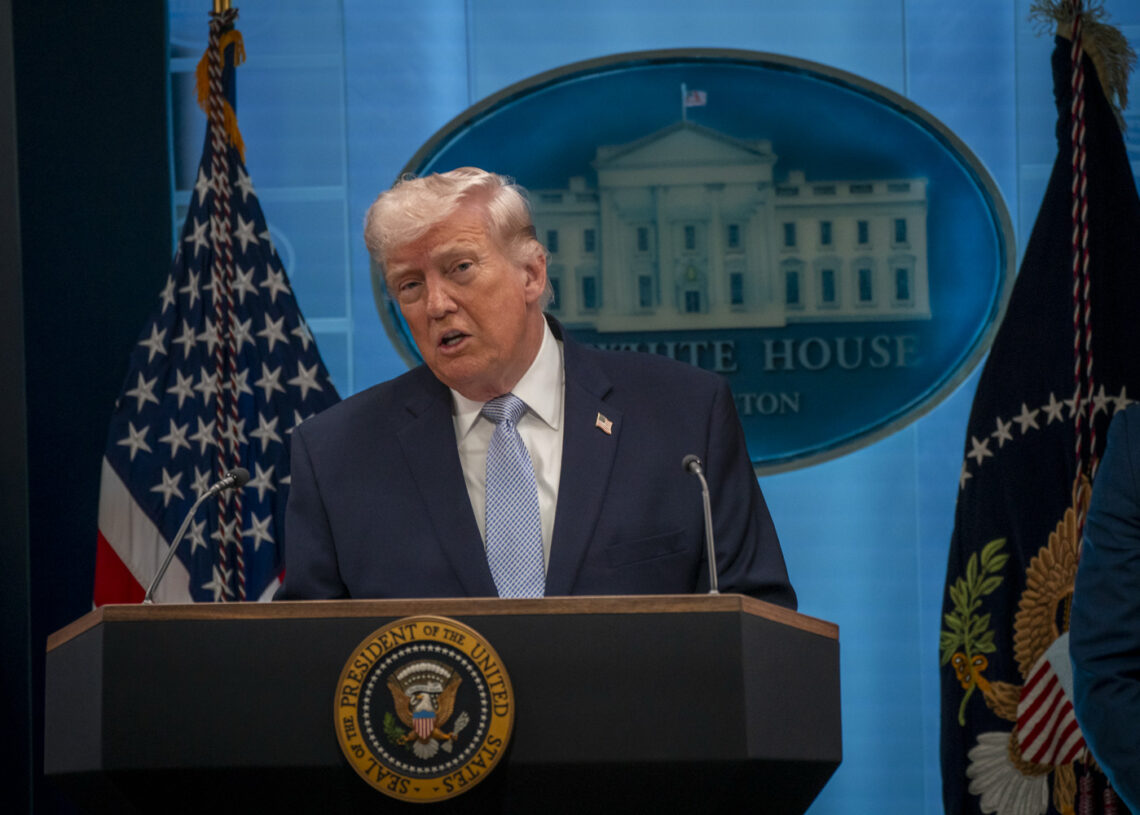
The Senate rejected a resolution Wednesday to block President Donald Trump from ordering further strikes on Iran, even as some Republicans raised increasing concerns about Congress’s lack of input on the war.
The vote was the latest test of lawmakers’ support for the unpopular conflict since Trump threatened last week to destroy Iran’s “whole civilization” then hours later agreed to a two-week ceasefire. Democrats have forced votes on three other war powers resolutions since the war’s start, all of which have failed.
Wednesday’s procedural vote failed 47-52, with Sen. Rand Paul (R-Kentucky) joining Democrats to support the resolution and Sen. John Fetterman (D-Pennsylvania) voting against it. Sen. Jim Justice (R-West Virginia) did not vote.
Some Republicans who opposed the resolution said they nevertheless want Trump to consult Congress as the war approaches the two-month mark — an important legal deadline.
The War Powers Resolution of 1973 — the law Democrats are using to force the votes — requires presidents to remove U.S. forces from any conflict that Congress has not authorized within 60 days. Trump can obtain a 30-day extension if he certifies that it is an “unavoidable military necessity.”
Trump predicted shortly after the war started that it would be over within four or five weeks, but the 60-day deadline, which arrives May 1, is rapidly approaching. He has sent mixed signals about how long the conflict will go on, telling Maria Bartiromo of Fox Business on Tuesday that he the war was “very close to over” even as he imposed a naval blockade on Iran and sent thousands more troops to the Middle East.
“The president recognized ahead of time when he first went into Iran that this was going to be a short-term thing, right?” Sen. Lisa Murkowski (R-Alaska) said. “We’re probably not going to be dealing with 60 days. Well, here we are.”
Senate Majority Leader John Thune (R-South Dakota) did not say Wednesday whether he wants Trump to seek authorization from Congress before the 60-day mark, but he has called for the administration to articulate how it plans to end the war as the deadline approaches.
“They need a plan for how to wind this down and how to get an outcome that actually leads to a safer, more secure Middle East,” Thune told reporters.
Some Senate Republicans have gone further. Sen. John Curtis (R-Utah) has said he will not support more funding for military operations against Iran unless Congress declares war. Sen. Susan Collins (R-Maine) said Congress needs to authorize the conflict if it exceeds 60 days or if the U.S. deploys ground troops, which Trump has not ruled out.
“I have been clear from the beginning of this military operation that the President’s power is not unlimited as Commander in Chief, as the Constitution gives Congress an essential role in matters of war and peace,” Collins said in a statement.
The House is expected to vote Thursday on its own resolution to block Trump from ordering more strikes on Iran. A similar resolution narrowly failed last month, with two House Republicans voting for it and four Democrats opposing it.
Rep. Don Bacon (R-Nebraska), who voted in January for an unsuccessful resolution to prohibit Trump from taking further military action against Venezuela, said he was inclined to oppose the Iran resolution because he wants Trump to “finish the job” in Iran. Still, he said Trump needs to seek authorization from Congress to before the 60-day deadline.
“The president, if he wants to continue doing this, is going to have to sort of lead the way on it, because the 60 days are coming due,” Bacon said.
Polling indicates the war is unpopular. Fifty-five percent of Americans oppose it and 32 percent support it, according to an Economist-YouGov poll conducted between Friday and Monday. A CBS News-YouGov poll conducted last week found 64 percent of Americans disapprove of Trump’s handling of the conflict while 36 percent approve.
Murkowski has spoken with other Republicans about drafting legislation to authorize the war if it drags on, she said. Congress passed similar authorizations before the start of the wars in Afghanistan and Iraq, but Trump did not ask lawmakers to do so before striking Iran.
Sen. Thom Tillis (R-North Carolina) said he was open to supporting an authorization for the use of military force but expected the administration to respect the 60-day deadline.
“At the end of the day, the law is the law, and we should follow it,” Tillis said.
The 1973 law bars presidents from ordering U.S. forces into hostilities without congressional authorization unless the country or its troops are attacked.
Other Republicans have downplayed the looming deadline.
Sen. Lindsey Graham (R-South Carolina) has said he believes the war powers law is unconstitutional. Sen. Ron Johnson (R-Wisconsin) said Trump should not allow it to restrict him from removing the Iranian regime from power.
“Once we made the tough decision to do this, to stir this hornet’s nest, you’d better finish the job,” Johnson told reporters. “I don’t want to leave a regime in place that still wants to create nuclear weapons, to keep producing missiles, to keep producing drones.”
Senate Democrats have also brushed aside the 60-day deadline, arguing that Trump started the war illegally, so the deadline means little.
“If we allow this as a Congress, this is the new standard,” Sen. Cory Booker (D-New Jersey) told reporters. “Donald Trump can wage war on Cuba next for 30, 60 days before having to consult Congress.”
Senate Minority Leader Charles E. Schumer (D-New York) echoed those concerns.
“We don’t need 60 days to know this war is a mistake,” Schumer said in a statement. “Every day more means more risk, more chaos and billions spent on a failed war.”
Oona Hathaway, a professor of international law at Yale who served as a special counsel to the Defense Department during the Obama administration, said the 60-day deadline would still apply even if Trump started the war illegally.
The 60-day threshold, Hathaway wrote in an email, “is meaningful in that it makes exceedingly clear to anyone who is wondering that the President is prepared to ignore the law altogether.”
The Trump administration argued last year that it was not bound by the threshold during its campaign against alleged drug traffickers in the waters off Latin America, telling Congress in private that it did not believe the strikes rose to the level of hostilities governed under the law, The Washington Post reported.
Rebecca Ingber, a senior State Department legal adviser during the Biden administration, said the same case was nearly impossible to make with the current operation.
“There is no plausible argument that the U.S. is not engaged in hostilities in Iran,” she said.
The White House has not said whether Trump would seek a 30-day extension.
“The President’s preference is always diplomacy, and Iran is desperate to make a deal — but they first must renounce their desire for a nuclear weapon and agree to redlines articulated by the United States,” Anna Kelly, a White House spokeswoman, said in a statement.
Trump would not be the first president to be undeterred by the 60-day deadline.
President Barack Obama did not seek authorization from Congress before ordering strikes on Libya in 2011, which continued beyond the 60-day threshold. (Hathaway warned at the time that Obama’s failure to comply with the law would condemn it “to a quiet death by a president who had solemnly pledged, on the campaign trail, to put an end to indiscriminate warmaking.”)
Neither did President Bill Clinton when he ordered the bombing of Kosovo in 1999, though his administration argued that Congress implicitly authorized the strikes because it passed legislation to fund them within 60 days of the start of the campaign.
Sen. Josh Hawley (R-Missouri) said he hoped that the ceasefire — which is set to expire next week — is still in force once the 60-day deadline arrives.
“We’re not engaged in hostilities now,” Hawley told reporters. “I would hope that we would not be then and that there’d be a resolution to this by then.”
Scott Clement contributed to this report.
The post Senate rejects resolution to block Trump from striking Iran appeared first on Washington Post.