This article is part of our Museums special section about how institutions are commemorating the past as they move into the future.
It’s a Sunday afternoon in late winter, and the Metropolitan Museum of Art’s Great Hall is abuzz with activity.
A cloakroom line snakes along the east wall. Visitors cluster, clutching maps, craning their necks as they orient themselves. Heads are raised, fingers point upward, phone cameras click as visitors take in the enormous domes, arches and grand staircase of this landmark 1902 entryway, designed by the architect Richard Morris Hunt.
More than 15,000 people will visit the museum today — typical attendance for a weekend day at one of the most-visited art museums in the world. Just past the Great Hall, in a side gallery housing the Vélez Blanco Patio, (a 500-year-old Spanish courtyard that looks like a movie set), Lenore Pott has gathered a group of 17 for her “Highlights of the Museum” tour.
Pott, a tour guide at the museum since 2014, uses an eclectic medley of six to eight works from the Met’s collection of 1.5 million objects to tell a story of evolving, international art: from a stone Aegean figurine, in the Greek and Roman Art section, made around 2,700 B.C. (“That’s pretty old,” Pott deadpans, as her group chuckles), to an imposing, 19th-century Congolese “power figure” in the African gallery; from the striking 1610 Caravaggio painting “The Denial of St. Peter” in the European section to the sprawling, anarchic Jackson Pollock canvas “Number 28, 1950” in Modern and Contemporary Art.
Over the course of the 60-minute tour, Pott leads her group down corridors and connecting spaces, through galleries with cathedral-like ceilings, as well as collections that seem as intimate as if you had just entered the artists’ workshop.
The sheer size and complexity of the Metropolitan — what Patrick Bringley, in his 2023 memoir about his decade working as a guard at the Met, “All the Beauty in the World,” calls “a place of impossible breadth” — seems almost overwhelming.
“It just keeps on going,” one woman on the Highlights tour whispered in amazement.
Indeed it does — and it’s about to go even further: Seemingly unnoticed by visitors as they make their way briskly down a partly cordoned-off hallway near the Tisch Galleries, a series of six wall panels proclaim nothing less than a transformation of the 156-year-old museum.
“Designing Tomorrow’s Met,” reads the headline. “Our two-million-square-foot Fifth Avenue location now stands at the threshold of an essential transformation. We are partnering with leading architects to usher the museum into the future by renovating one quarter of our galleries and public spaces over the coming years.”
That future is already here — although as the unobtrusive signs suggest, it is revealing itself gradually, in a slowly unrolling metamorphosis of the Met’s 21 linked buildings, 17 curatorial departments and over 500 galleries into — what? An even bigger museum?
No.
Unless one believes the museum should be pouring concrete onto the lawns of Central Park — which it not only abuts but is technically a part of — there is no enlarging its footprint.
“The Met is not expanding,” Max Hollein, its director and chief executive, said in a phone interview. “What we are doing is rethinking, reimagining and reinstalling.” The $1.5 billion project, he said, represents “a deep commitment to moving upward and improving.”
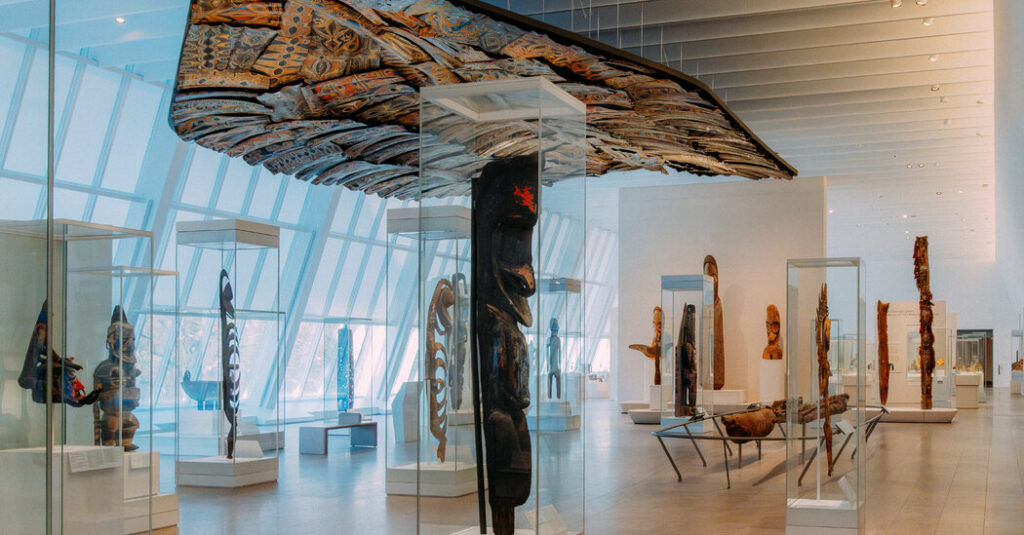
Beginning with the renovated Michael C. Rockefeller Wing, which reopened to mostly enthusiastic reviews last spring (ARTNews called it “a masterpiece”) and culminating in 2030 with the opening of the Tang Wing in the southwest part of the museum, the changes will include renovated galleries for art from ancient West Asia and Cyprus; a refurbished library; an improved accessible entrance; new retail and dining areas; and improvements in infrastructure.
There is also a new first-floor exhibition area, the Condé M. Nast Galleries, where the Costume Institute’s annual spring exhibition (opening May 10) will be held.
In sum, the current renovation will represent the biggest changes in the museum in 50 years.
“It’s hugely ambitious, but if you’ve got the money and the will to do it, why not?” said Morrison H. Heckscher, the former Met curator, writer and historian. “Max has the will and the support of the board and the money to go ahead with these projects concurrently.”
Since the last major renovations in the 1970s and ’80s, Heckscher said, “it’s been a question of, ‘We can’t get bigger, how do we get better?’”
To Hollein, who began as director of the Met in 2018 and added chief executive to his title in 2023, getting better requires fresh perspectives. “It’s kind of the next generation looking at how the stories we tell about the art could be better told, and made more timely,” he said.
Another important aspect to these renovations: They’re happening while the museum is open. Thus, one can open a door in a discreetly roped-off area — in the company of the museum’s head of capital projects, Brett Gaillard — and find yourself in the midst of a construction site, while on the other side of a wall or two, visitors continue to marvel at Monet and Van Gogh.
The changes underway, Gaillard said, will enhance the visitor experience while retaining the distinctiveness of the museum’s myriad galleries and collections.
“The spaces are different,” Gaillard acknowledged, weaving her way past hard-hatted workers and through a forest of forklifts and risers set up on cardboard-covered floors. “We want to keep it that way. We’re not trying to blow it all up and make it one big white box.”
To that end, the museum has engaged what Hollein (whose father was the Pritzker Prize-winning architect Hans Hollein) calls “some of the most interesting architectural voices of the day.” Among them: the Brooklyn-based architects Miriam Peterson and Nathan Rich, whose assignment has been to reshape 11,500 square feet of main floor space into the new Condé M. Nast Galleries, which will house the costume show and other special exhibitions.
“We talked a lot about the complexity of being adjacent to the Great Hall,” Rich said. “The way we approached it was to create a series of transitional experiences to this new contemporary gallery space.”
The work here has uncovered a brick wall that was part of the facade of the original 1880 building, designed by Calvert Vaux. It’s a reminder that while the Met may be moving forward, the past is never far behind.
The influences of Met architects — including Hunt; Vaux; McKim, Mead & White; and more recently, Kevin Roche, who oversaw the renovations in the 1970s and ’80s — are palpable. “We’ve joked that we’re either haunting them, or they’re haunting us,” Peterson said.
While one wonders what the spirits of stiff-collared Gilded Age architects would make of Doja Cat or Rihanna’s “omelet dress,” the new galleries are scheduled to open in time for the Met Gala on May 4 (the Costume Institute’s show opens to the public six days later). The enthusiastic Gaillard said she had no doubts that the deadline would be met. “I’m very confident about this,” she said.
The crowning piece of the museum’s renovation, the new Tang Wing for Modern and Contemporary Art, is not scheduled to open until 2030. There, the Met and the architect on this part of the project, Frida Escobedo, are confronting different obstacles.
The southwest corner of the Met, visible from Central Park’s main drive, is a modern and, many say, dull part of the museum, notable chiefly for its large glass walls. “It’s important to rethink how to connect that part to the building,” Escobedo said, “and make it feel like it has a better relationship with the park.”
That association is a long and complicated one. When Central Park’s designers — Vaux and Frederick Law Olmsted — looked for a place for an art museum, they chose a 15-acre site on the east side of the park that had been previously considered for a play area or a parade ground.
As the Met’s first architect, Vaux sought to link his two creations through a park-facing entrance. Some of his successors tried that as well — to no avail. “Entering the museum from the park is a nice idea, but it doesn’t work,” Heckscher said, citing, among other obstacles, security concerns.
But while there may not be a direct entrance, there is a deep connection. As Escobedo pointed out, the Met, repository of so many artistic masterpieces, “lives within a masterpiece, which is Central Park. “We need to be respectful of that,” she said.
In a statement on the museum’s renovations, Betsy Smith, the president and chief executive of the Central Park Conservancy, called this “an opportunity to truly integrate the building into the park.”
The energy and creative spirit behind the renovations speaks to another relationship that needs to be taken into account. “The Met is the museum of the metropolis,” said James Panero, who has written a number of essays on the museum for The New Criterion. “It’s not named after a donor, it’s named for us. And most of us who live in New York take tremendous pride in the fact that we have this world-class, encyclopedic museum in our backyard.”
A world-class museum of timeless art; a museum that can change with the times. At the end of Pott’s Highlights tour, she chats with a visiting docent from the Getty Museum in Los Angeles and reflects on the renovations and the spirit that animates them.
“The museum is constantly evolving, with new galleries and new perspectives,” Pott said. “It’s always exciting here.”
The post ‘Rethinking, Reimagining and Reinstalling’ the Metropolitan Museum of Art appeared first on New York Times.