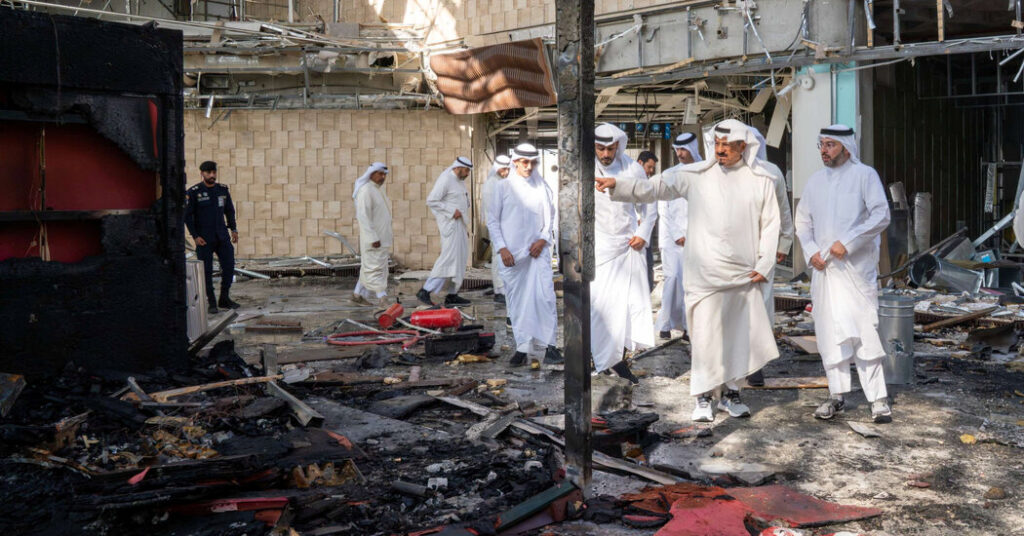
Iran fired a barrage of missiles and drones at Kuwait on Wednesday, killing a civilian and injuring dozens of others at the international airport, Kuwait and the United States said. It was one of the biggest Iranian strikes and the first known fatality in a Gulf nation since the cease-fire took effect in April.
The attack inflamed tensions in the region as indirect peace talks between Iran and the United States dragged on with no clear resolution. Iran denied that it had struck the airport and blamed the damage on an error by a U.S. missile interceptor.
U.S. Central Command, which oversees American forces in the Middle East, denied the claim and said Iran had struck the airport with drones in a “deliberate, calculated and unjustified attack.” Kuwait also said the airport had been hit by an Iranian drone.
Video footage verified by The New York Times showed people running from fire and smoke in Terminal 1 of Kuwait International Airport, where a gaping hole had been ripped in the roof. The Kuwaiti authorities said an Indian resident had been killed and at least 63 other people injured, including travelers and airport workers.
Iran’s foreign minister, Abbas Araghchi, mimicking a phrase used by the American military, said that Iran had launched “self-defense strikes” against sites that the United States used as staging grounds for attacks. In recent years, American forces have operated out of a site in the Kuwaiti airport complex, although it was unclear if they were still doing so or if that had been the intended target.
Kuwait’s Ministry of Foreign Affairs said it had told Tehran that it had refused to allow its land or airspace to be used “for any act of aggression against any country.” Incensed by the strike on Wednesday, Kuwait said it had summoned the interim chargé d’affaires of the Iranian Embassy to lodge an official protest and had declared two Iranian diplomats persona non grata, demanding that they leave the country within 24 hours.
Since the beginning of the war, Iran has also struck major energy facilities, ports and hotels in Gulf countries as it seeks to punish U.S. allies and increase economic pressure on the Trump administration. The attack on Wednesday involved 13 ballistic missiles and 17 drones, Kuwait said.
U.S. Central Command said that Iran had also fired missiles and drones at Bahrain, another U.S. ally in the Gulf, as well as at civilian sailors in nearby waters. None of those strikes hit their targets, the military said.
Iran’s Islamic Revolutionary Guards Corps said it had targeted the headquarters of the U.S. Fifth Fleet in Bahrain and an American vessel in retaliation for recent U.S. strikes on an Iranian vessel and military sites. Bahrain’s military said it had intercepted three Iranian missiles and several drones.
The attacks came as President Trump confirmed a report in Axios that he had called Prime Minister Benjamin Netanyahu of Israel “crazy” during a tense phone call on Monday and had repeatedly used expletives to express his frustration with the Israeli military’s campaign in Lebanon.
The Israeli offensive against Hezbollah, a Lebanese militia backed by Iran, is potentially complicating the already difficult path to a deal between Washington and Tehran that would resolve their conflict and end Iran’s effective blockade on commercial ships in the Strait of Hormuz.
“I was a little bit perturbed at his constantly fighting with Lebanon,” Mr. Trump said in an interview with The New York Post published on Wednesday. Israel continued to target Hezbollah on Wednesday, killing at least six people in strikes near the southern Lebanese city of Tyre, Lebanon’s state-run news agency reported.
Still, Mr. Trump praised his relationship with the Israeli leader despite signs of strain between them as their goals for the war, such as destroying Iran’s nuclear program and eliminating its ballistic missile capabilities, have not been fully achieved.
“We’ve worked very well together,” Mr. Trump said.
Mr. Netanyahu, in an interview with CNBC, said he had “tactical disagreements” with Mr. Trump but believed their relationship was solid. “We can disagree in the morning, and by the afternoon, we have common action,” Mr. Netanyahu said.
In his interview with The Post, Mr. Trump floated the idea of meeting with Iran’s supreme leader, Ayatollah Mojtaba Khamenei, who is believed to have been injured in U.S.-Israeli strikes at the beginning of the war and has not been seen in public for months.
“I’d like to meet him,” Mr. Trump said. “We’ll probably meet him at some point.” There was no immediate comment from Iranian officials, and it was far from clear whether the hard-line ayatollah would be willing to meet the American president.
Although American and Iranian attacks have slowed significantly since the two sides announced a cease-fire, they have not stopped altogether, with both sides declaring they are defending themselves against threats.
The latest attacks started early Wednesday, after U.S. Central Command said it had conducted “self-defense strikes” on an Iranian military ground control station on Qeshm Island, off the coast of Iran.
Central Command later said a wave of Iranian drones aimed at U.S. forces had “failed to hit intended targets” and that no American personnel had been harmed in an attempted strike on U.S. forces in Kuwait.
Secretary of State Marco Rubio, testifying before Congress on Wednesday, said that American strikes on Iran had been “completely defensive in nature” and intended to protect commercial ships trying to pass through the Strait of Hormuz, the critical choke point for crude oil and natural gas shipments.
Mr. Rubio again said that the U.S. military operation against Iran “has concluded,” reiterating a message that Mr. Trump has also delivered.
Reporting was contributed by Edward Wong, Max Bearak, Johnatan Reiss and Euan Ward.
Vivian Nereim is the lead reporter for The Times covering the countries of the Arabian Peninsula. She is based in Riyadh, Saudi Arabia.
The post Iran Launches Deadly Attack on Kuwait, Inflaming Tensions in Region appeared first on New York Times.