This article is part of our Museums special section about how institutions are commemorating the past as they move into the future.
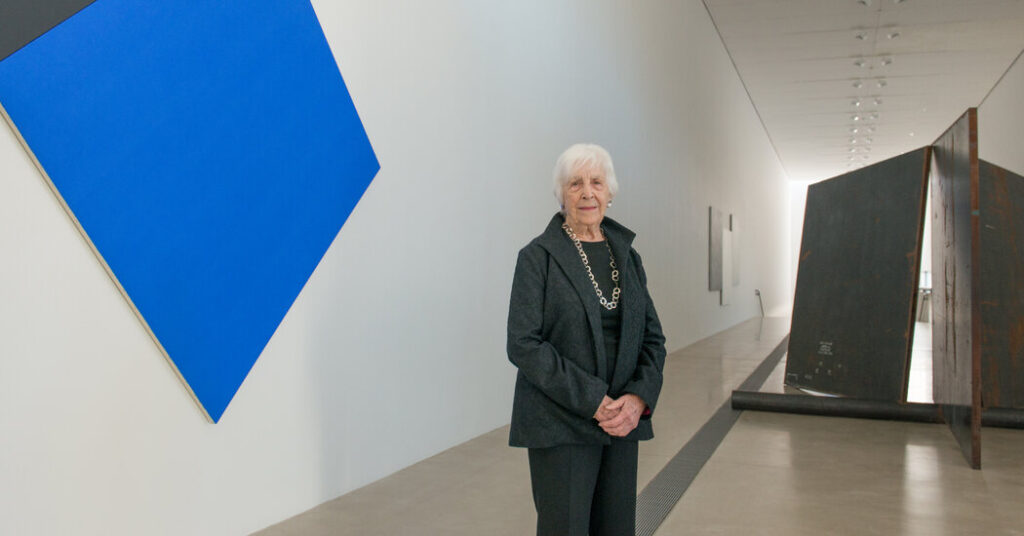
A couple of months ago Emily Rauh Pulitzer, a modest Midwestern Medici, was giving a tour of the museum she established, the Pulitzer Arts Foundation. At 92 she is sharp-witted and vigorous.
A crew was installing Richard Serra’s “Joplin” (1971), a large sculpture made up of three squarish rusted steel plates that fit at different angles into a pipe-like form lying on the ground. It has not been on view for 18 years, and Pulitzer had not laid eyes on it since then.
As the protective blankets came off the piece in the foundation’s main gallery, she smiled as if she had been reunited with an old friend.
“That’s why it was the first thing I said I wanted for this show,” Pulitzer said, referring to “Dialogues & Conversations,” an exhibition that opened in March and is on view until Aug. 9. She chatted warmly with the installers while also making sure everything was just so.
The show marks the museum’s 25th anniversary with some 85 works, and it was curated by Pulitzer herself. It includes pieces by artists whom Pulitzer developed close friendships with, like Serra and Ellsworth Kelly, as well as works by Henri Matisse, Constantin Brancusi and Edgar Degas.
Such a show would be a victory lap for most, but as the title suggests, Pulitzer, a curator at heart, is more interested in a back-and-forth discourse than in showing off her treasures.
Drawn mostly from her personal collection — unlike most of the foundation’s shows — the exhibition reflects her personal taste, with fewer than 10 paintings on canvas in the mix. “I tend to go toward drawing and sculpture,” Pulitzer said.
Because she has lived so long, Pulitzer has been able to write a life with multiple, distinct chapters; she was already 68 when the foundation opened.
Unlike most patrons with their own museums, Pulitzer formed her taste as a professional curator when she was just Emily Rauh, working for years at museums before marrying into the famous newspaper fortune of her husband, Joseph Pulitzer Jr.
Beginning in the late 1950s, she was an assistant curator of drawings at the Fogg Museum (now part of Harvard Art Museums) for seven years. For a time in the 1960s, she was the only curator on staff at the Saint Louis Art Museum, and worked there for nine years in total.
In her tenure in St. Louis, she introduced audiences to some of the most important artists of the day, like Dan Flavin, Donald Judd and Claes Oldenburg, when those makers were considered radical.
“I like to be thought of more as a professional than as a rich collector,” Pulitzer said.
When it was pointed out to her that she is inescapably both, she chuckled. “Exactly,” she said.
Cara Starke, the museum’s director, said she finds it impressive that Pulitzer’s taste has not “calcified” as it does for some older collectors; it would be easy for Pulitzer to coast on her holdings, and knowledge, of some of the agreed-upon greatest artists of all time.
“Dialogues & Conversations” includes works by living artists like Delcy Morelos, whose work Pulitzer did not know well until it appeared in a show at the museum.
Glenn Lowry, former director of the Museum of Modern Art, said that Pulitzer, a longtime MoMA board member, “knows her art inside out and upside down.”
“She’s centered and knows who she is,” Lowry said. “She doesn’t throw her weight around.”
And yet she has left a deep footprint. At the Saint Louis Art Museum, many significant works acquired under Pulitzer’s curating tenure, or donated by her and Joseph Pulitzer Jr. (1913—1993), as a couple or separately, are on display this spring.
“Emmy’s kind of everywhere here,” Min Jung Kim, the museum’s director, said of Pulitzer’s presence.
Kim added, “She’s helped St. Louis punch above its weight when it comes to arts and culture.”
Occasionally, local residents have pushed back when her interests ran too far ahead of local taste. Most notable has been the reaction to Serra’s public work “Twain,” made up of eight huge steel plates, placed with gaps between them and forming an irregular shape.
“Twain” stands in Citygarden park in St. Louis’s downtown, and has stirred controversy for more than 50 years, since Serra was selected to create a work there.
Pulitzer was on the committee that picked Serra in the mid 1970s, and has been a vocal supporter of the work ever since. It was completed in 1982, and met with outrage from some local officials and residents. There was even an effort to have it removed by referendum.
Graffiti art has been an issue recently, and time has only marginally helped its reputation. “It has not become beloved,” Pulitzer acknowledged, though that is not stopping her. She is currently working with a local organization to clean it up, relight it and better preserve it.
She also recalled notable negative feedback that came from a panel discussion at the Saint Louis Art Museum for a seminal show she curated there, “7 for 67.” The sculptors Ernest Trova, Mark di Suvero and Judd were on the panel, and gave only laconic responses, appearing to be hostile to one another and uninterested in explaining their art to the audience.
The St. Louis Post-Dispatch — of which her future husband was the editor and publisher — printed an article reporting that the event was marked by “mass frustration and mutual antagonism, punctuated by laughter, applause, boos, hisses.”
Pulitzer said: “I have never done a panel discussion again. It was that traumatic.”
She grew up in the Cincinnati area. Her parents appreciated art and commissioned the Bauhaus-style home where she grew up — rare in the Midwest or anywhere else in the United States at the time.
Such a childhood gave her a comfort level with boundary-pushing work, as well as the varied reactions to it. “I grew up with art all around me, and with a lot of people not understanding it,” Pulitzer said.
Not far from where Pulitzer was being interviewed in the foundation’s library was a work by Ralston Crawford, “Maitland Bridge” (1938), an abstracted cityscape with strong horizontal lines that is featured in “Dialogues & Conversations.” Crawford, a well-regarded painter, married Pulitzer’s aunt, and the piece was owned by her parents.
Something in the composition’s spare geometries recalls the Pulitzer Foundation’s building, a concrete structure by the Pritzker Prize-winning Japanese architect Tadao Ando, his first completed public work in the United States.
“People have said, ‘Oh, is that a painting of this building?’” Pulitzer said. “No, this building came out of that painting,” adding that the inspiration was indirect.
Pulitzer graduated from Bryn Mawr and began her career at Harvard’s Fogg Museum. It was there she met Pulitzer, a patron of Harvard, in the early 1960s, showing him some drawings by Gustave Courbet.
Once she moved to St. Louis, she got to know him and his wife, Louise Vauclain. After Vauclain’s death, “He asked me to do some projects, and things developed from there,” Pulitzer said. They were married in 1973 and collected together until Joseph’s death in 1993. “We had very similar tastes,” she said.
The Pulitzer Arts Foundation did not start out as a museum open to the public. More than a decade after the first discussions about building something — first as a couple and then Pulitzer on her own — it morphed from a private art viewing space into something very different.
“It was going to be aimed at scholars and curators,” Pulitzer said. “Through the years, it became more and more community oriented.”
Unusually for a privately founded museum by a single patron, it was never intended to be primarily a vehicle for showing Pulitzer’s own collection. Although she has endowed the museum and funds it, save for a handful of works it does not have a permanent collection, and operates more like a kunsthalle, borrowing art for shows. “Most of the work we show I don’t own,” she said.
Nor will the foundation receive Pulitzer’s art holdings after her death. She could not say exactly how many artworks she owns, but agreed that the total number is well into the hundreds, and said that with a few exceptions, most will go to the Saint Louis Art Museum and Harvard.
Always thinking like a museum veteran, Pulitzer is considering how a work will fit like a puzzle piece into a collection. “All my best drawings are going to Harvard because they’ll be seen,” she said.
As for the decision to establish the museum that bears her name, she said her opinion had evolved over time.
“I only recently discovered a piece of paper where I had written the pluses and minuses of going ahead with this,” she said. “One was that it’ll take over my life. At the time, that was a negative. But now I think it’s a positive.”
The post A Benefactor Gets Personal at the Museum She Founded 25 Years Ago appeared first on New York Times.