It’s Mark Carney’s Canada now.
One year, almost to the day, since the stunning electoral win that made him prime minister but still left him a few parliamentary seats short of an outright majority, Mr. Carney on Monday completed his plan to clinch control.
In so doing, he secured his dominance at home, shielding his government from the vagaries of a minority government.
He will now be able to more easily pass budgets and other crucial bills to advance his ultimate goal of making Canada more independent from the United States. His majority will insulate him from parliamentary challenges, even if some of his big plans, such as trade talks with the United States, do not go fully as planned.
If Mr. Carney can keep his majority together, he will not even need to hold an election before 2030.
How he got here was not pretty.
The Liberals won all three special elections on Monday. In the months before, Mr. Carney had lured five opposition lawmakers — four Conservatives and one from the leftist New Democrats — to “cross the floor” (or, in American terms, “cross the aisle”) and join his party.
Some hold positions far from traditional Liberal policies and had been sharply critical of Mr. Carney before flipping sides, sparking complaints that the defections amounted to cynical, self-interested betrayals of voters’ preferences.
Still, even if it has been messy, Mr. Carney has now completed the remaking of the Liberal Party as his own. He has moved it rightward to the political center and turned it into a “big-tent” that includes a motley crew of progressives, environmentalists, social conservatives, former bankers, like himself, and others.
Mr. Carney’s methodical majority-building now leaves him unmatched in domestic power and recasts Canadian politics by usurping space on the right from Conservatives and freeing up space on the left for the small New Democratic Party.
The end result perfectly encapsulates Mr. Carney’s Canadian pragmatism to do what is needed to accomplish what is necessary: Help Canada grow and thrive with less dependence on the United States.
“People are quite happy with this purple version of a Liberal Party,” said Shachi Kurl, president at the Angus Reid Institute, a nonpartisan political research group. “It’s pragmatism, a business-minded ‘let’s get on with it’.”
Making Of A Majority
To fully appreciate Mr. Carney’s achievement, it is important to recount how we got here.
Mr. Carney last year inherited a broken Liberal Party from his predecessor, Justin Trudeau, who had been in power for 10 years and had shaped the party around his progressive politics. At that point, the Conservatives dominated polls.
But within a few weeks, President Trump’s menacing rhetoric toward Canada and Mr. Carney’s decision to enter politics and replace Mr. Trudeau after an international career in finance and monetary policy upended the political dynamics.
Propelled by intense worry and anger about Mr. Trump’s tariffs and sovereignty threats, voters helped Mr. Carney erase the Conservative Party’s lead to win a general election. (Canadians elect local representatives; the party with the most parliamentary seats forms a government, which can be a minority government. Its leader becomes prime minister.)
But the Liberals landed a handful of seats shy of an outright majority in the House of Commons, leaving Mr. Carney’s minority government vulnerable to votes of no confidence and forcing it to seek support from opposition representatives to pass important legislation.
Over the past eight months, Mr. Carney and his colleagues quietly recruited five opposition parliamentarians to their ranks.
Each deal was different, but broadly speaking he offered the Conservative and New Democratic lawmakers resources and better support for their constituents, as well as in some cases, titles.
Two of the former Conservative members were invited to join Mr. Carney on high-profile overseas visits, allowing them to feel more valued and visible at a time when the Conservatives were weakened by concerns over leadership and an overall lack of direction.
The coup de grâce came on Monday when the Liberals won all three special elections and secured a safe majority in the House of Commons.
Crying Foul
The Conservatives have been outraged and frustrated by Mr. Carney’s recruitment campaign.
“If these turncoats have any shred of integrity left, they should resign their seats tonight and run in a by-election tomorrow,” Pierre Poilievre, the Conservative leader, said in a March speech. “Let the people decide if they want a Liberal representing them, because they sure didn’t vote for one in the general election.”
One Conservative member of Parliament went as far as to label Mr. Carney “authoritarian” on national television, only to be reminded by the presenter that when his own party had the opportunity to change the rules around such switches, it had chosen not to.
Floor crossings are not only permitted in Canadian politics, they happen with some frequency. The five Mr. Carney has attracted is not even a record: Jean Chrétien, another pragmatic Liberal prime minister, lured as many as nine opposition politicians from several parties to his ranks between 1995 and 2003.
But the concentration of floor crossings within just a few months, that helped turn a minority government into a majority one, is extremely rare in Canada’s history.
The Business at Hand
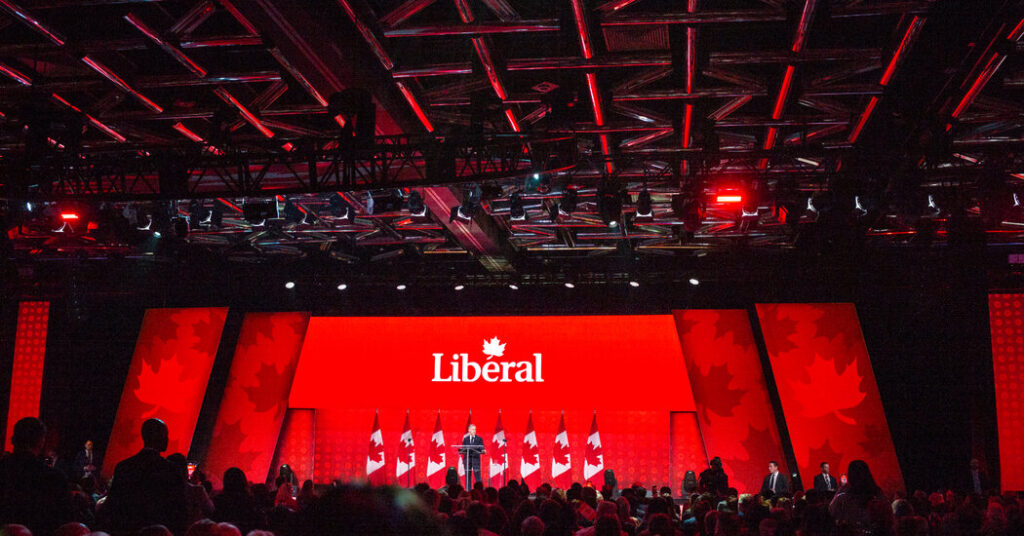
At his party’s convention this weekend, Mr. Carney couched his triumph in a we-live-in-extraordinary-times terms, casting his projected new majority as a kind of national unity government.
“This is not the time for politics as usual, for petty differences, or for political point scoring,” he told party faithful in Montreal. “Members of this House are choosing to join us because they understand the stakes — they know that a house divided cannot build, but a nation united is unstoppable.”
Mr. Carney’s government is starting negotiations with the United States to decide the future of a vital free-trade agreement between the two nations and Mexico. Failure to deliver on a favorable deal for Canada will be a big hit to him, but, no longer necessarily fatal to his government.
And beyond the trade talks, Mr. Carney has set in motion an ambitious agenda to wean Canada off an increasingly erratic United States.
He wants to spend taxpayers’ money to build major infrastructure. He has been scouring the globe seeking new trade partners, including with governments that are not democratic. He has boosted Canada’s military spending even as its health care system struggles, and he is evangelizing drilling and digging to bring more Canadian oil, gas and minerals to market.
These plans involve flexing the state’s power over dissenters such as some Indigenous groups, well-established environmental advocates, progressive members of the Liberal Party and the Conservative opposition. It also requires deficit spending and accumulating more debt in a country where most political forces and voters are fiscally conservative.
A number of factors could still derail Mr. Carney’s carefully laid plans, Ms. Kurl said, including an economic downturn, increased volatility from the White House, bubbling concern among voters that their priorities are being ignored and a regrouped and ascendant Conservative Party.
But, for now, Mr. Carney seems unstoppable.
“Look at what he has been able to do; ‘remarkable’ is just not the correct word,” Ms. Kurl said. “He took a party that was a bus with no brakes headed for a brick wall and somehow managed to not only pull it from the brink of oblivion, but then within a year, get it into a majority position.”
She added: “It comes down to, do you want to be on the winning team, or do you want to be on the losing team?”
Matina Stevis-Gridneff is the Canada bureau chief for The Times, leading coverage of the country.
The post Carney Seals a Majority and Remakes Canada’s Liberal Party appeared first on New York Times.