One day in February, under a relentless midday sun, I arrived in a small village in South Sudan, just across the border from the Sudanese civil war, which will enter its fourth year on Wednesday.
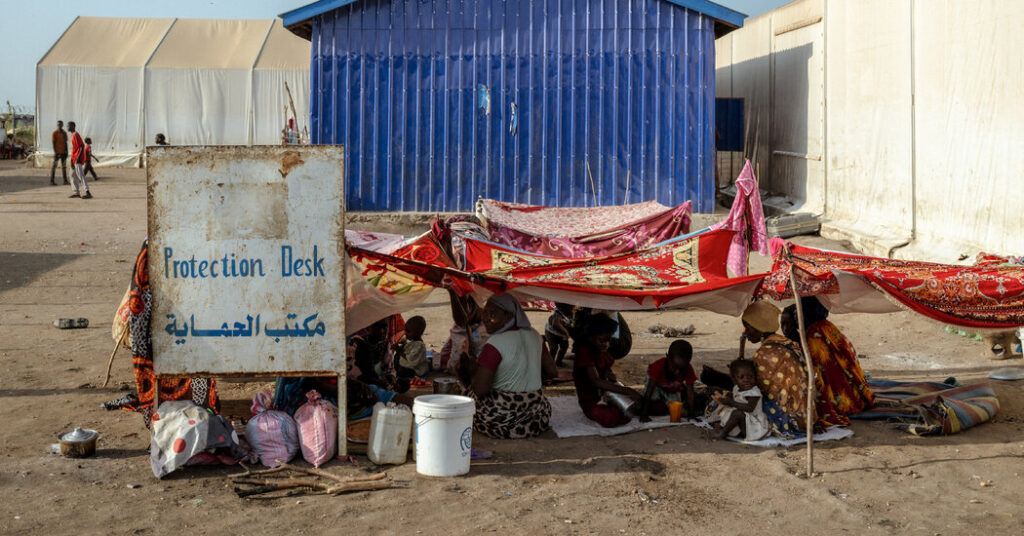
Twelve women, some of whom had fled the bombing of Sudan’s capital, Khartoum, and others who had run from ground attacks on small towns and remote villages, were sitting in a circle together under a tent where they had gathered to sew. “It releases us,” one woman explained.
I had just asked a delicate question, about whether any of the women could confirm reports that sexual violence was being used as a weapon in this war. Heads lowered. This is exactly what many women fleeing the conflict don’t want to talk about, even to their families. Still, one by one, they answered, describing attacks on women and girls by fighters on both sides.
Amna Osman Mohammed, a young mother, said she was hiding in the bush when she witnessed fighters threatening a family of four. “Either we rape your girls, or we will kill your wife,” she recalled a man saying. She watched as the father stepped forward and said, “Kill me, not my family.” That’s when they shot him, then his wife, before one of the daughters suddenly “took the gun and shot her sister and then herself,” Ms. Mohammed said.
“Women are always in danger,” another woman in the circle finally said.
For over three years, the Sudanese Army has been fighting the Rapid Support Forces, a paramilitary group that evolved from the Janjaweed militias accused of genocide in Darfur. These two forces, which once worked together under the ousted leader Omar al-Bashir, are vying for control of the oil- and gold-rich nation. Both sides have committed atrocities. According to The Times’s reporting, military backing for the rival forces has been supplied by Egypt, Saudi Arabia, Qatar, Turkey, Iran, Russia and the United Arab Emirates, which that nation has denied.
So far, a staggering 13.6 million Sudanese have been forced to flee, according to the World Health Organization’s estimate. The World Food Program has said the country is enduring the world’s largest hunger crisis.
Over 40 percent of the population faces acute food insecurity; children are dying of malnutrition. High on the list of areas in the world where the United Nations has warned that hunger is at catastrophic levels are Gaza and Sudan.
Despite all this, the crisis receives only a small fraction of the humanitarian aid that’s needed, in large part because of deep cuts in U.S. aid. Survivors of the war whom I saw in another town, Renk, arrived at a U.N.-run center there exhausted, devastated and hungry. They weren’t offered a warm meal, but a small biscuit. Sometimes there weren’t even biscuits, workers told me.
Nearby, a transitional center run by the U.N. refugee agency provides beds and blankets to survivors, but it has long since run out of room; it was built for 3,000 people and now shelters some 9,000. Thousands of others who have fled to Renk, including families, sleep out in the open or in rough shelters they build themselves of sticks and cloth.
Since the refugee agency, formally named the U.N. High Commissioner for Refugees, was established in 1950 to aid the millions of people displaced by World War II, it has worked as a last line of defense for people fleeing war and persecution. Now the system is struggling to fulfill that mission. “We don’t have the funds to be the last resort anymore,” Carla Calvo, a veteran agency worker, told me.
Is it too much for us to care about the world’s largest humanitarian disaster? So many of us are overwhelmed by a world that feels increasingly chaotic. Like others, I’ve found myself wondering how much more I can absorb. Why not turn away and let myself be distracted when I am powerless to do anything about it?
Here is the problem with that: I know something can be done. Throughout my career, I have witnessed what can happen when Americans care about a wrong in the world — how the United States responded to ethnic cleansing in Kosovo, to tsunamis in Southeast Asia and Japan, to a devastating earthquake in Haiti.
Americans who spoke out against the war in Darfur in the 2000s did not end the Janjaweed’s ethnic targeting, but they helped fund a humanitarian response and almost certainly influenced the U.S. government’s decision to tighten sanctions on those involved, which, in turn, put pressure on the Sudanese government to reach a peace deal.
When we care — as individuals, as a nation — we can make things happen. This is the real source of America’s greatness. The women I met that day didn’t have the luxury of not caring. And neither do we.
Ann Curry is a former anchor and national and international correspondent for NBC News. She is a Trumbull and Chubb fellow at Yale University, where she has also been a Poynter fellow and volunteers for the U.N. refugee agency.
The Times is committed to publishing a diversity of letters to the editor. We’d like to hear what you think about this or any of our articles. Here are some tips. And here’s our email: [email protected].
Follow the New York Times Opinion section on Facebook, Instagram, TikTok, Bluesky, WhatsApp and Threads.
The post Is It Too Much to Ask to Care About Sudan? appeared first on New York Times.