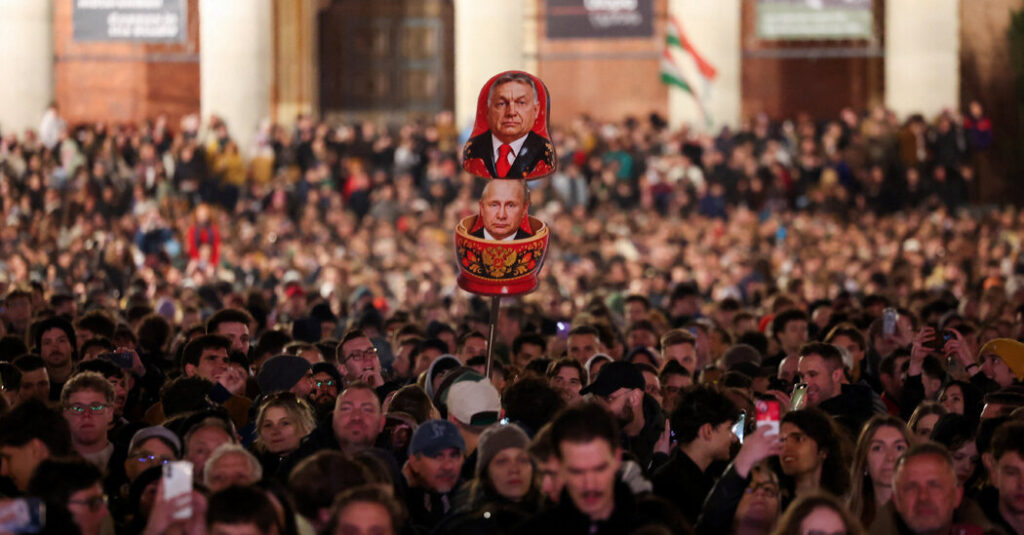
Prime Minister Viktor Orban’s crushing loss in Sunday’s election in Hungary deals a serious blow to the Kremlin, which for years relied on Budapest as a rare friend inside the European Union. But Moscow still retains significant energy leverage over the landlocked nation, complicating any aggressive break with Russia.
That reality creates a delicate situation for the incoming prime minister, Peter Magyar, whose Tisza party won a large majority in Parliament in part by vowing to normalize tense relations with the European Union and NATO.
On the campaign trail, Mr. Magyar said that Hungary did not want to become the first American-Russian colony, referring to Mr. Orban’s support from both President Trump and President Vladimir V. Putin of Russia. Mr. Magyar vowed to support a free, European Hungary, to root out corruption and to take a cleareyed approach to Moscow.
“Anybody who knows Hungarian history knows that we were attacked many times by Russia,” Mr. Magyar noted in an interview with The New York Times this year.
Still, Mr. Magyar signaled that he would not fully sever ties with Moscow, embracing pragmatism given the energy dependency that Mr. Orban’s government has built up over 16 years in power. Mr. Magyar will inherit a struggling Hungarian economy that imports more than 80 percent of its natural gas and crude oil from Russia. He said that Hungary would work to diversify its energy supplies but laid out a distant timeline for doing so.
That is likely to give Moscow some influence in Hungary for years to come. But more immediately, the election defeat of Mr. Orban deprives Mr. Putin of one of his most effective allies in advancing his goal of dividing Europe, which the Russian leader has come to see as a bitter adversary.
Mr. Putin’s estrangement from the continent hardened after it largely rallied around Ukraine in the war that Russia started more than four years ago. Mr. Orban was the European Union’s most vocal internal critic, and he often stood in the way of the bloc’s policy goals.
Mr. Orban’s actions stalled European responses to Russia’s invasion, including by blocking a loan of 90 billion euros, about $105 billion, to Ukraine and sanctions packages targeting Russia, and by opposing the opening of talks to bring Kyiv into the union. His continued purchases of Russian energy helped Moscow retain an economic foothold in Europe as most of the rest of the continent moved to cut such ties.
The Kremlin will probably try to adapt to the new Hungarian government, said Andras Racz, a senior fellow at the German Council on Foreign Relations, a research group.
“The Orban government was not a moral ally, not a spiritual ally. The Orban government was a pragmatic, corrupt ally,” he said. “If such an ally loses power, Russia is usually ready to drop these guys or push these guys under the bus.”
Mr. Magyar’s victory was so convincing, Mr. Racz said, “that it would be simply irrational for the Kremlin not to shift.”
That shift was already evident on Monday.
“Hungary made its choice. We respect that choice,” the Kremlin spokesman, Dmitri S. Peskov, told reporters. “We expect that we will continue our very pragmatic contacts with the new leadership of Hungary.”
Mr. Peskov said that Russia would like to continue to have a positive relationship with Hungary and noted that maintaining dialogue would be good for both Moscow and Budapest. Russia is and will remain “one of the most reliable suppliers of energy in the world,” Mr. Peskov added.
Russia played a significant role in the election, with Moscow working actively to sway the vote in Mr. Orban’s favor, according to analysts, who noted that Mr. Orban’s campaign messages demonizing President Volodymyr Zelensky of Ukraine borrowed from Russian intelligence talking points.
Those efforts, however, were hurt by leaks of calls and transcripts in which Mr. Orban and his lieutenants pledged fealty to officials from Moscow. Some Hungarians chanted anti-Russian slogans during rallies for Mr. Magyar and his party, Tisza.
“Much of Hungary voted for Tisza because they wanted to get rid of this Russian dependency,” said Zselyke Csaky, a senior research fellow at the Center for European Reform, based in Brussels. “But once governing starts, and Tisza has more clarity on what this relationship means, perhaps they will have some hard decisions to make.”
One place where there will be immediate change is in Russia’s influence over Hungarian media and security services, Mr. Racz, the analyst, predicted. He said that the new government would almost certainly move quickly to sever ties that Mr. Orban had developed and might politely send certain Russian diplomats home.
Additionally, Hungary is very likely to stop playing a spoiler role in the European Union’s efforts to support Ukraine. But Ms. Csaky said that she expected Mr. Magyar to remain cautious in his Ukraine policy, given divisions in the Hungarian electorate and the continued energy dependency on Russia.
As Hungary looks to find new energy sources, Mr. Racz said that the incoming government would likely start with Russian oil, the easiest energy source to diversify. Ending its dependency on Russian natural gas and nuclear power will be more difficult, Mr. Racz noted.
In 2021, Hungary signed a 15-year contract for Russian natural gas that could be impossible to exit quickly. And nearly half of the country’s electricity comes from a Soviet-built power plant in Paks, southern Hungary. That facility uses Russian fuel and is being expanded by Russia’s state nuclear giant in a deal that could be hard to unwind.
Mr. Magyar has said that, before making any decisions, he needs to understand the details of the energy contracts that Mr. Orban signed with Russia.
The new Hungarian government is likely to try to make Russia compete with alternative energy suppliers rather than push Moscow out entirely, Mr. Racz said.
“In terms of energy security, radical immediate changes are very, very rare,” he said. “So, yes, Russia maintains certain leverage.”
Paul Sonne is an international correspondent, focusing on Russia and the varied impacts of President Vladimir V. Putin’s domestic and foreign policies, with a focus on the war against Ukraine.
The post Hungary May No Longer Be Putin’s Ally, but It Can’t Afford a Full Break appeared first on New York Times.