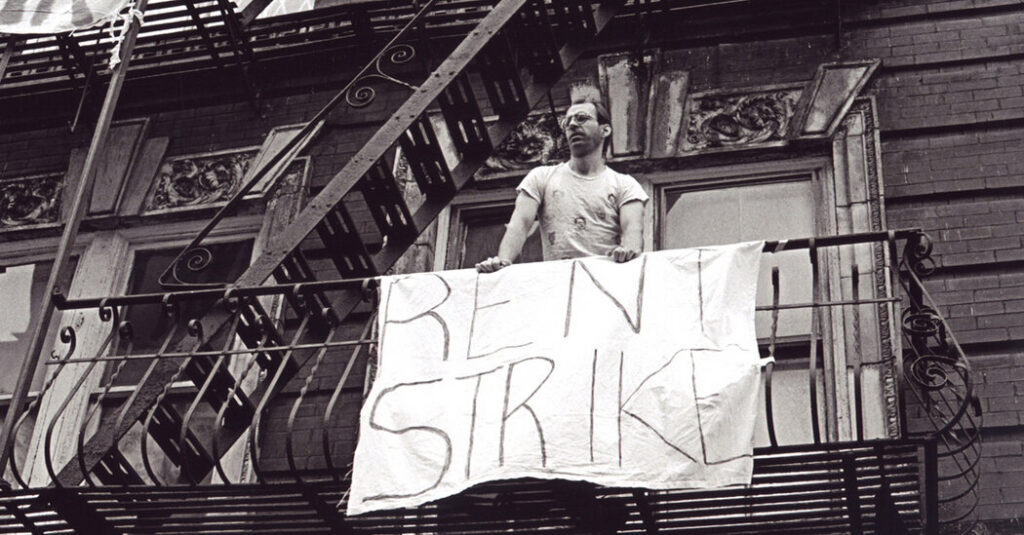
Mac Cohen (David Brisbin), the 30-something protagonist of Philip Hartman’s “No Picnic,” shot in 1985, is a failed musician living the East Village tub-in-kitchen life. He and fellow tenement residents have been on rent strike for two years. Bad-tempered neighbors pound on his door. Prostitutes ply their trade, sharing the garbage-strewn block with blanket sales of household possessions. The temperature is a brain-boiling 97 degrees and yet “No Picnic” feels weirdly Arcadian.
The movie, which had its restoration premiere earlier this year at the Museum of Modern Art’s annual To Save and Project series, is revived for a week at Film Forum, through April 23.
After four decades, “No Picnic” is less a walk on the wild side than a stroll down memory lane, past a barbershop with a handwritten sign in the window: “Punk Haircut Any Style $2.75.” As shot by the experimental filmmaker Peter Hutton, a master of urban landscape studies, the movie is steeped in local color, albeit rendered in grainy black-and-white.
Formerly a member of a band named Three Legged Dog, Mac keeps close to the music by servicing jukeboxes, a premise that allows the film to commemorate a good number of long-gone dive bars. Commenting on the action in a voice-over that owes a debt to Raymond Chandler, Mac is himself something of a relic. (With his round glasses, receding hairline and perpetual T-shirts, he suggests a depressed version of the Alphabet City legend Keith Haring.)
Mac drinks in grungy watering holes — one amusingly identified as the Club 86, a last refuge for obnoxious problem patrons. He passes through street fairs and neighborhood “gardens,” jumps the line outside a makeshift music venue, and makes occasional side trips to visit Mom in the suburbs or watch the Mets at Shea.
There is no shortage of back story. Mac is haunted by memories of an old girlfriend who has enlisted in the Air Force; he fends off an amorous upstairs neighbor and attempts to avoid people who knew him when. Still, as the New York Times critic Caryn James wrote in a mixed but sympathetic review when “No Picnic” opened at Anthology Film Archives, where it played for much of the summer of 1990, “Mac’s life crisis is never as convincing or as subtly portrayed as his surroundings.”
Indeed, Mac’s voluble alienation and shambolic search for a mysterious woman distract from Hutton’s superb images. Albeit seasoned with clever one-liners (“Believing in something went against everything I believed in”) and observations (“I had the feeling I was in the middle of a party I hadn’t been invited to”), Mac’s world-weary commentary can itself grow tiresome. No question that “No Picnic” looks better than it sounds. The East Village’s seedy glamour has never been more lovingly presented.
As a celebration of community, “No Picnic” was in some ways prophetic. A few months after the movie was first shown at the Sundance Film Festival, where it won an award for Hutton’s cinematography, Hartman and the producer Doris Kornish opened Two Boots, a pizza parlor and eventual cultural center on Avenue A which, among other things, boasted a vintage jukebox.
No Picnic
Through April 23 at Film Forum in Manhattan, filmforum.org.
The post ‘No Picnic’ Is a Walk Down Mean Street Memory Lane appeared first on New York Times.