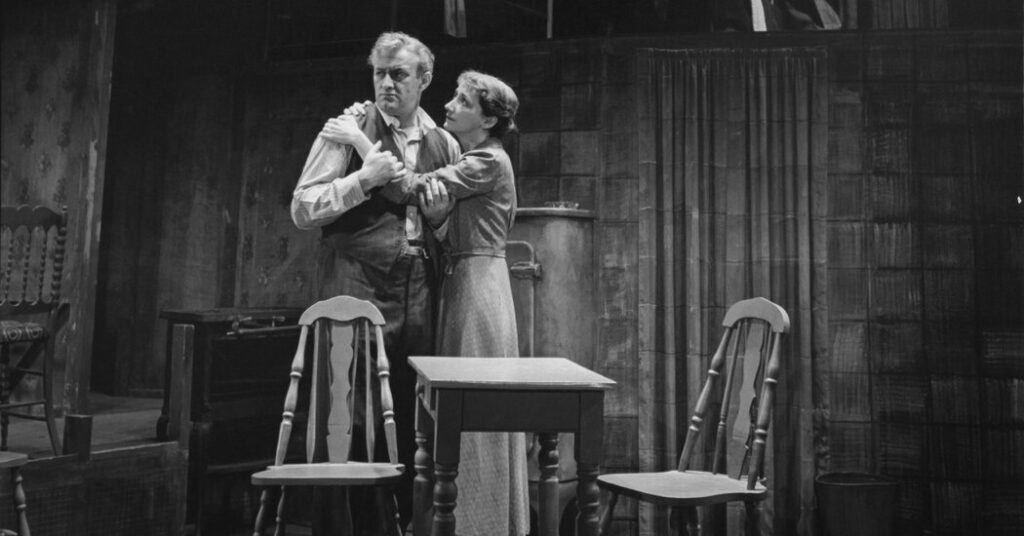
I first met the salesman Willy Loman in 1975. I was 15 when I sat beside my father at the Circle in the Square Theater. I’ll admit that on that first encounter, what I was seeing onstage did not make much of an impression. What did, however, was my seeing tears streaming down my dad’s face for virtually the entire performance.
I had never seen him cry before (nor have I since). I had trouble believing that he was not only weeping, but doing so in public. This was not something, as I understood it, that grown men did.
Weeping, it should be said, is not an uncommon reaction to Arthur Miller’s “Death of a Salesman.” If you happened to be seated next to me at the play’s fourth revival, in 2012, you would have seen yet another middle-aged man sobbing in his seat — though in my case, not for myself so much as for the man who raised me. From its opening night in February 1949 to the current sixth and ecstatically reviewed revival, “Salesman” has been a play that cracks the steeliest of men and women.
Like Willy, my dad, now 95 and long retired, was a Jewish traveling salesman. And, like Arthur Miller, he came of age when, thanks largely to the Holocaust, Christian America was reconsidering its own deep-rooted antisemitism. At the same time, Jews were testing the opening of boundaries that had denied them professional opportunity but also kept their communities tight-knit, with strong social networks of mutual support.
As did so many Jews of his generation, my father — armed with a City College engineering degree after a short stint in the Air Force — had emerged from a poverty-stricken childhood to become a success: Unlike Willy Loman, who was stuck in Brooklyn in a house surrounded by buildings that blotted out the sunlight in his yard, he had a nice home in the suburbs and paid — in full — college tuition for three children. It was a life that his Yiddish-speaking immigrant parents could have barely imagined.
But the cost? Well, he never talked about the cost. I was crying, I imagine, about the price he paid, though even today, I can’t say I know my dad well enough to describe what exactly he thought it was. That’s how dads were in those days.
“Death of a Salesman” is about many things: the cruelty of capitalism, of old age, of the pressure to be perceived by one’s peers as a “success,” as well as the demands of filial piety and self-delusion. Though Arthur Miller long denied it, the play is also about problems facing American Jews after the discovery of the Holocaust and the founding of the State of Israel: Just how Jewish should — or could — an American Jew be?
That’s not to say there are clear Jewish markers in the play. Willy can be seen as a sort of bland American male archetype: His sons are called Biff and Happy, and Biff is a star player in what was then the decidedly non-Jewish sport of football. The Lomans celebrate no Jewish holidays and evince no concern whatsoever with world events facing Jews in the 1940s, either in post-Holocaust Europe or in the new nation of Israel. They are given no history, nor any anchoring in any ethnic, much less religious, tradition.
And yet, as Samuel G. Freedman wrote in The Times back in 2012, Miller could never escape the charge that he had written a play that could only be about Jews, even as he had tried to hide their identity in order to address what he considered to be the crisis of the common man.
At the time he wrote “Salesman,” Miller was still a Marxist, hardly unusual for Jewish intellectuals of the 1930s and ’40s. Unlike most of them, however, he remained as faithful to using his gifts as a storyteller to exposing and critiquing capitalism as he had when, as a young man, he committed to getting involved with any number of what were then clearly Communist front organizations. Though Miller denied having formally joined the party, he was more than willing to sign petitions, speak at rallies and contribute to the pro-Communist magazine New Masses under a pseudonym. By the late 1940s, he had already managed to earn more than 200 references in various F.B.I. files.
Further, Miller faced antisemitism many times, both as a blue-collar laborer and while trying to get his early work published and performed.
For decades, Miller complained that critical arguments about Willy’s alleged Jewishness represented a degree of “parochialism” he could not countenance. By 1999, a half-century after the play’s Broadway debut, he was finally willing to admit that the Lomans were a Jewish family that had traveled “light-years away from religion or a community that might have fostered Jewish identity.”
Without intending it, what Miller achieved in “Salesman” was to illustrate the age-old conflict of Jewish universalism versus its particularism in one character. It is a play that simultaneously creates a story about the tragedy involved with simply being human while speaking to age-old Jewish fears and aspirations. Are we Jews or Americans first? Is it even up to us?
Now that the so-called Zionist consensus that once sustained most American Jews until recently is openly fracturing, how will everyday Jews manifest their differences from American Christians and do they even want to? What are those Jews who are desperate to assimilate into the American mainstream likely to find there anyway? Will it be satisfaction with “success?” Will they, like Willy, die trying? Or will they, like my father, myself and so many others, end up crying in the seats as the curtain comes down, without fully being able to explain, much less understand, why?
Now Nathan Lane, a Jesuit-educated Catholic who has made a career of playing some of the most prominent Jews in the history of American theater — including Roy Cohn in “Angels in America” and Max Bialystock in “The Producers” — has stepped into what is almost certainly the most famous maybe-Jewish role in American theater. I still don’t know what made my father cry seeing “Salesman” the first time. But I know that when I see it again, he’ll be right there in my head, crying alongside me at the final curtain, with a degree of power and intensity that neither one of us will ever likely fully understand.
Eric Alterman is an English professor at Brooklyn College and the author of “We Are Not One: A History of America’s Fight Over Israel.”
The Times is committed to publishing a diversity of letters to the editor. We’d like to hear what you think about this or any of our articles. Here are some tips. And here’s our email: [email protected].
Follow the New York Times Opinion section on Facebook, Instagram, TikTok, Bluesky, WhatsApp and Threads.
The post Why American Jews Still Weep for Willy Loman appeared first on New York Times.