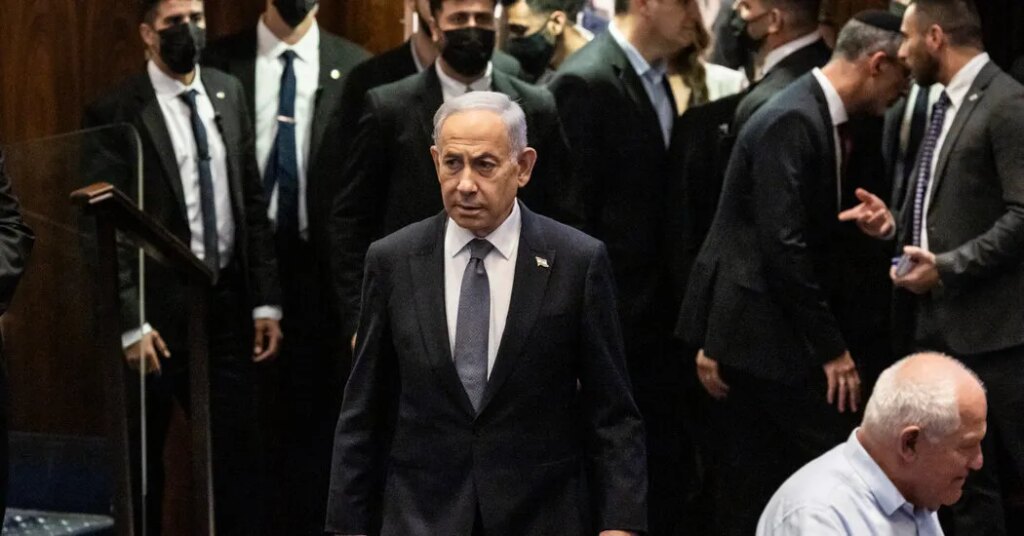
Talks on Sunday between Prime Minister Benjamin Netanyahu of Israel and his chief political rival, Gadi Eisenkot, to form a power-sharing unity government ended without agreement, according to party officials.
The two men’s parties said in a joint statement that the discussion “was businesslike, with both sides seeking to bridge the substantial differences between them,” but no plans were announced for further talks.
A representative of Mr. Netanyahu’s party, Likud, speaking on condition of anonymity to discuss sensitive negotiations, later said that the talks were over and would not be renewed. Officials from Mr. Eisenkot’s bloc said that Sunday’s unity talks did not produce any agreement.
That made it more likely that Mr. Eisenkot, a center-right former military chief who focused his recent election campaign on ousting Mr. Netanyahu, would proceed with his efforts to form a minority government made up of parties opposed to the prime minister.
These were the first formal coalition talks between Mr. Eisenkot and Mr. Netanyahu since last month’s inconclusive election, which left neither with a clear path to forming a new government. Mr. Netanyahu’s right-wing and religiously conservative coalition received 53 seats in the 120-member Parliament, while the core parties in the bloc supporting Mr. Eisenkot got 48.
The opening for the talks came on Saturday night when Mr. Netanyahu offered a major concession to his opponent, proposing a unity government in which both men would serve as prime minister, with Mr. Eisenkot going first.
The two have little mutual trust, however, and Mr. Netanyahu has a history of crossing rivals who ally with him, making the prospect of such cooperation a long shot.
Israel’s president, Isaac Herzog, granted Mr. Eisenkot the first attempt at forming a new government after he received endorsements from 67 members of Parliament, those of his core bloc and an additional 19 from Arab-led parties. Mr. Eisenkot has about a week left to complete the task under that offer, though the president could also agree to an extension of up to two more weeks, if requested.
Mr. Eisenkot has so far struggled to build a coalition that his allies could sign up to. Israel’s Arab-led parties, which also oppose Mr. Netanyahu, won a record number of seats in the election, giving the anti-Netanyahu bloc a clear parliamentary majority. But many Jewish Israelis reject the idea of a government that depends on Arab support, particularly after the war in Gaza, which was ignited by the Oct. 7, 2023, Hamas-led attack on Israel, and because of other unresolved regional conflicts.
Disagreements within Mr. Eisenkot’s diverse bloc have added to his predicament. Naftali Bennett, the leader of Together, a party in the bloc that won 12 seats, favored a unity government and had called on Mr. Eisenkot to exhaust negotiations with Mr. Netanyahu before opting for a narrower coalition.
Other leaders in the bloc — Avigdor Liberman, a right-winger, and Yair Golan, on Mr. Eisenkot’s left flank — have urged him to stay firm in his resolve to remove Mr. Netanyahu from government.
“Gadi, the Israeli public is behind you,” Mr. Golan, the leader of the left-wing party Democrats, said in a social media post after the meeting on Sunday. “Now is the time to form a genuine government of change, without those responsible for the October 7 failure,” he added, referring to the Netanyahu government.
The post No Sign of Unity Deal in Israel as Netanyahu-Eisenkot Talks End appeared first on New York Times.