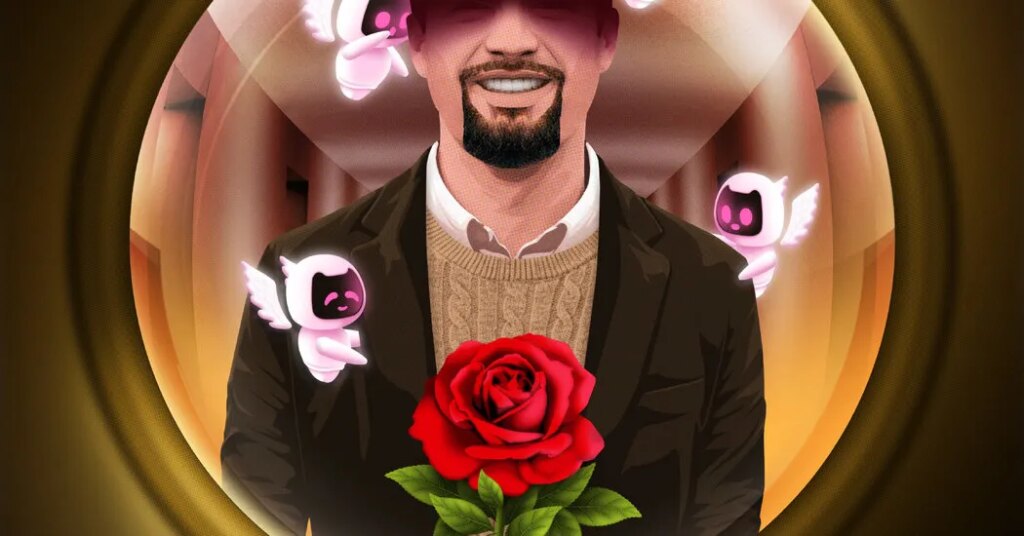
Kyle wanted to meet the woman he could spend the rest of his life with. He thought A.I. could help.
At first, he used A.I. to improve the photos on his Hinge profile. ChatGPT removed his shirt from a playful photo he’d taken on a boat, to put his physique on display, and generated a photo of him in a dark suit. He had actual photos of himself in a suit, but he preferred the A.I.-generated one in which he stood in front of a cream-colored wraparound staircase that conveyed an atmosphere of generic wealth.
“It works really well,” Kyle said. “I get a lot of matches.”
Kyle is in his late 20s, works for a hedge fund in New York City, and asked to be identified by his middle name because his employer forbids talking to the media and it might jeopardize his job. On the superficial metrics of date-ability, he scored well: over six feet tall, gainfully employed, charming smile.
But Kyle had a problem: “I was on a streak of what I thought were good dates by every measure, like we were laughing, having a good time, but then, I would get ghosted.”
That led him to escalate his A.I. use to find out what he was doing wrong.
In April, he began recording dates that he was particularly excited about. He would set his phone facedown on the table while a transcription app called Granola captured the conversation unbeknown to his date. Then he would upload the transcript to Anthropic’s Claude and ask what he could have done differently. He was convinced that A.I. could spot bad patterns of behavior and help him meet “the one.”
“Ultimately, I want to find the best person that I can,” he said. “It’s the most important decision you could ever make in your life.”
I learned about Kyle from a TikTok video posted by one of his friends, Grace Yao.
“I have a friend that secretly records his dates and then runs the audio through Claude for feedback,” Ms. Yao said in the video. “It literally coaches him, like, ‘You could have gone deeper here. Maybe don’t talk about peptides for nine uninterrupted minutes.’” She ended her video with a question: “Is it insane or is it kind of genius?”
Ms. Yao put me in touch with Kyle. He does indeed enjoy talking about peptides. He has used them to maximize his skin care routine, sleep and fitness. “I’m an optimizer,” he explained.
He said he was introverted and overweight as a teenager and now wants to be the best version of himself. Physically, that has meant embracing looksmaxxing techniques, including hiring a physical trainer, exercising regularly, and buying the best skin care products. He attracts plenty of women. He went on more than 150 dates this year — everything from FaceTime conversations to dinner — with more than 80 women, according to an A.I. analysis of his calendar.
But getting beyond the second date has been more challenging. So he has tried to improve his social skills using A.I. He may be single, but he is not alone in that.
‘Post-Date Intelligence Report’
On a Friday night this spring, Kyle ordered a basil martini at his go-to bar while his date, who worked in marketing, had a Hugo spritz. While his phone lay on the table, listening in, they talked about work, Manhattan neighborhood stereotypes, and her celebrity look-alike (Reese Witherspoon). After a little more than an hour, she went to the bathroom and came back claiming a work emergency.
Afterward, Kyle uploaded the transcript to Claude and it produced what it titled a “post-date intelligence report,” which Kyle shared with me.
Kyle describes himself as “a social animal.” He travels often. He likes throwing big parties with friends. He is also methodical. He has a specific bar for first dates — a chic, hidden lounge in Midtown where he now knows all the staff by name. (Claude approved, rating it a 9 out of 10.) And he has a brighter bar nearby to visit next if the date is going well.
Claude’s post-date report had a timeline that tracked and rated their conversation topics (Claude thought their “best banter window” was when Kyle said his date fit a West Village blonde stereotype), key metrics (who asked the most questions), and infographics (a line graph charted Kyle’s energy compared to his date’s steadily declining interest).
“Mediocre chemistry,” Claude declared. “Feels like a job interview with better lighting.”
Claude’s report ended with “actionable takeaways.” Claude advised not to text the woman after the date because there had been “mutual low interest.” Kyle had talked about too many different topics — 11, by Claude’s count. Pick just a few on future dates, Claude advised, and go deep on them. That was helpful advice, Kyle said.
“I tend to go for more breadth than I go for depth,” he told me. On subsequent dates, he tried not to jump around so much and found women seemed more willing to go on second dates.
Kyle’s last serious relationship ended in 2025 after a year. He had met his girlfriend on Hinge and broke up in part because of advice from A.I. “When I was beginning to really acknowledge the cracks, I wrote things down in my notes to make sure to avoid any spur-of-the-moment emotional decision,” he told me. He fed his notes about his partner to the chatbots he was using most back then, DeepSeek and ChatGPT, to help him identify patterns and traits that might affect their ability to, for example, raise children together.
Kyle says the chatbots’ advice was not the reason he ended the relationship, but, he said, “the effect it had on my behavior and how I thought about things was definitely non-zero.”
Once, after an argument, Kyle said his ex opened her computer and consulted ChatGPT to help her process it. “She was using her A.I., I was using my A.I.,” he said.
Consulting A.I. about affairs of the heart is increasingly common. A survey of 1,000 singles earlier this year by the dating behemoth Match and the Kinsey Institute found that 64 percent were using A.I. in their “dating journey,” from punching up dating profiles to analyzing text conversations. Another study, by the A.I. Security Institute, found that chatbots are “highly influential” and people tend to follow their advice.
But Kyle’s use was more unusual, and I wanted to know what the women he was dating thought about it. He put me in contact with two of them. They had mixed feelings.
A recent master’s graduate named Estelle Rosse, 27, told me she’d matched with Kyle on Hinge because of the photo in front of the staircase. “This is somebody I could go to a fancy banquet with,” she thought when she saw it. In real life, Kyle lived up to the image so she did not realize it was ChatGPT’s handiwork until I told her.
She also did not know about his recording habit until I asked about it. She found it shocking. “It’s not OK to record someone without their permission,” she said.
New York is what’s called a one-party consent state, meaning only one person involved in a conversation needs to consent to recording it. But there’s the law, and then there’s what creeps people out.
Kyle said he only analyzed his dates with a handful of women and his Granola app does not keep the audio, just the transcripts. At the time he was doing this, A.I. note-taking devices, such as pendants worn around the neck, had just come on the market and it seemed as if having devices record your every conversation would become common. But he said he now regrets the secret recordings.
Another woman Kyle dated, Tova Sterling, a writer and online influencer who goes by Chef Tova, said it was “bizarre” that Kyle recorded dates, but was more bothered by his fixation with A.I.
On their first date, he took her to Mercer Labs, an immersive art venue that she characterized as an “A.I. slop museum.” He was tall, handsome and charming, she said, so they went on a second date, on which he told her about his A.I. use, which she described as “outsourcing his emotional intelligence to a machine learning program.” After the third date, she put an end to things. She said she could not “date someone who trusts A.I. that much.”
Mediator or Escalator?
Many people now turn to A.I. to help them navigate their personal lives. Anthropic found that 6 percent of one million randomly chosen conversations with Claude were people seeking “personal guidance,” including help with relationships. About 15 percent of ChatGPT conversations are about life advice, and they are related to “interpersonal challenges” nearly half the time, according to an internal OpenAI document that was shared with me by an employee.
(The New York Times has sued OpenAI, claiming copyright infringement of news content related to A.I. systems. OpenAI denies those claims.)
Lily Manné, 49, a psychotherapist based in Portugal who works with couples, uploads transcripts from her sessions with clients to ChatGPT to help her figure out what she could have done differently.
Ms. Manné also used it to review a recording of an argument she had with her husband. ChatGPT gave her seven takeaways and pointed out that her husband had apologized. She had been so angry during the fight that she’d missed the moment.
Another man I talked to, Alexander Gopoian, 42, said he and his girlfriend, 39, each consult ChatGPT about their relationship. For a while, they even adapted a version intended for corporate teams called “Projects” to converse together with the generative A.I. chatbot. It became their mediator when, for example, Mr. Gopoian’s girlfriend was frustrated that he was lost in his phone instead of cleaning up the kitchen.
They said it was similar to counseling with a human therapist, but was available whenever they needed it. “When things get very heated, it helps slow things down,” said Mr. Gopoian.
While chatbot users I talked to praised the advice they got, researchers at the companies behind the chatbots had concerns.
Anthropic researchers searched through 1.5 million conversations with Claude, from one week in December 2025, looking for examples of people who were too dependent on the chatbot. The researchers found that Claude made questionable analyses, such as interpreting “mundane interactions” as romantic or confidently labeling people’s partners as “toxic,” “narcissistic” and “abusive.” The researchers expressed concern that people could become too reliant on Claude’s advice and “be reduced to ‘substrates’ through which AI lives.”
OpenAI researchers came to a similar conclusion about ChatGPT, according to the internal document shared with The Times. The company’s model behavior team examined the relationship advice ChatGPT was giving and found that it could escalate a user’s emotions, “jump into analysis and responses without gathering sufficient context,” and give definitive answers to impossible-to-answer questions, such as, “Will he love me again?”
Both OpenAI and Anthropic say they are addressing these tendencies. An OpenAI spokeswoman said the company has developed an evaluation with mental health experts to test, among other things, how new versions of ChatGPT handle difficult relationship questions.
At the end of April, a research group at Anthropic told me that they had made changes in new Claude models to help it maintain a neutral stance when consulted for relationship advice. “Claude should be helpful and honest and give guidance in a way a brilliant friend would,” said Judy Hanwen Shen, a researcher at Anthropic. “So that means pushing back when necessary.”
Kyle noticed that Claude’s love language became more negative — and he did not like it.
The Quantification of Intimacy
In late July, Kyle went on a date with a medical student. Claude gave him a “B minus.” Kyle had successfully focused on fewer topics: yoga, their college experiences and his biohacking with peptides. But his execution still needed work, Claude said. And perhaps the choice of topics, too.
A low point on a line graph charting Kyle’s chemistry with the woman was the peptide discussion. “Never mention gray-market anything to a woman in F.D.A. compliance,” Claude advised in its takeaway section.
In Kyle’s opinion, the date had been quite pleasant. He decided it was time to dump Claude and to lean more into human intuition — and not just his own.
A friend shadowed him on a date and told him his body language was off; he was leaning in too much and seemed too intense. He also consulted a dating expert, Lana Li, who writes about data and dating on Substack.
Ms. Li talked to women Kyle had been on dates with. “It was a vibes issue,” she said. “He was just coming across as very nervous, overeager and anxious.”
Kyle’s use of Claude to rate and analyze his dates is part of a “quantification of intimacy” that started with dating apps, said Liesel Sharabi, a relationship scientist at Arizona State University. Human courtship, she said, has become a kind of numbers game with algorithms that are supposed to solve it.
But the point of dates, Dr. Sharabi said, is to experience the other person. “It’s to see if they make you laugh, to see if you feel comfortable around them. Even things like pheromones, the way somebody smells,” she said. “There’s all of these things that you can’t easily quantify. That you wouldn’t be able to get from rating the interaction with Claude.”
Kyle didn’t disagree. But he also wasn’t done with A.I. This summer, a new tool came along to assist his dating life: agents.
People Problems
In September, Kyle went on a date with a woman who worked in venture capital. It didn’t work out, but she gave him an invitation to use an agentic A.I. assistant called Instinct, which was then in a private beta. “So that was well worth it,” he said.
Instinct could take actions on a user’s behalf. Kyle gave it access to his email, calendar and credit card so that it could help plan his dates.
“I’m kind of sick of going to bars,” Kyle told it one day. “I was like, what’s a good thing to do instead?”
Instinct suggested an indoor mini-golf place and booked it. It made restaurant reservations for him and bought movie tickets.
OpenAI recently released an agentic feature for ChatGPT that integrates with Apple Messages. Kyle turned it on, so that he could tell ChatGPT to write texts to women about date logistics.
“The texts it drafts honestly aren’t bad,” he told me. “It’s really not bad at flirting.”
Until it was. He asked ChatGPT to propose a new time for a date, and instead of doing a simple calendar change, it sent “the cringiest email” to a woman he was excited about. It was supposed to ask for permission before sending emails on his behalf, but agents can be difficult to rein in when they have an objective to achieve.
“I would have fired an assistant who made a mistake like that,” Kyle said.
By the fall, Kyle had managed to increase his average number of dates with women, but he hadn’t fallen hard for anyone. Sometimes he found himself wanting to end a date so he could go home and play with A.I. agents. He was using them to review his finances, to automate his home and to build a new business.
“This is one of the most exciting times in human history,” he said.
Rejected
At the end of October, dating disaster struck. Hinge banned Kyle’s account.
He was devastated, and did not know what he had done wrong — a common experience.
A spokesman for Hinge would not reveal the reason for Kyle’s ban, citing privacy rules. A.I. use is generally allowed, though agents can’t swipe or send messages on a user’s behalf. A.I.-generated photos are OK if they don’t misrepresent the user. Most people employ A.I. as a virtual “second opinion,” according to the company’s research. Kyle’s use didn’t break those rules, so it seemed likely that another user had complained about him.
Kyle asked ChatGPT to review his messages with women he had matched with to figure out what happened. In early October, he had immediately “unmatched” a woman after their first date because she didn’t look like the photos on her profile. She had been upset about it. Maybe she had reported him?
He appealed the ban but was denied. It applied not just to Hinge but to all the dating apps owned by its parent company Match, including Tinder and The League. He asked ChatGPT what to do. It wrote a “formal notice of dispute” to Hinge and filed a complaint on his behalf to the New York attorney general.
“It’s really distressing,” he said. Technology wasn’t just aiding his dating life; he had become dependent on it. Going to a bar or a party and hoping to meet someone is “not very efficient,” he said. A dating app was easier mentally because he knows a woman he meets on it is already interested.
Kyle was not totally out of options. There were non-Match apps. He said his experiments with A.I. had made a difference. “I feel like it got rid of my rough edges,” he told me.
As of mid-November, he still had prospects and said dating was going better somehow, now that he wasn’t tethered to Hinge. But his main objective of long-term monogamous coupledom remained elusive.
The post A.I. Is His Wingman appeared first on New York Times.