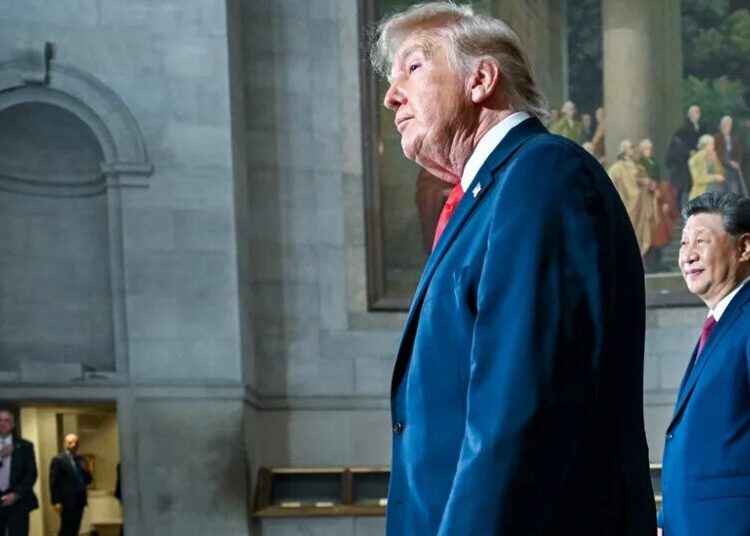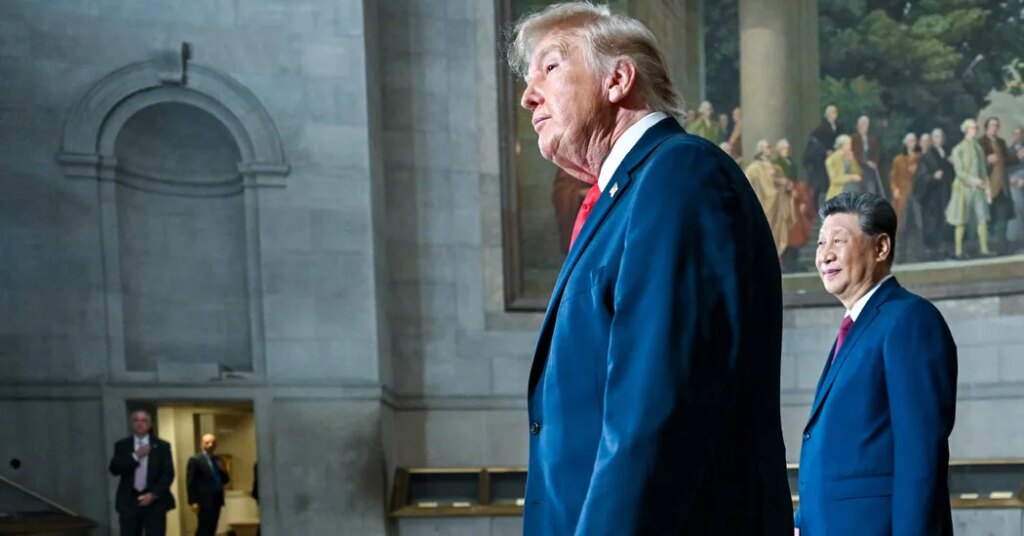
In a two-week span this month, President Trump embraced China’s president, Xi Jinping, then brushed aside Chinese espionage concerns to back Jensen Huang’s return as chief executive of the chip-making giant Nvidia.
Mr. Trump’s actions were a shocking rebuff of the loose coalition of lawmakers, national security officials and strategists from both parties who argue that the United States and China are locked in a fierce struggle for global supremacy. That requires nothing less than a confrontational, Cold War-style approach to Beijing, they say.
But former U.S. officials and experts say Republicans might be emboldened to challenge Mr. Trump’s China policy with new vigor, as Democrats attack the president for putting corporate profit ahead of national security.
A new round of anti-China politics would bring risk, however, given Beijing’s ability to punish the U.S. economically.
The moment represents a setback for China’s critics — but also an opportunity to reassert their warnings about Chinese power and influence. Over the past decade, they have come to see the country’s rapid growth, once welcomed by U.S. politicians as a source of cheap consumer goods and business profit, as a threat to America’s security and prosperity.
Their warnings have grown even more urgent amid what some call a winner-take-all race for A.I. dominance between the two powers.
Mr. Trump himself helped forge that consensus. He has long condemned China’s trade practices, and as a candidate in 2024 he branded the country an “enemy” of the U.S., vowing to curtail economic ties.
During his first term, the White House’s official national security strategy declared China a strategic competitor and called for tougher resistance to its growing power. That was a paradigm shift for U.S. foreign policy, one so widely accepted that it was largely embraced by the Biden administration.
But midway through his second term, Mr. Trump’s conciliatory approach to Mr. Xi, and now Mr. Huang, has prioritized short-term corporate profit ahead of U.S. national security, warned Rush Doshi, a former National Security Council adviser for China in the Biden White House.
”China policy is often seen as hawks versus doves but on a lot of the fundamental issues it actually looks more like corporate interest versus national interest,” Mr. Doshi said.
Soon after taking office in 2025, Mr. Trump imposed harsh tariffs on Chinese goods as high as 20 percent. But he soon backed off as Beijing retaliated, in part by restricting critical rare earth exports to the United States. Last November Mr. Trump and Mr. Xi agreed to what amounted to an economic truce.
Since then, Mr. Trump has met three times with Mr. Xi, whom he praised during his recent visit to Shenzhen as a friend and “incredible leader.” He relaxed some restrictions on the sale of advanced chips to China despite opposition on national security grounds.
And Mr. Trump embroiled the U.S. in a war with Iran, diverting military resources from Asia amid worries about a potential Chinese invasion of Taiwan — whose defense has never much seemed to interest him.
Perhaps most dramatically, Mr. Trump has downplayed alarms from U.S. intelligence agencies that Mr. Huang may have been compromised by a suspected Chinese intelligence asset with whom he had an affair. That has enraged prominent China critics like the former Republican House Speaker Newt Gingrich, who wrote on social media this week that Mr. Huang’s return to Nvidia was “profoundly wrong” and “a national security issue of enormous proportions.”
“The worst kept secret in Washington is that not only is Donald Trump not a hawk on China, he is extraordinarily dovish,” said Evan Medeiros, a former National Security Council official for China in the Obama White House and professor at Georgetown University. “He has rediscovered the language of engagement.”
In doing so, Mr. Trump has undercut China hawks within his own administration, including his secretary of state and national security adviser, Marco Rubio, who warned Mr. Trump about Mr. Huang’s entanglement with a suspected Chinese spy.
Mr. Rubio has long called China the top national security threat to America. He has not publicly commented on Mr. Trump’s decision to push for Mr. Huang’s return to Nvidia.
Mr. Trump may also have gone too far for Republican China hard-liners in Congress, who until recently put up modest resistance at best to Mr. Trump’s softening approach toward Beijing.
Now, with Mr. Trump a politically weakened lame duck after a Republican blowout in the midterm elections, American policy toward China may yet boomerang, Mr. Medeiros and other experts argued. A backlash to Mr. Trump’s approach could galvanize support in Congress for anti-Beijing measures, including tighter controls on the export of advanced microchips sought by China.
Republican Senator Tom Cotton of Arkansas said that the drama around Mr. Huang’s affair with Alice Huang, an executive at the Singaporean technology company Megaspeed, was “just the tip of the iceberg, and it’s not resolved because Jensen Huang has his job back.”
“Congress has much to investigate,” Mr. Cotton wrote on social media, saying that Congress would pass new limits on microchip exports “one way or the other.”
Mr. Medeiros said that Democrats also see political opportunity in the drama around Mr. Huang and will likely link it to larger themes of corruption, corporate wrongdoing and the rule of law once they assume control of the House and Senate in January.
The result could be a new round of pressure from Washington that will test the U.S.-China truce of the past year.
Amid growing political pressure, Mr. Trump has also taken some initial tough steps. On Wednesday, he threatened — but did not implement — new tariffs on China along with several other U.S. trading partners. The Trump administration also said last week that it would close a regulatory loophole that enabled China to sidestep a ban preventing Chinese firms from buying the most advanced A.I. chips made by companies like Nvidia.
Jessica Chen Weiss, a China expert and professor at the Johns Hopkins School of Advanced International Studies, warned that Mr. Xi was unlikely to “take it on the chin” and might not hesitate to flex his country’s powerful economic muscles.
“So far the conversation has been high on outrage and hasn’t really reckoned with the fact that we can expect China to retaliate,” said Ms. Weiss, who served as a State Department adviser from 2021-2022.
She cited as a top Chinese concern the Match Act, proposed legislation that Congress could vote on next month that would pressure U.S. allies to restrict the export of their technology to Beijing.
As a cautionary tale, Ms. Weiss recalled the 2023 furor over a runaway Chinese spy balloon that floated over the United States and derailed relations between Washington and Beijing for months despite its limited practical importance.
“The scandal is disgusting — but as a basis for policymaking, I worry we are overcorrecting,” she said.
Writing in the journal Foreign Affairs on Wednesday, Yun Sun, director of the China Program at the Stimson Center, said that China was preparing for new turbulence in its relationship with the United States.
“There is a tacit consensus in Beijing that heightened competition and hostility are likely to re-emerge as a U.S. priority once Trump is gone, if not sooner,” she wrote.
“We have a very large community of people highly suspicious of China, and they are currently put on the back burner,” Ms. Sun added. But, she said, “There is no way this is sustainable.”
The post Trump’s Embrace of Xi and Huang Stun China Critics in Washington appeared first on New York Times.