In his eight years as Spain’s prime minister, Pedro Sánchez has gained international renown among left-wing voters for his welcoming position toward migrants, his pivot to renewable energy and his criticisms of big tech companies, the Israeli government and President Trump, all as the Spanish economy boomed.
That reputation may count for little in Spain’s national elections on Sunday, which are essentially a referendum on Mr. Sánchez and which seem likely to remove him from power. Polls have consistently forecast that he will be replaced by a coalition of the mainstream conservative People’s Party and a far-right ally, Vox. That would mark the return of far-right nationalists to the Spanish government for the first time since the Franco dictatorship ended in 1975.
With far-right parties also gaining strength ahead of major elections next year in France, Italy and Poland, the elections in Spain amount to the latest barometer of the continent’s willingness to let long marginalized forces back into power. Though nationalist leaders have lost recently lost power in Hungary and Serbia, they are surging in France, where Marine Le Pen leads all rivals; in Germany, where the far right is set to lead a state government for the first time since the defeat of Nazism; and now in Spain.
“Having post-fascist formations, either as the leading force in their countries or inside the government, is a mortal wound, a very hard blow, to the postwar European philosophy,” said Guillermo Fernández-Vázquez, a political scientist at Carlos III University of Madrid. He added that a loss by Mr. Sánchez would mean that “supporters of the European project are becoming fewer and fewer.”
Vox has campaigned on a platform of expelling illegal migrants, reducing benefits for legal ones and scaling back the European Union’s involvement in Spanish affairs.
If Mr. Sánchez manages to pull off a victory, it would amount to yet another stunning turnaround for perhaps Europe’s most accomplished political survivor. He came to power against the odds in 2018 and kept it over three elections, including one in 2023 that few thought he had a shot of surviving.
“With all the things that we have passed over the last years,” Mr. Sánchez said in an interview on the campaign trail, “I think that I have made a positive impact in my society, in my country and in Europe.”
He explicitly predicated his campaign on holding back Europe’s right-wing wave. He argued that he would continue on a left-leaning path, pursuing multilateral international relations and a robust welfare system, which he has fortified by increasing pensions and creating a minimum basic income.
The last days of the campaign seemed like a handout frenzy, as he raised minimum wages and salaries for government workers, and extended time off for bereavement.
Those pledges, and his skill on the campaign trail, have helped him gain steam leading up to the election, in which Spanish voters elect 350 members of Parliament. A candidate needs the support of a majority of lawmakers to govern and often needs help from smaller parties to cross that threshold.
Mr. Sánchez’s Socialist Party has risen in the polls by drawing support from weakened leftist parties, but that could make it harder for him to form a winning alliance.
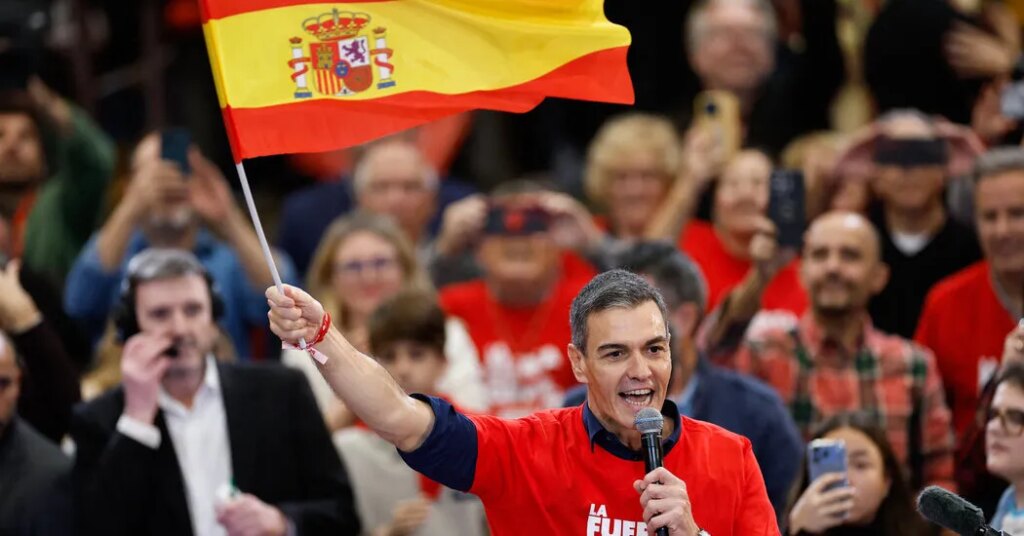
Now, after tacking left, Mr. Sánchez has sought to win over a small but decisive group of moderate voters by promoting a moderate economist to the position of vice premier, by embracing the Spanish flag that was long a symbol of conservatives and by assuming a measured, almost subdued and stately manner in debates.
Still, some moderates have expressed frustration with Mr. Sánchez’s divisive depiction of the right as Franco’s political descendants, just as they balk at the harsh language and anti-migrant sentiment of the hard right.
“He’s trying to win back the voters he lost by moving leftward,” said Cristina Monge, a political scientist and the author of “Against Discontent,” a book about growing disaffection with democracy. She added, though, that many voters seemed especially partisan in “the most ideological campaign I have ever experienced.”
Mr. Sánchez has a lot else going against him. He has faced corruption scandals in his inner circle, a national electricity blackout last year, a migration crisis this summer, spiraling rents and two horrific train crashes this year.
“A leader who has been in power for eight years suffers from wear and tear,” said Luis Cornago-Bonal, a researcher and political scientist at the London School of Economics.
Under Mr. Sánchez, Spain’s unemployment rate has fallen, its gross domestic product has grown and its deficit has shrunk. Last year, Spain accounted for more than 40 percent of the jobs created in the European Union.
But Mr. Cornago-Bonal said that although Spain’s macroeconomic picture had improved, “voters haven’t always felt that improvement.”
And even for those who had, he said, the strength of an it’s-the-economy-stupid message was diluted in a fragmented and highly polarized Spain.
For years, conservatives have chanted, “Pedro Sánchez, son of a bitch,” essentially wherever they gather, including in soccer stadiums and on street corners. In the days before the election, Mr. Sánchez said, his daughters heard it at a disco.
The animus against Mr. Sánchez surged after the 2023 election. Then, the People’s Party, led by Alberto Núñez Feijóo, who is again its candidate and the country’s most likely next leader, won more votes than Mr. Sánchez, but not enough to win outright.
Vox had underperformed, and together, it and the Popular Party did not win enough seats to form a government. Mr. Sánchez then cobbled a minority government together, with the support of small parties from Catalonia that want independence from Spain.
To win their backing, he pledged amnesty deals for separatists convicted of leading a 2017 push for Catalan secession — breaking his promise never to make such concessions, which are anathema to the nationalist right and to a segment of his own Socialist Party voters.
The about-face kept right-wing voters mobilized for years.
Some political analysts blame Vox’s ascension partly on Mr. Sánchez. For years, he focused on Vox as a boogeyman to mobilize his own left-wing voters, but in the process, he bolstered the far-right party’s profile.
“He has been a driver of polarization because his only viable argument was always fear of the far right,” said Daniel Gascón, a political columnist for the newspaper El País. “He has extensively shined the spotlight on Vox.”
Officials in Mr. Sánchez’s government privately acknowledge that they sought to scare supporters to the ballot box, but argued that they did so because Vox was scary.
Vox, led by Santiago Abascal, wants to deport all undocumented migrants and strip benefits from legal migrants to give more to Spanish citizens.
The party says the European Union is too intrusive in Spain’s affairs, has called for laws repealing some abortion rights and wants to cut funding to feminist organizations that support victims of gender violence, arguing that those groups are partisan and absorb resources that should go directly to victims. In Vox’s view, feminism has gone well beyond equal rights for men and women, and has become oppressive to men.
Vox is against gay marriage and has opposed Pride parades in city centers, though it supports civil partnerships and says it opposes discrimination based on sexual orientation.
Referring to the potential consequences of a right-wing government, Ana Osma, 23, who is gay, said, “We could lose all our rights.”
“It took a huge fight to win them,” she added, waving a pride flag at a recent campaign rally for Mr. Sánchez in Albacete, eastern Spain. “The right in general worries me.”
Others maintain their support for Mr. Sánchez because of his social democratic credentials.
“I’m going to vote for Pedro Sánchez because he’s the one paying me right now,” Benito Jiménez, 69, a retired truck driver, said in Albacete, expressing content with his rising pension.
But a few feet away, Paqui López, 49, a supermarket cashier and former Socialist Party voter, said that the handouts had gotten out of hand.
“I’m voting for Vox,” she said. “I want change.”
Carlos Barragán contributed reporting.
The post Abroad, Spain’s Leader Is a Left-Wing Hero. Will He Lose Power at Home? appeared first on New York Times.