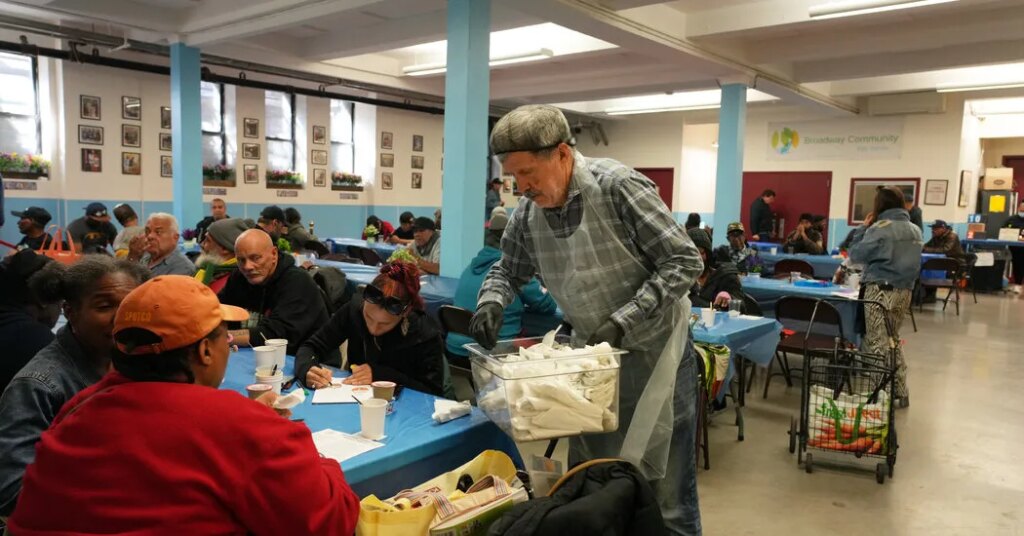
Broadway Community squeezes its solutions to New York City’s most enduring ills into a 4,500-square-foot church basement.
The subterranean space inside Broadway Presbyterian Church in Morningside Heights holds a shelter, a soup kitchen, a doctor’s office, a psychotherapy suite, a laundromat, a computer lab and a benefits center — all free and accessible via its red-carpet-lined entryway.
The nonprofit organization says it helps over 10,000 hungry and homeless Manhattan residents each year as one of a shrinking number of church-based shelters among the city’s more than 5,000 houses of worship.
And its 28-year-old executive director has started persuading other faith leaders to work with Broadway Community and possibly replicate its model, marrying their commandments to help those in need with the expanded use of their most valuable resource: space.
“There are lots of congregations out there that feel deeply called to this already and they don’t need any sort of inspiration, per se,” said Isaac Alderstein, the group’s executive director. “They just need the infrastructure. They need the technical know-how.”
Over the past 40 years, dwindling congregations and the changing priorities of both faith and civic leaders led to the closure of shelters run out of church sanctuaries, synagogues and fellowship halls. Then the Covid-19 pandemic further diminished many faith-based volunteer networks.
But Broadway Presbyterian, which founded Broadway Community in 1982, received an influx of funds during the pandemic, church leaders said, enabling it to pay staff members at the nonprofit and keep its anti-poverty work alive.
So far, Mr. Alderstein has enlisted an Upper West Side synagogue to restart its shelter and is in discussions with a Quaker congregation in Union Square to expand the number of shelter beds it offers. In getting the faithful to use their spaces as shelters or expanded soup kitchens, Mr. Alderstein and his allies believe many congregants would be returning to their initial missions.
“It’s really trying to remind people that you used to do this — and you did it well,” said the Rev. Bryan Mealer, a Presbyterian chaplain who directs Broadway Community’s spiritual support services. “I think in this situation, we’re here now to even help them further — to try to take a lot of the X factor out of it.”
More than 120,000 people sleep in New York City shelters each night, according to a report from the city comptroller’s office, which also found that the homeless population ballooned by more than 175 percent between 2000 and 2020. A majority of those in city shelters are families with children.
Houses of worship have sought to widen the safety net for homeless New Yorkers over the years. When an influx of migrants strained city resources several years ago, Mr. Alderstein, then a recent college graduate, and other nonprofit leaders helped to secure a city contract for 50 faith-based emergency shelters.
But obstacles like aging church infrastructure that ran counter to fire code requirements barred many of the houses of worship from opening their doors as sanctuaries. In the end, only about dozen assisted in the effort, according to Mr. Alderstein and others involved.
Despite such setbacks, Mr. Alderstein appears unfazed by the challenges of expanding homeless outreach.
“I strongly believe that as long as you have a mission alignment and good people willing to work with each other towards that shared goal, I do think it’ll happen,” he said.
Mr. Alderstein said he had been trying to solve the problem of homelessness in New York since he was a teenager. While commuting into Manhattan from his family’s homes in Queens and later on Long Island, he noticed how pervasive the issue was. He started carrying snacks and dollar bills with him while walking around the city, to hand out to people.
After high school, he took a gap year to work in the soup kitchen at the Interfaith Nutrition Network, a Long Island-based homelessness service founded out of a church, and volunteered with faith-based support organizations while attending college in Baltimore.
Mr. Alderstein moved back to New York in 2020 to work with another aid organization, Commonpoint Queens, before being hired at Broadway Community in 2021. In September, he was awarded the city’s David Prize for his work, which comes with $200,000 that he plans to put toward expanding Broadway Community’s reach.
With an annual budget of about $2 million, the nonprofit feeds roughly 300 people a day and shelters 19 adults every night.
Mr. Alderstein emphasizes Broadway Community’s interfaith approach. He is Jewish, while most members of the center’s spiritual support staff are Christian or Buddhist. He relies on a cadre of volunteers each day, and many of the most involved are Muslim, he said. Students from the Jewish Theological Seminary are also regular volunteers. And Broadway Community remains supported by the Presbyterian church it is housed in.
“The values of the faith community are incredibly powerful if they can be lived out,” said Marc Greenberg, the co-founder and executive director of the Interfaith Assembly on Homelessness and Housing, who has worked closely with Mr. Alderstein. Broadway Community provides “a way for people to live out those values,” he added.
City leaders have taken notice, too. Helen Arteaga, the deputy mayor for health and human services, and Erin Dalton, the commissioner of the Department of Social Services, have toured Broadway Community’s space in recent months and started exploring options to work with the organization, Mr. Alderstein said.
Still, his approach can come up against harsh realities with the congregations themselves, which need to be judicious in how they spend their thinning budgets and navigate their internal politics.
“If you’re loving your neighbor, that’s the work,” the Rev. Chris Shelton, the senior pastor of Broadway Presbyterian said, adding: “And for so many churches, I think they get fixated on: ‘Oh, we need to fix that boiler. We need to fix that crack in the wall. We need to have money to pay a pastor.’”
Additionally, houses of worship are largely reliant on volunteers — making it difficult to consistently staff their efforts to help a population with unpredictable needs.
One of the first places Mr. Alderstein led expansion to was Ansche Chesed, an Upper West Side synagogue that regularly provided food and shelter to roughly a dozen people before the pandemic limited its ability to retain volunteers and space. When Mr. Alderstein joined the synagogue, he helped restart its small shelter program.
Still, keeping the program going while running its preschool has been a delicate financial and interpersonal balance.
“We had some financial resources,” said Rabbi Jeremy Kalmanofsky, the rabbi of Ansche Chesed. “We had the space resources. It’s always a little bit harder to mobilize some of the human resources.”
Mr. Alderstein has spent months finding the thousands of churches, synagogues, mosques, gurdwaras and meeting houses that are offering aid in all five boroughs. And he’s preparing to survey a broad swath of them to find out what is stopping them from expanding their efforts, like the need for more volunteers, kitchen space or employees.
From there, he hopes to hold focus groups and Bible studies with their congregants to determine how they can get more involved.
It is unclear how long it will take for Broadway Community to expand beyond a handful of congregations. But Mr. Alderstein’s hope is that, even if houses of worship decide not to replicate his model, they can play a larger role in combating homelessness around the city.
“I want to inspire congregations to shift from preaching about doing justice, to actually doing justice,” he said. “And I think the highest form of that is serving the people that are at one’s front steps already.”
The post One Man’s Mission: Turning Church Basements Into Homeless Shelters appeared first on New York Times.