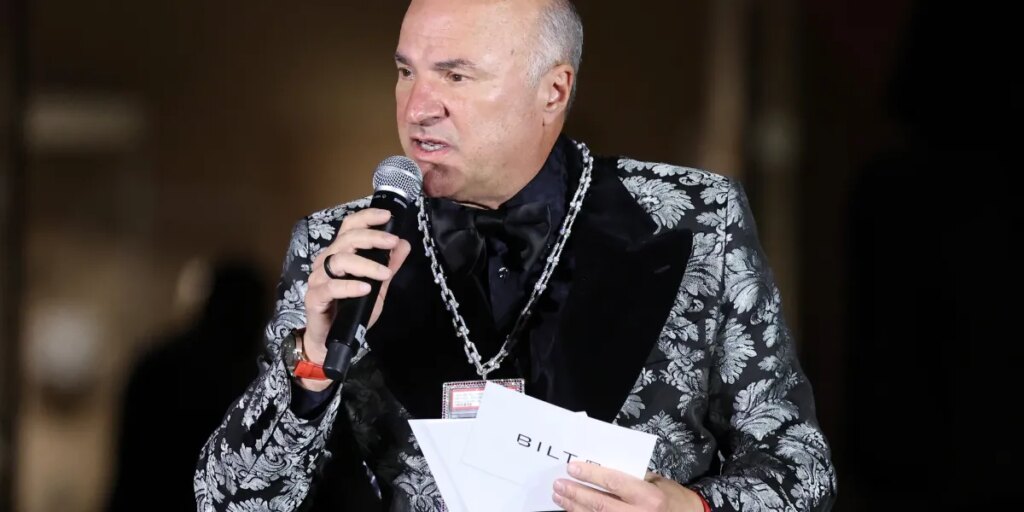
Shark Tank investor Kevin O’Leary rehashed a familiar pitch for Americans who want to get rich: spend less, save 15% of every paycheck, and let the gains compound in the stock market.
But when O’Leary faced down 20 Gen Z workers in a Jubilee Media-hosted debate, one participant challenged the traditional bargain between labor and capital. Why should employees spend their lives drawing wages while investors get rich off the surplus value they create?
“Why should all the money we make doing our work, our labor, why should it go to people like you? We did the work,” the participant, a software engineer named Joe, said to O’Leary.
The episode of Jubilee’s YouTube series “Surrounded,” titled “1 Millionaire Boss vs 20 Gen Z Workers,” posted Nov. 15 and put the multimillionaire investor face-to-face with younger workers questioning the rules of the modern economy. The 8-minute exchange over whether workers deserve a bigger piece of the profits they help generate became one of the flashpoints of the nearly two-hour debate.
The argument lands as employee ownership gets a mainstream hearing. SpaceX’s June IPO was expected to make more than 4,400 current and former employees millionaires, welders among them. And Mark Cuban has proposed that companies choose between giving every employee stock and paying higher corporate taxes.
From Starbucks dividends to Amazon stock grants
Joe opened with a Starbucks hypothetical: Why shouldn’t some of the chain’s billions in profits go to the workers making and serving the coffee? O’Leary argued that would shortchange investors who supplied the capital.
Joe wasn’t suggesting workers get all the profits, just a bigger share. He pointed to Starbucks’ dividend payments to shareholders as evidence that the company already distributes its profits. Starbucks, which reported $37.9 billion in revenue for the fiscal year that ended Sept. 27, recently raised its dividend.
The debate then moved from coffee shops to one of the country’s biggest employers: Amazon, which this year unseated Walmart as No. 1 on the 2026 Fortune 500.
Joe argued that the company offers one of the starkest examples of how pay can split by role. A software engineer with the same ability to execute and work hard as a warehouse employee could potentially receive substantial restricted stock units, or RSUs, as part of their compensation. The warehouse worker, meanwhile, might receive no equity stake, despite long shifts doing physically arduous work.
Why, Joe wanted to know, should one employee have a chance to build wealth through company stock while another is limited to a paycheck?
O’Leary said the labor market ultimately shapes compensation. If Amazon couldn’t find enough people willing to work in its warehouses, he said, the company would have to increase compensation to attract them.
He also questioned whether equity could realistically be distributed across every type of business. “You can’t do that in every business. You can’t give equity to a utility,” O’Leary said.
Joe said equity wasn’t the only answer. Companies could also offer dividends or profit-sharing arrangements that give employees a direct financial stake in their success.
He pointed to O’Leary’s fellow Shark Tank investor, Mark Cuban, who gave employees equity at companies he founded and has urged every CEO to do the same. If investors can benefit financially when a business grows or is sold, Joe argued, employees who helped create that value should have a chance to benefit, too.
The two did find one patch of common ground: SpaceX, where rank-and-file employees became millionaires when the company’s shares took off. O’Leary said he was perfectly fine with that outcome.
Joe’s point, however, was that such windfalls are the exception, not the norm. The economy, as structured, funnels the gains from workers’ labor upward while asking employees to build wealth out of whatever is left of their paychecks.
What investors bring to the table
O’Leary wasn’t particularly receptive to the idea that investors were simply getting rich off other people’s labor. “I worked pretty damn hard to get rich. Really hard,” he said.
Joe said that while O’Leary may have worked hard to build his fortune, he questioned what investors contribute beyond their money. O’Leary explained that he looks for entrepreneurs with promising ideas and business plans, then puts his own capital behind them.
When Joe asked what he brought to the table, O’Leary answered bluntly. “Money.”
The 15% rule meets the rent
The exchange eventually circled back to O’Leary’s familiar advice about personal financial discipline. Rather than waiting for companies to distribute profits, he suggested workers take 15% of their weekly earnings and invest it in the stock market.
O’Leary has repeatedly offered this advice to younger Americans. The investor has argued that someone earning $68,000 a year could retire a millionaire by consistently investing 15% of their income over a career.
But Joe questioned how realistic that prescription was for people already struggling to cover everyday expenses. Earlier in the episode, another participant, a security guard named Kieran, described working 80 hours a week only to spend 55% of his income on rent.
O’Leary said people could cut unnecessary purchases from their budgets. Joe pushed back, joking that O’Leary wouldn’t find much to criticize in his own winnowed-down wardrobe.
The exchange ended on an unexpected note of encouragement. Apparently impressed by the passion of Joe’s argument, O’Leary told him he’d make “good television” and invited him to come on Shark Tank.
Joe declined. “I never will,” he said. “I don’t want to be an entrepreneur, bro. I just want to live.”
For a generation staring down rent, gas prices and student loans, that may be the more radical ask.
The post Kevin O’Leary told Gen Z to invest 15% of each paycheck. One worker asked why investors get the profits appeared first on Fortune.