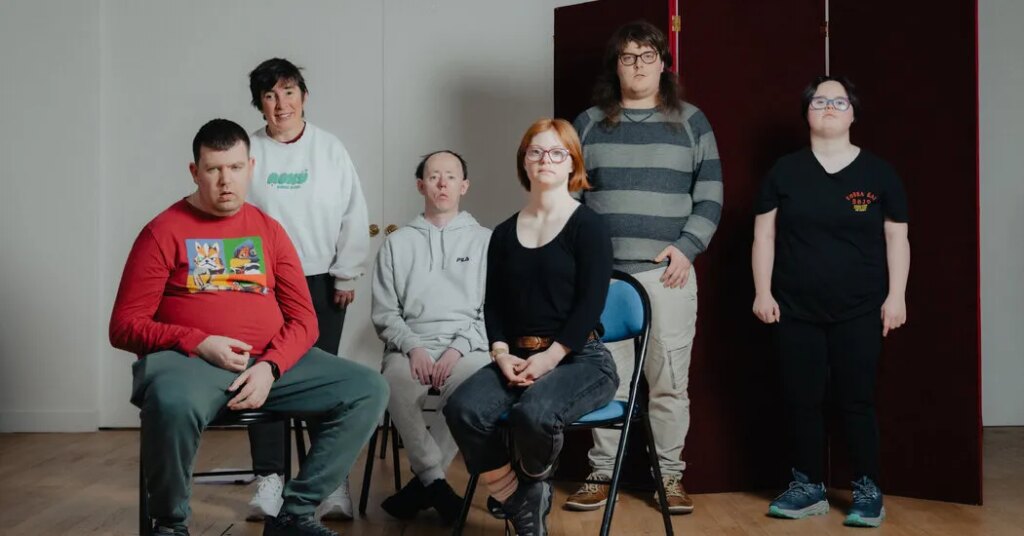
On a recent afternoon in Paris, six actors from the Australian company Back to Back Theater sat in a circle with an audience looking on during an open rehearsal. One by one, the performers, who are neurodiverse or have an intellectual disability, succinctly described their conditions before slipping into the characters they will play in “Neanderthal,” a new work they will premiere next year in Melbourne.
“It’s quite intimidating to see the audience,” Scott Price, an ensemble member, said at the end. “It’s hard to look people in the eye when you have autism.”
Back to Back’s artistic leader, Bruce Gladwin, interjected: “And you have a director who keeps asking you to do that!”
Based in Geelong, a coastal city southwest of Melbourne, the company has become one of Australia’s most internationally acclaimed theater ensembles. In 2024, it won the Golden Lion for Lifetime Achievement at the Venice Theater Biennale. Now, Back to Back is in the spotlight in Paris as a guest of honor at the Festival d’Automne — a high-profile multidisciplinary event where the ensemble is presenting five works over eight weeks this fall and inviting the public to observe “Neanderthal” in development.
“It’s been really difficult for everyone,” Price said of such a long tour’s physical toll. “But it’s good. I just enjoy connecting with people.”
Over nearly four decades, the company has developed a body of work that challenges not only how audiences see artists with intellectual disabilities, but also how stories about power get told onstage. “Ganesh Versus the Third Reich,” a 2011 work it is presenting in Paris, is a surreal journey into Nazi Germany that also touches on cultural appropriation; “Food Court,” a production from 2008 that will be shown at the Odéon-Théâtre de l’Europe in December, examines a woman’s public humiliation.
Francesca Corona, an artistic director at the Festival d’Automne, said that Back to Back acted like a “magnifying glass”: “It’s as if disability brought into sharper focus the power dynamics that shape our lives,” she said.
The company was founded in the late 1980s, when the Australian authorities were transitioning people with intellectual disabilities and mental health issues out of psychiatric institutions and into community-based care. It grew out of workshops run by several artists, including the theater-maker Cas Anderson, who became Back to Back’s first director.
“She just saw everyone as an asset,” Gladwin said of Anderson. Early shows, like “Stinking Houses,” involved actors who had lived in institutions for most of their lives and addressed that experience.
Gladwin, who doesn’t have a disability, first saw the company in the late 1980s as a young theater performer and director. “I grew up in a family where my parents would say: ‘If you see a person with a disability, don’t stare, that’s rude.’ So it was really challenging to sit in the audience for the first time and to go: ‘Well, I have to look at them.’”
He was immediately drawn to the company’s style and ethos, and after working with them as a freelancer, he was appointed as the company’s artistic director in 1999.
While Back to Back Theater does a lot of community work in Geelong — like school workshops, and a training ensemble for actors with intellectual disabilities called Theater of Speed — it established itself primarily as a company producing professional shows. Its actors are paid for their work, and its funding structure reflects that hybrid identity: While about 10 percent of its annual budget is provided by Australia’s National Disability Insurance Scheme, it is also supported by public arts funding bodies, like any other theater.
Six performers are currently part of the permanent ensemble, with a guaranteed part-time contract for three days a week and the option to work full-time during busy periods. Many stay for decades: Price, who grew up in Geelong, has been in the ensemble since 2007, which he said had given him a sense of stability.
“Geelong is quite a working-class town,” Gladwin said. “Some of the actors that have been in the company throughout its history have been the major breadwinners in the family. They are bringing in a substantial income.”
Gladwin’s role, as a non-disabled artist who directs most of the company’s productions, has raised questions over the years. “There’s a lot of curiosity around who gets to make the decisions,” he said. Every Back to Back Theater production is collectively authored over two to three years through a process of “free association,” with the actors and any artistic associates all credited as “devisors.”
“It’s not in my interest to kind of dominate,” Gladwin said.
Audiences sometimes find that hard to believe. During a Q&A session after a show in Brussels some years ago, Gladwin recalled, “Someone stood up and said, ‘I don’t believe the actors made this work.’” Price found this insulting, and in response, Back to Back Theater wove some metatheatrical scenes into “Ganesh Versus the Third Reich” that explore the power dynamics of making a show.
The company also made space for personal projects led by ensemble members. In 2019, for instance, Price made “Oddlands,” a 28-minute sci-fi television pilot.
Getting the theater’s work in front of international audiences has been a major collective goal. “When I started, the actors at the time just said: ‘We want to tour the world,’” Gladwin said. The first step was performing at an international festival in Melbourne, which started conversations with presenters from abroad.
Since then, Gladwin and his team have built a global network of contacts without an agent, managing all of the relationships themselves. Close ties with prestigious events have helped sustain the expense of touring from Australia. About 35 staff members are traveling for the Paris residency, and the company will be back in Europe in the spring to show “Neanderthal” at the Vienna Festwochen. That show is then set to tour the continent.
Price, who is 39, said he imagined still working with the theater for “probably a long time.” After a pause, he added: “I’ve just got to try and help out the next generation of artists. I think that’s my main goal now.”
The post How an Australian Troupe of Actors With Disabilities Conquered the World Stage appeared first on New York Times.