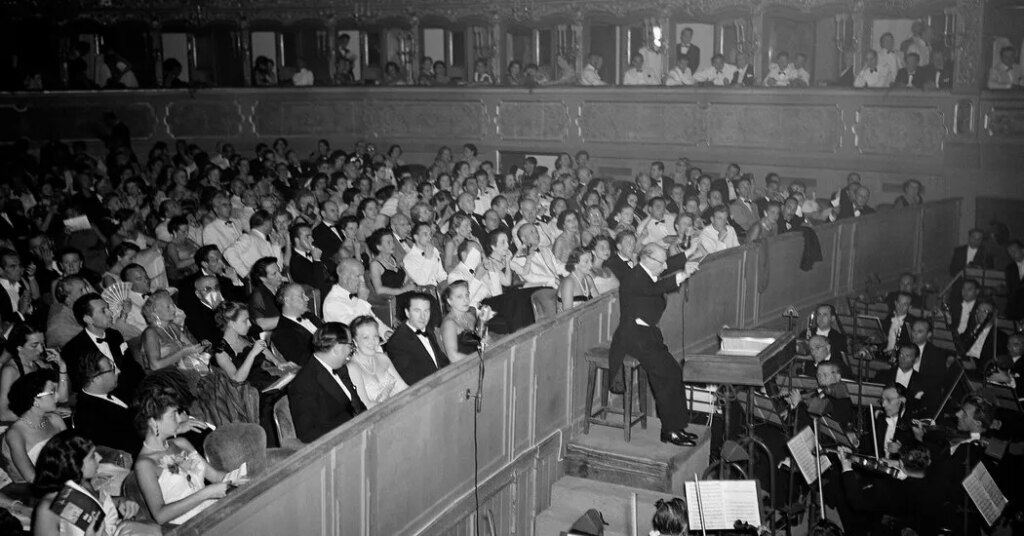
When Igor Stravinsky returned to Europe for the first time in 12 years to conduct the 1951 premiere of his opera “The Rake’s Progress” in Venice, the city was gripped by anticipation. According to a report in The New York Times, “Public and press, musicians and devotees of opera assembled from all over the world, and the town buzzed.”
But the performance at La Fenice, Venice’s historic opera house, drew sharply divided reactions. One critic called it “the pinnacle” of Stravinsky’s “entire art” while another dismissed it as “a pile of junk.”
Some detractors saw the work as a dated anachronism. Stravinsky’s neoclassical opera — his only full-length contribution to the art form — looks backward to earlier music, particularly Mozart. It had landed in Italy only because the composer had been offered a huge fee amid Cold War backroom dealing, and Italy was looking to the future as it rebuilt from the ruins of Fascism. It took many decades, and contributions from artists like David Hockney and Ingmar Bergman, to establish “The Rake’s Progress” as a masterpiece of the 20th century.
Now, 75 years on, Italy is staging two major productions to celebrate the opera’s anniversary: at the Teatro dell’Opera in Rome, premiering Friday, and at La Scala in Milan, in April. The stagings are a homecoming of sorts, even though the opera, written by a Russian émigré in Hollywood with an English-language libretto, is hardly Italian.
The directors of both productions say its story, about a man enticed down a path to ruin by the promise of prosperity and happiness, will resonate with audiences today.
“This is a piece of our time,” said Kasper Holten, who will direct at La Scala. “For someone living in the world today, we have to look at everything and think: ‘Is this fake? Is this real? Is this a scam?’”
Stravinsky had gone to the United States in 1939 to deliver a series of lectures at Harvard, and remained as war engulfed Europe. He decided to write the opera after encountering an eight-part series of satirical paintings called “The Rake’s Progress” by the 18th-century English artist William Hogarth at an exhibition in Chicago.
The series, also reproduced as engravings, tells a vicious morality tale about the lazy spendthrift Tom Rakewell, who inherits a fortune, squanders his money on prostitutes and gambling, and ends up in prison and then a psychiatric hospital.
The composer’s Hollywood neighbor, the British author Aldous Huxley, suggested W.H. Auden as the librettist. Auden roped in his companion Chester Kallman to assist, and the pair added details of their own: Rakewell is lured from the countryside to London by his satanic servant, Nick Shadow, abandons his betrothed Anne Trulove and marries a bearded woman called Baba the Turk.
The music eventually came to be seen as a pinnacle of Stravinsky’s “neoclassical” phase, eschewing the experimentation of works like “The Rite of Spring” to revisit the conventions of earlier music reworked in his own idiom. With Mozart as his blueprint, Stravinsky interspersed arias, duets and ensemble numbers with harpsichord-accompanied recitatives. Within that framework, he refracted echoes of Monteverdi, Handel and Verdi through a modern language of spicy dissonance, unexpected harmonic shifts and sudden silences.
As the work took shape, Stravinsky and his publisher, Boosey & Hawkes, weighed where to premiere it. The publisher floated a London or Edinburgh premiere, with La Scala for the first continental performance, while Stravinsky preferred a smaller venue like Colorado’s Central City Opera.
In the end, he agreed to a Venice performance, which he would conduct himself, and Stravinsky was offered his largest fee to date: $20,000, equivalent to about $260,000 today.
The deal was brokered by Nicolas Nabokov, a Russian composer, Stravinsky supporter and cousin of the writer Vladimir Nabokov. While Stravinsky was writing the opera, Nabokov was crisscrossing Europe for the Congress for Cultural Freedom, a C.I.A.-funded organization that promoted Western modernism as a counterweight to Soviet propaganda. During a meeting with Mario Labroca, the director of music at RAI, Italy’s public broadcaster, he suggested that Stravinsky would accept an Italian premiere if the price was right.
The powerful and well-connected Labroca, acting on behalf of other state-funded music institutions, offered performances in Milan, Florence or Venice. Stravinsky chose Venice, and the Venice Biennale seized the opportunity to stage the premiere. Italy’s culture ministry could afford such a high fee because it was channeling Marshall Plan funding into the arts, explained Chandler Carter, a music professor at Hofstra University who wrote a book on “The Rake’s Progress.”
“Had there not been a Cold War, it probably wouldn’t have happened,” Carter said.
The premiere featured the German soprano Elisabeth Schwarzkopf as Anne and the orchestra and chorus of La Scala, rather than La Fenice’s house ensemble — a compromise after the Milan house expressed outrage at missing out on the first continental performance.
But Italian opera was in crisis: Years of underfunding had drained its theaters’ coffers, and Italy had no obvious successor to Giacomo Puccini, the composer of “La Bohème” and “Tosca,” who had died in 1924. The country was also in the midst of a wider forgetting of its Fascist past, sustained by the myth that ordinary Italians bore little responsibility for the regime’s crimes.
Together, these left Italy unsure what a modern opera should look and sound like, and Stravinsky’s backward-looking answer seemed, to some, more like a dead end than a path to the future.
“Stravinsky foregrounded the past,” said Harriet Boyd-Bennett, a music professor at the University of Nottingham in central England. “That was a political point in Italy at this time.”
In the days before the premiere, speculation and debate about the opera filled newspaper columns and spilled into the cafes of Piazza San Marco in Venice, where people who had attended rehearsals at La Fenice discussed its “pros and cons,” according to The Times.
Gian Paolo Minardi, a retired music critic and music professor, was among those who attended the premiere, aged 18. Speculation about the opera had been circulating for weeks, he recalled, and many had “doubts” and “suspicions” about whether such a backward-looking work could succeed.
“I sensed this air of uncertainty,” said Minardi, now 93. “What would Stravinsky do?”
By some accounts, the premiere was a messy affair. La Scala’s chorus struggled with the English text. (Auden himself had been appointed to coach them on diction but “didn’t lift a finger,” Carter said.) The tenor Robert Rounseville, who was cast in the title role less than two months earlier, sounded uncertain. Stravinsky’s conducting was shaky, and both he and Auden later complained about Carl Ebert’s naturalistic staging.
The opera was coldly received at the 1953 U.S. premiere at the Metropolitan Opera, but later productions helped improve its reputation. Those include a shadowy 1961 staging by Bergman in Stockholm and Sarah Caldwell’s 1967 Boston production, which immersed the action in contemporary “mod” culture, complete with motorcycles and a disco.
Few did more to establish the work than a 1975 production at the Glyndebourne Festival in England, with sets by Hockney.
The staging resembles a colorful book illustration brought to life, with cartoonlike speech bubbles on two-dimensional sets that recalled Hogarth’s etching technique. Its vivid scheme fades to black and white as Tom sinks into destitution. John Cox, the director, injected irony and whimsical humor, as well as emotional depth.
Cox, 91, recalled the moment when he pitched the project to Hockney, who had published his own 16-part two-tone “Rake’s Progress” etchings inspired by Hogarth in 1963. “His very first reaction was, ‘Oh, I don’t know whether I’ve got the talent, the technical skill, to do that,’” Cox recalled. “I said: ‘Don’t worry about that, David. We’ve got people with technical skill,’” Cox said. “‘All we want from you is some good pictures.’”
The staging has been produced at Glyndebourne eight times, and was most recently revived in 2023, when it became Britain’s longest-running opera production. It has also toured widely, including to New York, and Milan, where it was conducted in 1979 by Riccardo Chailly, who will also lead the upcoming La Scala production.
Holten, its director, said the Glyndebourne staging was inevitably “part of the baggage” for any director who approaches the opera.
Rafael R. Villalobos, who’s directing the Rome staging, agreed. His production is partly a “homage” to Cox and Hockney’s creation, he said, with lighting shifts between monochrome and color. He added that the set recalled a “cabinet of curiosities,” inspired by Sir John Soane’s Museum, the London home of Hogarth’s original paintings, with boxes and compartments that open to reveal a brothel, an auction house and a psychiatric hospital.
As Tom, the Ohio-born tenor Lawrence Brownlee, who has made a career singing bel canto roles, will tackle a part usually associated with more floaty Mozartian voices.
“I had to get my mind into the land of Stravinsky,” Brownlee said. In operas by “Rossini, Donizetti, Bellini,” he said, “you know where it’s going, it’s intuitive, it’s clear. But ‘The Rake’s Progress’ is the opposite.”
Holten said his La Scala staging would be a parable about the commodification of human life in a world built on deception. Shadow, the servant, will appear as “the ultimate scammer” growing wealthy at Tom’s expense, Holten said.
Tom’s admission to the asylum, he added, will represent the hardship people suffer when seduced by false promises of progress offered by contemporary societies. “It’s not just the rake’s progress, it’s the progress of all of us in Western civilization,” he said. “It’s easy to look around in the world today and think we have all ended up in the madhouse.”
The post 75 Years On, Stravinsky’s Opera Is ‘a Piece of Our Time’ appeared first on New York Times.