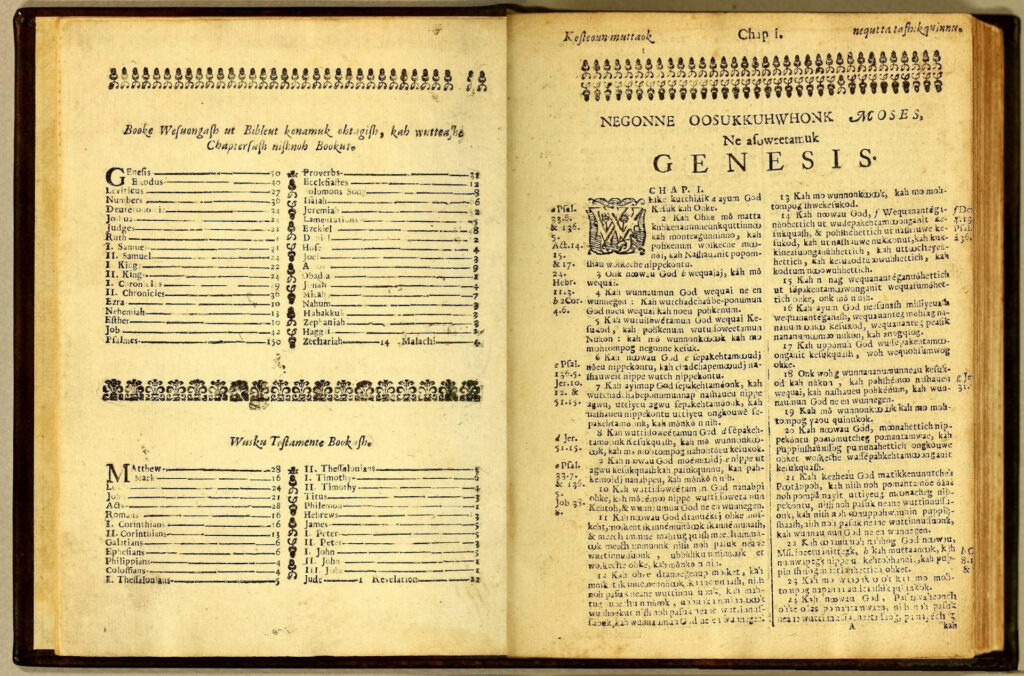
In 1663, colonial printers in New England produced a translation of the Bible into Wampanoag, an Algonquian language spoken in southern New England.
Printing the book would be an important story on its own. But it is even more remarkable because it was the first Bible that English colonists published in North America.
As a historian of early America, I believe this Bible sheds important light on relations between New England’s Native peoples and English immigrants, who saw themselves as crucial players in the spread of Protestant Christianity.
Consumed with the idea that their culture was superior, many English Protestants believed they could conquer North America without much bloodshed: that Indigenous peoples would voluntarily abandon their cultures and embrace the faith of the newcomers.
The historical record is more complex.
There were many moments, including the fabled first Thanksgiving of 1621, when Indigenous peoples and colonists coexisted. But there was brutal violence, as well, such as English colonists’ efforts to destroy the Pequot of southern New England in 1637.
In the aftermath of early warfare, some Puritan clerics looked for new ways to convert Native Americans — and decided religious texts were the answer.
During the Protestant Reformation, Martin Luther argued that the only infallible source of religious understanding was the Bible. Protestants believed the laity needed to become literate to read scripture for themselves.
The Puritans embraced this teaching, and in 1638, the Rev. Joseph Glover paid to transport a printing press to Cambridge, Massachusetts. Two years later, that press published the Bay Psalm Book, a collection of songs for worship — the first book printed in English North America.
In the years that followed, printers offered many religious tracts, often based on sermons. They believed that print would bring Protestant Christianity to a widening audience and provide guidance for existing believers.
John Eliot and Cockenoe
A Puritan minister named John Eliot sailed from England to Boston in 1631 and soon took a leading role in the church at Roxbury, just south of the city. Eliot purportedly brought 23 barrels of books with him from England.
By the 1640s, he began trying to spread his faith among Native residents of the region. He needed to be able to communicate with those he hoped to convert, and he understood that books could advance his cause.
Other colonists also hoped that print could foster good relations with the Native residents of New England. The most famous was Roger Williams, founder of Rhode Island. “A Key Into the Language of America,” a book he published in London in 1643, provided phrases in Narragansett, another Algonquian language. Such efforts were crucial to Europeans eager to trade with Native peoples — and to those, like Williams, who wanted to spread their culture without violence.
Eliot was intent on translating the Bible. He did not know Wampanoag, but he met an interpreter who impressed him: Cockenoe, a Montauk man from Long Island who had been taken captive during the Anglo-Pequot War in 1637.
Cockenoe became crucial to the Cambridge-educated cleric’s cause. He pronounced words clearly, which was crucial for Eliot: Like almost all Native languages in North America at the time, Wanpanoak did not have a writing system, so Eliot needed to transcribe what he heard.
The ‘Eliot’ Bible
Cockenoe’s instruction enabled Eliot to produce religious works in Wampanoag, including the Ten Commandments and the Lord’s Prayer. In 1663, printers Samuel Green and Marmaduke Johnson published “Mamusse Wunneetupanatamwe Up-Biblum God,” Eliot and Cockenoe’s full translation of the Bible.
It included some lines in English so that a literate person could recite the Native words out loud to others, even if they did not know the meaning. Green ordered enough paper to produce 1,000 copies of the book.
Wawaus, a Nipmuc man from what is now central Massachusetts, helped set type for the book. Also known as James Printer, he was studying at Harvard’s Indian College, which had been established in 1655 to spread Christianity among Native peoples.
Eliot also worked with a missionary society to establish new towns where Algonquian-speaking peoples would abandon their traditional practices and live like colonists.
Residents were to halt seasonal migrations, which had been crucial to their economies, and instead live year-round in houses. They were to dress like colonists, follow colonial laws and embrace Protestant religious practices.
Meanwhile, the growth of the colonial population was putting added pressure on Indigenous peoples who lived nearby. By the mid-1670s, any remaining goodwill between many Indigenous peoples and English colonists faded in a contest over limited resources, which was particularly difficult for Native Americans not living in the missionary communities.
In 1675, tensions erupted into what was called Metacom’s or King Philip’s War, named after the Wampanoag leader who led a widespread rebellion against colonists.
The two-year conflict spread across southern New England and reached the shores of Casco Bay in present-day Maine. According to historian Jill Lepore, it was the deadliest war in American history, in proportion to the population.
Peter C. Mancall is a distinguished professor and professor of the humanities at the University of Southern California’s Dornsife College of Letters, Arts and Sciences.
This article was produced in collaboration with the Conversation, a nonprofit news organization.
The post First Bible published by American colonists was in Wampanoag, a Native language appeared first on Washington Post.