Off the coast of Spain, a team of undercover operatives has been out patrolling the ocean. But they’re not on the government payroll. They work for fish.
Equipped with GPS devices and acoustic gear taped to their tail feathers, Balearic shearwaters and other seabirds are helping researchers detect fishing vessels that can’t be found on public tracking systems.
The data collected by the birds is helping researchers understand untracked fishing on the open sea and the risks vessels pose to marine wildlife, according to a study from the University of Oxford that was published this week in the journal Science Advances.
Fisheries reporting requirements have tightened globally as fish stocks drop and numbers for bycatch, the accidental taking of marine life other than the target species, rise. While onboard observers and cameras have helped curb some harmful practices, birds circling overhead can detect ships whose crews have no idea they are being monitored.
And, unlike drones or satellite monitoring, tagged birds help researchers understand how fishing boats affect seabird behavior and survival.
Seabirds are naturally drawn to fishing vessels because the boats concentrate fish and discard bait, but the gear creates fatal hazards: birds can become entangled in nets or hooked on longlines while diving for bait, among other dangers.
“We have a number of technologies for tracking vessels, but each method has drawbacks,” said Heather Welch, a researcher at the University of California, Santa Cruz, who was not involved in the study. “Seabird-borne audio detection offers another piece of the puzzle.”
Sea McKeon, the marine program director at the American Bird Conservancy, who also was not involved in the study, said it made sense to use birds because they had “physical capacities that we just do not have, that the best of our technology doesn’t have.”
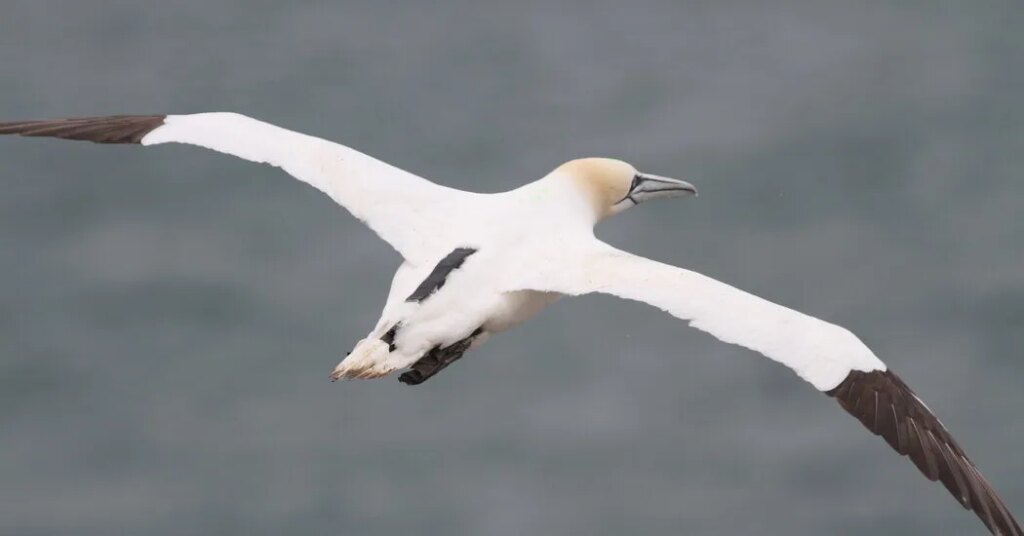
Three species were used for the study, each chosen for its distinct ocean habitat: Balearic shearwaters in the western Mediterranean, northern gannets in the North Atlantic, and Westland petrels in the South Pacific around New Zealand.
The team used a computer algorithm to pick out distinct sounds on recordings gathered by birds. Vessel engines emit a low-frequency hum, which was separated from other ambient noise. The researchers then compared the birds’ GPS locations with vessel coordinates from both Automatic Identification System and Vessel Monitoring System tracking data. Often, they would pick up that hum in what looked, on tracking software, like an empty ocean.
Nearly one-third of all vessel detections made by the gannets could not be matched to a tracked boat. Known for their dramatic, high-speed plunge dives, the gannets spent an average of 68 minutes per day around vessels. Of that, 22 minutes were around untracked vessels.
For the shearwaters in the Mediterranean, one in 10 detections indicated an untracked vessel.
Balearic shearwaters are critically endangered. “They’re the rarest seabird in Europe, and that’s because they’re often killed in fishing gear,” said Jonathan Rutter, a biologist at the University of Oxford and lead author of the study.
The shearwater and petrel data was collected by Dr. Rutter and his team. The researchers were careful to not overload the birds with extra weight and fitted the recorders to the animals based on size, ensuring each device sat evenly and wouldn’t stress the birds or inhibit their flight.
The gannet data set already existed. Because gannets are much larger than the other birds, they could carry heavier recorders with bigger batteries, allowing for continuous recording at sea.
Seabirds have been enlisted as ocean monitors before. A separate study published in Proceedings of the National Academy of Sciences in 2020 used albatrosses to detect illegal fishing vessels in the Southern Ocean that had intentionally turned off their tracking systems. “In those circumstances, the albatrosses were telling the story of where the fishers actually were,” Dr. McKeon said. “That tells us about some of the vulnerability of marine protected areas.”
Some unseen vessels in this year’s study were quite likely fishing illegally, too. Others may have been experiencing signal problems or were smaller vessels not required to enable tracking.
Regardless of why those boats were off the grid, the seabirds’ data offers a rare glimpse into otherwise unmonitored waters, especially where smaller, less-regulated vessels operate.
“There are a lot of systems where, particularly when birds are interacting with smaller-scale fisheries, we just have no idea what’s going on in terms of the footprint of risk,” Dr. Rutter said. “I think this could be a really powerful tool in those sorts of systems.”
The post These Airborne Undercover Agents Are Eavesdropping on Hidden Fishing Fleets appeared first on New York Times.