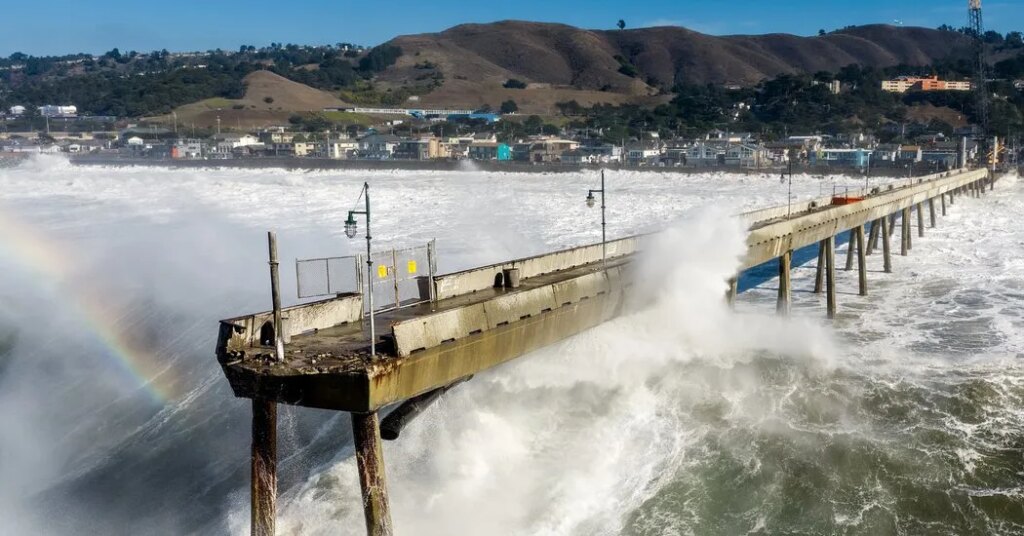
Just a week ago, elected officials posed on the beach in Pacifica, Calif., with an oversized check for $2.25 million — a down payment meant to help to stabilize the city’s beloved 1,100-foot pier.
The L-shaped structure’s long, spindly legs had been keeping anglers high above the surf for decades and served as a landmark in this Bay Area community since it was built in 1973. Every year, when Dungeness crab season opened, throngs of people would line up along the railing in darkness to secure a prime spot.
But along with the rest of the coastal infrastructure in Pacifica, the pier was crumbling.
In June, it was closed to the public after large cracks appeared in the concrete on its landward end. Then, amid record-high El Niño tides that created massive waves, a section of the pier collapsed.
Residents past and present watched the footage captured by a TV news helicopter and bemoaned the loss, wondering what it might mean for Pacifica’s identity and the obstacles ahead in a changing climate.
Alex Englund, 40, an owner of the Sharp Park Taproom, a block away, said he had gone to the pier every year to join the fun of crab season’s opening night.
“Instead of opening the pier at 6 a.m., they’d open it at midnight,” he recalled. “They’d open the gates and everyone would just, like, dash down and start crabbing.”
This year was different. The pier’s closure in June was followed by the demolition of the terra-cotta-colored Chit Chat Cafe, where patrons could watch the pier through distinctive arched windows. Crab season opened as usual in early November, but the Pacifica pier did not.
The pier was initially built for $5 million with the dual purpose of recreation and carrying treated sewage offshore. Over the years, it has become one of the most popular fishing and crabbing spots in Northern California.
State Senator Josh Becker, who represents the area and was one of the officials posing with the $2.25 million check, said there was always 50 to 100 people out on the pier.
“It’s recreation, but for some it’s actually subsistence-level fishing,” he said, noting that it was one of the only places along the coast that someone could fish without a license.
On a Facebook group called Save Pacifica Pier, one woman reminisced about growing up near the pier in the 1970s, when her parents would sublet their side-house for $100 a month to a succession of characters including a sculptor, a bird watcher and a “guy named Skip who used to dive off the pier.”
“The El Niño of 1983 took out our beach house and all the others along that row,” she wrote. “Sure will miss the pier.”
The pier has been closed periodically over the years, either for hazardous weather conditions or repairs. San Mateo County, which includes Pacifica, considers itself the California county most at risk from sea-level rise. Pacifica is particularly vulnerable to shoreline erosion because of its narrow beaches and bluffs and has been working for years to make the city’s sea wall and the boulevard that runs alongside it more resilient.
A 2021 report on the city’s coastline issues found that critical steel that helps anchor the pier to land was severely compromised. In recent years, even when parts of the pier were deemed safe, the section furthest from the shore — the angle of the L — remained off-limits.
That is the section that collapsed on Wednesday. A portion of the sea wall also collapsed, with water rushing over the promenade, and some residents reported eight to 10 feet of water on their properties.
“We’ll have to evaluate whether it’s a fixing of the current structure, or whether it’s a complete rebuild,” Senator Becker said about the pier in an interview. “But we’re talking in the scale of tens of millions of dollars for that.”
But, he said, he did not want the city, a relatively affordable place to live in the notoriously expensive Bay Area, to be without its pier.
On Wednesday, Aaron Klang, 57, a project manager in building maintenance, was shoveling detritus that had washed up in front of his house.
As he looked at what was left of the pier, he said: “I would be surprised if that thing’s still standing by the end of this winter. All that poured concrete, everything’s failing. The concrete’s spalling and rusting. It’s just past its life span.”
Brianna Bitz, 37, a therapist, moved to Pacifica in April. “When I drive home, I just see these sweeping views of the rocky coastline, and I’m like, ‘I can’t believe I live here,’” she said.
But she was shaken by how close the waves got to her home on Wednesday.
“I think there’s going to be mixed ways of dealing with this,” she said.
Some people wanted “to stay here and protect the houses instead of letting the ocean win,” she said, “but I think other people are also realistic that there’s only so much we can do.”
The post A City Fears the Loss of Its Pier After a Section Collapsed Into the Sea appeared first on New York Times.