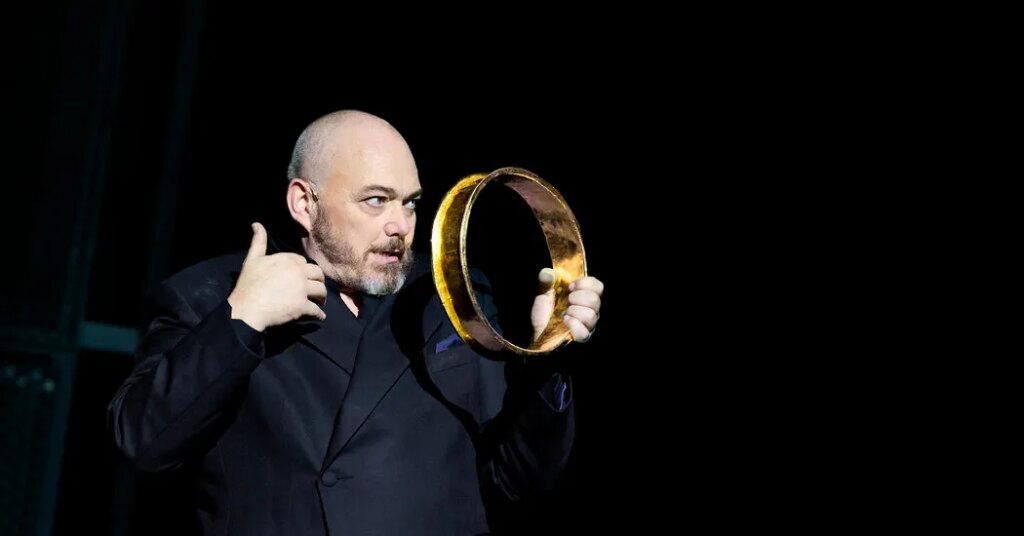
Calixto Bieito’s striking new production of Wagner’s “Ring” cycle at the Opera Bastille immerses the audience in a world in which technology means power. Specifically, power for the people who build, own and operate it. In “Die Walküre,” the saga’s second installment, Wotan, the king of the gods, sits at the center of a monstrous apparatus, displaying a paranoid dependency on its surveillance capabilities, even as the world around him suffocates on its effluvia.
Given that idea’s timeliness as data centers have become a political flashpoint in the United States, I was looking forward to seeing how Bieito would extend and develop the production’s central metaphor in the rest of Wagner’s huge, four-part “Ring.” But fate had other plans for Bieito’s “Ring,” which has had a rough path to the stage over the past several years.
When Paris first tried to present his production in 2020, the Covid pandemic derailed it. So the company proceeded with a concert-only performance, without a live audience, which was recorded and broadcast in December 2020 and January 2021.
Six years after that aborted run, Paris was again forced to present a large portion of its “Ring” in a concert-style setting. After performances of “Das Rheingold” and “Die Walküre,” a strike by some Paris Opera staff members meant that the sets could not be installed for performances of “Siegfried,” on Nov. 19, and “Götterdämmerung,” on Nov. 22. (Audiences who attended the first of two cycles, from Nov. 6 to 13, were able to see the full productions.)
When the Paris Opera’s general director, Alexander Neef, announced from the stage that “Siegfried” would be played without a set, audience members cheered at his offer of a 30 percent refund and a free glass of Champagne, with several remarking that the production was ugly anyway. When he made the same announcement before “Götterdämmerung,” though, the audience revolted, booing, whistling and yelling out for full refunds.
Throughout the second cycle, the musicians’ careful preparation shone in an unusually sensitive, deeply human performance that nonetheless achieved the aural grandeur that Wagner envisioned. For the last two operas, the singers, largely relying on their costumes, some video projections and a few static props, worked quickly with the stage management teams to adapt the performances.
“Das Rheingold” provided a straightforward, if somewhat uninspired, groundwork for Bieito’s cycle, with the gold-stealing dwarf Alberich toiling away amid cables and monitors, and Wotan and his wife, Fricka, suited up like astronauts bound for Valhalla. The center of attention was Simon O’Neill’s Loge, the outcast god, whom Bieito and the costume designer Ingo Krügler styled as an ’80s glam-punk drag queen, equal parts Joan Jett and Suzanne Sugarbaker, with an over-it air and insinuating vocal style. Like Loge, the baritone Brian Mulligan’s suavely sung Alberich, with his moonlit, tenor-like timbre and long, beautiful lines, was a surprisingly humane foil for the narcissistic king of the gods.
Bieito apparently invested his theatrical prowess in the world building of “Die Walküre,” with its closed-circuit-style video (by Sarah Derendinger) and scaffolded set (by Rebecca Ringst), which gave the action a claustrophobic, surveilled, dystopian feel. “Walküre” was a linchpin in more ways than one, with the opera’s two stars, Christopher Maltman (Wotan) and Tamara Wilson (Brünnhilde), laying out the musical values that would carry the rest of the cycle.
Maltman’s haughty king roared to life with a flinty, robust baritone that never seemed to tire even as it made the air quake. Singing a complete “Ring” cycle for the first time, Maltman fully realized a character he sketched out in last year’s stand-alone “Walküre.” The pugilistic arrogance was still there, but he plied it with a lieder singer’s command of nuance, subtext and, above all, vulnerability. Wotan’s farewell to Brünnhilde, full of rage at her insolence and breathy tenderness at her banishment, became the climax of his character arc, as it was meant to be.
Without full sets for the last two operas, dramatic continuity came from Pablo Heras-Casado’s conducting. His pliable sense of drama balanced shapely sounds with theatrical bite. Leitmotifs rose organically from the orchestral fabric and tousled with one another for dominance. He deftly layered motifs to give the drama dimension, as when the love motif expired meekly as fate and hate overtook the action.
In a model of collaborative conducting, Heras-Casado ensured that the singers weren’t buried within the orchestra’s lustrous sound, but he did so without ever seeming to dampen the orchestra’s impact. Silvery strings and luxuriant, well-shaped brasses, whose affect ranged from dreamy to gruesome, provided the foundation for Heras-Casado’s straightforward storytelling, but in a way, the unfussy woodwinds were the hallmark of his beautifully controlled style.
Given the lack of stage pictures, Paris was fortunate in Heras-Casado’s singer-focused approach, which melded especially well with Wilson’s sensitively shaped Brünnhilde. “Pretty” is not a word often associated with Brünnhildes, but it’s apt for Wilson, whose voice shimmered with introspection in quiet moments. Still, when Wilson’s Brünnhilde opened up in full cry to proclaim bloody vengeance or righteous redemption, she pointed her voice at the top of her range and shot it like a missile that whistled through the air with tight vibrations.
Paris Opera’s enviably deep bench included the tenor Stanislas de Barbeyrac and the soprano Elza van den Heever, who repeated their standout vocal performances as Siegmund and Sieglinde from last year’s “Walküre.” The later operas introduced the tenor Andreas Schager as their son, Siegfried, who brandished the brassy, trumpeting timbre of a classic heldentenor and, a few flat pitches aside, emerged largely unscathed from the vocally punishing opera named after him. The bass Mika Kares’s Hagen, the sinister, half-dwarf member of a royal family, had a compelling vocal profile for the role’s split personality, mingling a handsome, well-balanced timbre with a dark edge.
It’s hard to say whether the staff strike impeded an unqualified success. Bieito’s character work struggled between genuine insight and awkwardness. In “Götterdämmerung,” Hagen stuck several pieces of cutlery in Siegfried’s chest after murdering him during a hunting party’s feast. I get it, everyone wanted a piece of a man who just wanted to be loved in return, but it was hard to get over the image’s inelegance.
Certainly, an unfinished production was not the way Paris wished to honor the 150th anniversary of Wagner’s “Ring” cycle. It’s worth noting that when Neef made his remarks from the stage on both nights, he started off by saying the singers were just fine, to allay the audience’s fears about last-minute substitutions. That announcement, by the way, got the heartiest cheer of all.
The post Humanity Bests Technology in Paris Opera’s ‘Ring’ appeared first on New York Times.