Anthropic’s remarkable growth over the past year helped inspire the biggest start-up investment frenzy that Silicon Valley has ever seen.
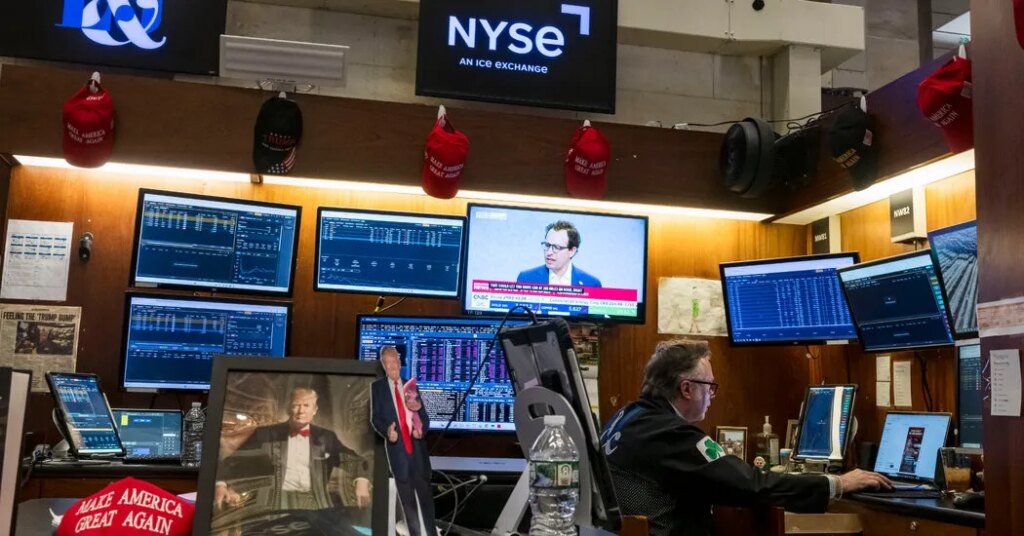
But Wall Street’s chilly reaction to the artificial intelligence company’s blockbuster public debut could now turn down the heat for younger tech companies.
The gut check came faster than many expected. On Tuesday, Anthropic finished trading at $81.90 a share, below the $83 for its initial public offering and down 27 percent from where it started trading last Thursday. On Wednesday, its stock dropped again in early trading. Its valuation, at just over $1 trillion on Tuesday, will become a regular reference point for A.I. companies that are trying to raise money from private investors, whose euphoria is starting to fade.
“I think there’s going to be downward pressure on valuations,” said Fred Wang, a tech investor at Adams Street Partners in Menlo Park, Calif., which invested in Anthropic last year. Clear evidence for a slowdown could take a while, he said, but “people are starting to think about that more.”
A comeuppance for start-up dealmaking, should it happen, would close a chapter that Anthropic itself kicked off last year. The San Francisco company, which makes the Claude chatbot, disclosed fast revenue growth that proved business customers would pay for A.I. tools. That led to a major rush of capital into A.I. start-ups across Silicon Valley.
Anthropic capitalized on the fervor by conducting the world’s largest public offering, raising about $120 billion to further its growth. Its employees were able to sell an unusually large amount of stock starting on the first day of trading, most likely pressuring the price.
Now Anthropic’s rivals could face a tougher time. If its stock decline is any indication, OpenAI, which has been aiming to go public in the coming months, is unlikely to command the same valuation as it has privately. OpenAI was valued at $1.25 trillion in a funding round this month.
(The New York Times has sued OpenAI and Microsoft, claiming copyright infringement of news content related to A.I. systems. The two companies have denied those claims.)
Anthropic did not immediately respond to a request for comment. OpenAI declined to comment.
Hanging over the entire industry are questions of whether businesses will keep buying A.I. tools to justify the enormous costs of the chips and data centers that power the technology. More optimistic Silicon Valley investors have generally shrugged off that question.
But Mr. Wang said he and his Adams Street colleagues had debated whether A.I. start-ups seeking more funding could continue growing fast enough to live up to high valuations. “We’re trying to meter our pace a bit,” he said.
That caution would be a shift for many venture capitalists. Venture capital firms pumped more money into all types of start-ups through September than they had in any full year, according to PitchBook, which tracks the industry. Median valuations that U.S. start-ups received through their first few stages of funding were higher than in 2021, the most recent boom, according to Carta, another provider of venture capital data.
One indicator of slowing interest in A.I. start-ups is starting to surface in the “secondary market” for private stock, where investors buy and sell stakes in one-off deals rather than open trading on the stock market.
Caplight, which tracks that market, has seen “significantly more sell interest than buy interest” from investors across A.I. start-ups since the beginning of October, a change from earlier in the year, said Javier Avalos, its chief executive. Caplight has tracked more interest from investors to sell shares in OpenAI than there is interest in buying the stock, he said.
A cooler fund-raising environment could bedevil A.I. start-ups, many of which face higher costs to operate than internet or software companies.
One hot A.I. start-up is Higgsfield, which sells video-based A.I. tools to make commercials and social media clips. The San Francisco-based company was valued at $5.4 billion in a funding round in August, just a few years after it was founded.
Recent private financial figures it shared with investors illustrate the conundrum. Higgsfield reached nearly $90 million in revenue in September, putting it on a pace for more than $1 billion annually. That month, it also spent more than $70 million for computing infrastructure, like advanced chips, that would power its A.I. models. Last month, the company announced it had raised additional funding from Nvidia and tech investor TCV.
Paul Madera, who co-founded Meritech, a venture capital firm, in 1999, said he saw parallels between A.I. investing and the late-1990s dot-com bubble, when the promise of the internet drove similar excitement about a torrid pace of tech change before a bust. He said he expected a similarly mixed outcome as A.I. companies got “feedback” on their valuations from Wall Street.
“There’s going to be a lot of capital lost over the next few years,” Mr. Madera said. “We have a lot of young investors that haven’t seen a downturn. Without the visceral feedback of losing money and realizing you paid too much money, it doesn’t hit you.”
The next major I.P.O. could be OpenAI. The company told prospective investors this fall that it expected to generate $35 billion in revenue this year, far below sales that Anthropic is likely to hit.
Even the most starry-eyed investors acknowledge that many start-ups will inevitably become casualties of a venture capital pullback, inherent in an industry of risk-taking. But venture capitalists are still finding reasons to believe that money can keep flowing, particularly to the fastest-growing companies with top management teams.
One reason for hope: the returns that many venture firms will reap once they can sell their stakes in Anthropic in the coming months. That money could go back into the next generation of start-ups, elongating the investment cycle, said Jared Sleeper, an investor at Avenir, which backed Anthropic and other highly valued A.I. firms like Cognition and Databricks.
“On the one hand you have an infusion of capital back into the market. On the other, you now have an iconic public company for investors to compare private markets valuations against,” he said. “I’m not sure how those two things will counteract.”
The post Anthropic’s Stock Debut Could Hurt Tech Start-Ups appeared first on New York Times.