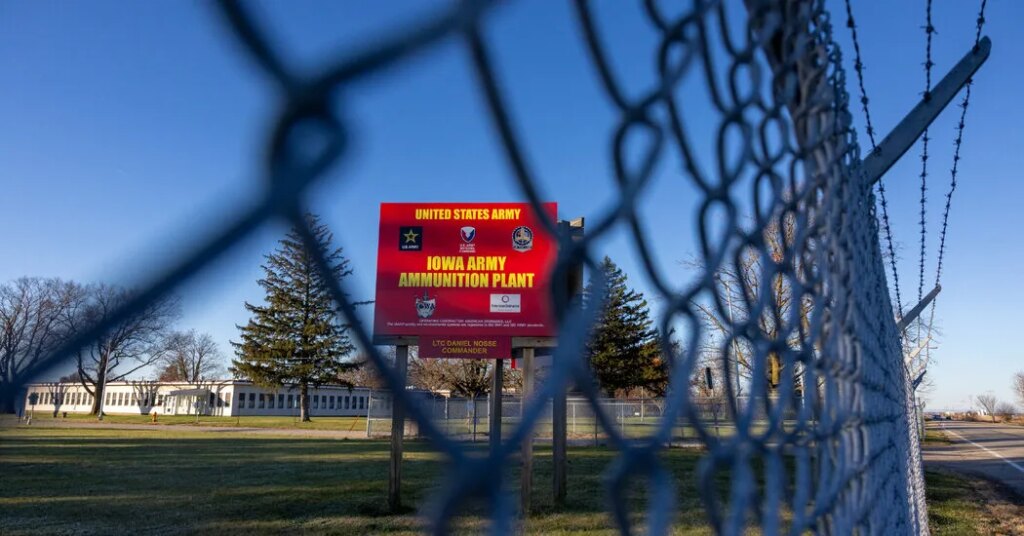
On Wednesday, despite an outcry from local residents, the Army is scheduled to blow up 9,600 pounds of dangerously unstable explosives at a facility in southeastern Iowa. The blast has the potential to produce a dust cloud containing lead and other compounds that could drift for more than 100 miles.
There are no safe levels of lead exposure, and children and pregnant women are particularly vulnerable. The Army has insisted that, without any action, the explosives could detonate on their own as the weather gets colder.
So how did an aging supply of military explosives turn into a potential environmental crisis? Times journalists have been working to understand how this situation developed, what missteps the Army may have made and what the health risks could be.
My colleague Quinn Glabicki hurried out of the office last week with a respirator in his backpack and has been in Iowa for several days. He’s been meeting with residents who plan to seal their doors with towels and speaking to farmers who are scratching their heads at a recommendation that they bring their livestock indoors.
The explosion was first scheduled for last Friday, then pushed back after court challenges and a backlash in Iowa and Illinois. On Monday, President Trump announced on Truth Social that he had ordered the Army to wait until a legal challenge was resolved. Later on Monday, a federal court rejected a request for a delay by environmental groups.
A FEMA alert, issued just before 8:30 a.m. local time on Tuesday, said residents within five miles southwest of the Army facility could be evacuated and warned residents within 20 miles to stay indoors to avoid dust, noise and vibrations.
Why the explosives are so dangerous
The compound slated for destruction is called lead azide, and it’s used to initiate explosions in military munitions. At the Iowa facility, it has been stored in barrels that also contain a stabilizing solution. Until recently, an Army contractor added more solution annually.
But in the spring, Army personnel learned that the lead azide had crystallized in 58 of the 68 barrels, meaning the barrels were not safe to open and could not be refilled with stabilizing solution. Freezing winter temperatures threatened to make the material even more unstable.
In March, the Army awarded a contract to MuniRem Environmental, a company based in Georgia that neutralizes munitions with chemicals. But the Army canceled the contract. Army documents reviewed by The Times said the chemical methods might pose “unacceptable risks” to the safety of the people handling the explosives. The Army has also said the barrels cannot be moved because of the risk of accidental explosion.
That left a controlled explosion as the other option. The Army has insisted that it has installed aqueous foam barriers, gel blocks and lead-containment screens to help contain particulate matter from the blast, and that it has settled on the least dangerous option to handle the materials.
Nearby residents were told to evacuate their homes, and the Army said the explosions might shatter windows. A spokesman for Gov. Kim Reynolds of Iowa said the state had not been told of the plans until four days before the scheduled explosion. Gov. JB Pritzker, of neighboring Illinois, called for a delay.
What are the environmental concerns?
Environmental groups, including Earthjustice, the Iowa Environmental Council and the state chapter of the Sierra Club, unsuccessfully sued on Thursday to stop the explosion, challenging the E.P.A.’s permit and arguing that the plan fails to prevent the release of lead into air, water and soil.
Their worry is that the explosion will generate a large plume of lead dust that will settle on homes and farmland. The most immediate risk is that people will inadvertently breathe in or swallow lead particles.
Measuring the potential impact
As Glabicki and Hiroko Tabuchi reported, a team of scientists fanned out across the rural farmland south of the Army facility on Sunday. They set up their gear in backyards and placed soil samples in plastic bags with gloved fingers to establish base line levels of lead.
“The only other place where you can get data like this is the middle of a war,” said Ezazul Haque, an environmental toxicologist from John Jay College, who arrived from New York City last week to study the plume.
Maps released by the Army on Tuesday showed that the plume from the detonation would travel southwest from the plant, and potentially as far as 100 miles into northeast Missouri. And the plume models showed that lead could be deposited over as many as 148 square miles.
COP31
“This is one of the darkest hours in the history of climate negotiations.”
That’s from Mark Watts, the executive director of C40 Cities, a coalition of nearly 100 mayors around the world working on climate change, who was reacting to the collapse of the United Nations climate talks in Turkey last week.
As Lisa Friedman and Chico Harlan reported, “After 12 days of meetings and nearly 50 hours of overtime, the talks broke down in deadlock on Sunday after Saudi Arabia and Russia, leading a group of oil- and gas-exporting nations, refused to allow a final declaration with any mention of transitioning away from the fossil fuels that are dangerously heating the planet. Roughly 90 countries — including the European Union bloc and small island states — walked away rather than sign what they viewed as an empty deal.”
So what happens now? For one, there’s growing concern about the limitations of the United Nations model, which requires consensus among nearly 200 countries to approve an agreement. Some governments, investors and advocates for climate action are increasingly looking past the U.N. toward smaller diplomatic alliances.
Other activists say the U.N. climate summit needs to be reimagined. “The process needs serious fixing, but it is still the only place where the smallest island nation sits at the same table as the biggest polluter,” said Harjeet Singh, a climate activist at the talks. “We can’t walk away from it.”
Vietnam’s electric revolution comes without cars
For generations the tens of millions of motorbikes that fill streets in Vietnam have run on gas. But that’s changing quickly, Alexandra Stevenson and Tung Ngo report. The Iran war has driven up gas prices sharply, the Vietnamese government has started initiatives to cut down on pollution, and a host of homegrown companies have entered the market.
In the first nine months of the year, e-motorbike sales saw a 91 percent increase over the same period last year, according to one industry data provider. Informal charging networks are popping up, with homeowners selling access to electricity, along with hot showers or beds.
More climate news from around the web:
-
Reuters reports that a Senate panel is investigating whether Vice President JD Vance played a role in awarding a lucrative contract to sell Venezuelan oil to Vitol, a commodities giant.
-
“In Grand Theft Auto VI,” Bloomberg reports, “already the most successful video game in history, virtual weather has evolved from background scenery into a critical part of the immersive experience that lures players and billions of dollars.”
Read past editions of the newsletter here.
If you’re enjoying what you’re reading, please consider recommending it to others. They can sign up here.
Follow The New York Times on Instagram, Threads, Facebook and TikTok at @nytimes.
Reach us at [email protected]. We read every message, and reply to many!
The post Iowa’s Toxic Explosion appeared first on New York Times.