This is an edition of Ordinary Extraordinary, Ian Bogost’s guide to making everyday life vivid. Sign up for the newsletter here.
The holidays are the worst time to give a gift. Expectations are just too high. Chocolate or socks received on a random Wednesday in August would be incredible; the same socks on Father’s Day or chocolate on Valentine’s Day veer toward cliché. A gift is a paradox: As it becomes more socially expected, it also becomes harder to give well.
I learned to give gifts from my late mother, who was terrible at gift giving no matter the time of year. She would agree to buy a specific thing for my kids but renege at the last minute, for mysterious reasons. Or she’d ask for the kids’ clothing sizes, then send garments in different ones. Once, she bought me a new set of flatware—nice!—but not in sufficient quantity to actually supply the kitchen, so I had to buy more to make the gift useful. Over the years, my wife received innumerable scarves and folk-art objects that matched Mom’s tastes but not her own.
Mom didn’t mean to be terrible at gift giving, and I now understand her effort as a struggle rather than a slight. She seemed to recognize that she couldn’t conceptualize the desires of other people. Often, she tried to make up for that deficiency with sheer volume. A birthday parcel would contain lots of little junk—the kind of stuff you’d collect as trade-show swag. Each delivered the earnest desire to make a gift connect, along with the tragedy of connection’s failure. In the end, by getting the practice so wrong, Mom gave me the gift of understanding gifts better. The best gifts give something greater than any one thing: the message that you know the recipient in a nuanced and personal way. To give well is first to see, and to receive well is to allow yourself to be seen.
This is very hard to do. Over time, people have developed ways to reduce gift giving’s burden: Wish lists, for example, were once limited to kids but now cross generations. Telling someone else exactly what you want is good, in that it disambiguates desire. But it also frees a person from the difficult work that can make a gift truly meaningful.
Think about the people closest to you—your spouse or children or parents, for example. You know so much about them, but when it comes to thinking of a gift, you might find yourself stumped. My wife likes knitting. I could try to learn about yarn or yarn-wrangling tools, and doing so might connect me to her through a deeper understanding of her interests. But it could also lead me astray. When I think about my own hobbies and avocations—home espresso and gelato, for example—I closely guard my tools and materials and don’t want someone else getting involved. Similarly, my adult son is really into photography, and because of that passion I know that he already owns a version of almost anything I might think of.
Setting aside the most obvious interests of your gift recipient can help avoid this mess. But doing so makes giving a gift even harder, because now you must find an even less apparent feature of the other person to develop into an opportunity for communion.
Unfortunately, this is where many people settle on options from the gift-guide mainstay, “the person who has everything.” That usually means things nobody wants or needs—superfluous curiosities such as a neck massager or an electric gravy warmer. An indulgent or expensive gift might also not fit the bill. You might feel formidable or magnanimous when you give a lavish gift, but receiving one can be disquieting. Or, if a wish list is on offer, it might entice you to choose a variation on the category of item listed. Do not do this; this is very bad. (Everyone remembers getting the wrong version of the popular toy as a kid.) Understandably, you will want to make your mark on their wishes. But the best gift is not about you at all—not even your generosity in the giving. A gift entails the attempt to set yourself aside as much as possible, and to wrap a bow around the most nuanced and tender understanding of someone else that you can muster.
To do this, you will have to dig deep. Think back over the past year or so, and try to recall when your gift recipient may have revealed a desire, problem, aspiration, or fact that felt distinctive. I’m not talking about a specific yearning for a consumer good, although that is one option. I mean a moment that, when revisited, reveals something fundamental about their current self. Focus on the most ordinary events and encounters, the ones even the person on your mind may not remember. Those moments can offer the richest information about what makes someone who they are. Perhaps a friend delighted at a specific jam served at a brunch out. Maybe, while unloading the dishwasher, a family member noted that their favorite old teaspoon had lost all its counterparts over time. Maybe you witnessed a parent’s struggle to haul out a large appliance, which a smaller version could ease. Many times, these gifts are the most meaningful, yet also decidedly affordable and easy to find besides.
These gifts need not be substantial or even useful. You might give a friend who couldn’t come on a group vacation an especially smooth stone found at the destination. You could bake your own rendition of a cookie your spouse had recalled buying from a long-closed shop as a child. Identifying the pattern for a singleton china teacup purchased from an antique store might be more appreciated and enduring than splurging on the rest of the set. Likewise, finding an exact replacement for a wind chime that fell in a storm, or secretly arranging the repair of a zipper on a favorite sweater, will make them feel seen rather than simply checked off a list. (Imagine how delighted you would be to unwrap that old sweater you’d tossed aside to discover that it had been revived.)
Giving a gift truly well is so hard to do, it happens very infrequently. You may not give or receive a good one this year, or any year. I wish we had a better name for when it really works (or that gift had not become so hollowed out as a noun). In addition to the thought and the act, giving requires an alignment of circumstance and timing. It rarely succeeds. That’s okay. Think of gifts not merely as good intentions or as things offered but as a way to practice the act of giving—and to appreciate the sanctity of those moments when we get it right.
PS
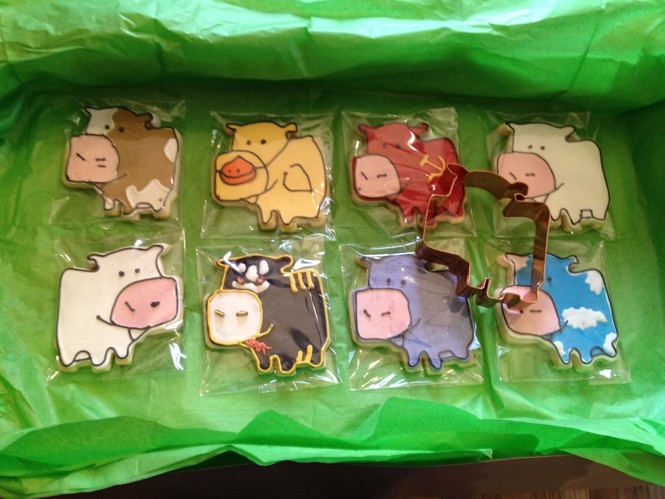
A long time ago, I made a ridiculous game called Cow Clicker, which was about clicking cows (or pictures of them anyway). I’ve written about it before for The Atlantic, and I’ll send you to that story instead of trying to explain it. I drew a lot of cute and unusual cows for the game, and they became a sort of trademark.
That year, my wife had a custom cookie cutter made in the shape of my cows, and then she used it to make dozens of detailed cookies that looked like them. We still have the cookie cutter and bring it out for most holidays, a reminder of my bovine period. It’s one of the most memorable gifts I’ve received.
I would love to hear about your favorite gifts. That could mean the best gift you’ve received, or one you recall giving with fondness or intensity, or even one whose unwrapping you witnessed and found particularly delightful.
Tell us in the comments. We may share your answer, including your first name and last initial, age, and/or location, with fellow readers in a future edition of this newsletter or on our website or social-media platforms.
The post A Better Philosophy of Gift Giving appeared first on The Atlantic.